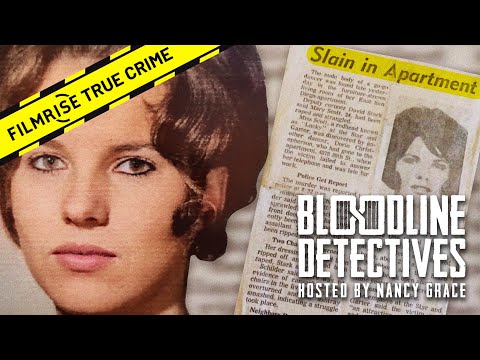
Bloodline Detectives - Episode 9 - Road trip to Hell
Read the full transcriptHide the full transcript
- I'm Nancy Grace. And this is "Bloodline Detectives." Road trips can be fun, exciting adventures.
- Off the beaten path, silence surrounds you. Nothing to hear, but the wind in the trees.
- In 1987, that also meant no cell phones and no way to call for help. Two Canadian teens, Jay Cook and Tanya Van Cuylenborg,
- take such a trip. The route from their home in British Columbia down to Seattle is to be a romantic getaway for this couple still
- getting to know each other. But, ultimately, they never return home. Both are murdered.
- Tanya's body was found quickly, but Jay's is not. They've gone missing in the dense labyrinths of
- Washington's national forests. Police will spend years looking for a predator that
- took advantage of young love. A killer intoxicated by his prey, but the Hunter eventually would become the hunted.
- The target of the Bloodline Detectives. November 1987, a young couple from Saanich, British Columbia,
- are reported missing. They haven't returned from an overnight road trip to Seattle.
- CLOYD STEIGER: They were coming down on a little adventure from Vancouver Island.
- Little did they know when they left that island, they'd never be back. NANCY GRACE: Their bodies are discovered
- more than 60 miles apart. The victims of a sadistic killer. DAVID HEITZMAN: Even as a experienced homicide detective,
- it was quite shocking. NANCY GRACE: An investigation is launched and a manhunt starts.
- DAVE WILLARD: Everybody who worked together passed along information. Any little scrap that anybody found or knew of
- was relayed to everybody involved in the case. JUSTIN HARLEMAN: Detective Scharf
- was chasing those leads down day by day, the pit bull that he is. It took a lot of Detective Scharf's time
- to track down those leads only to find that that wasn't the person. NANCY GRACE: This is the story of a romantic road trip
- turned real-life horror movie. A police investigation that leaves no stone unturned
- and how DNA and genetic genealogy helps solve the murders for the Bloodline Detectives.
- [THEME MUSIC] NANCY GRACE: On November 24, 1987, police in the Skagit County Sheriff's Office in Washington
- State get a 911 call. It came in from a gentleman who lived in the area of Parsons Creek Road.
- He had been out walking his dog and he saw what he believed to be a person's body rolled down the side of a ditch up
- against a culvert. NANCY GRACE: Police are immediately dispatched to the area. I went down to examine the body and see what was there.
- I saw a half-clothed female. JUSTIN HARLEMAN: She was naked from the waist down.
- Her bra had been pushed up above her breast. She did have socks on, I believe, but her pants had been removed, her underwear had been removed.
- DAVE WILLARD: On closer examination, I could see that there was blood coming out of the back of her head.
- She was laying on her back. And there was blood in the dirt and the leaves underneath the head.
- NANCY GRACE: The coroner is called and detectives start processing the scene for evidence.
- DAVE WILLARD: I found what appeared to be brain tissue like something had leaked
- out of the gunshot wound. And that was collected. GERALD BOWERS: I stayed up at the top just looking.
- Found a pair of zip ties that were discarded fairly close to the road, actually.
- Skagit County did not have a coroner's office where they could do autopsies so they would bring
- the body to a funeral home. And the autopsy would have been done there. JUSTIN HARLEMAN: They did find a 380 Partridge in her brain,
- so it was pretty obvious the way that she had died. The medical examiner or the coroner
- took swabs from her mouth. JIM SCHARF: We learned from the swabs that were taken that the suspect had had
- anal and vaginal sex with her. And that she had been shot with a 380 automatic handgun.
- [GUNSHOT] NANCY GRACE: Police get an alert from the Royal Canadian Mounted Police or the RCMP a few days before.
- The RCMP sent out a BOLO saying that there were two missing persons. And they described the two young people and the van
- that they were in. They said that the van would have been traveling on the international ferry
- coming to Port Angeles. NANCY GRACE: Investigators immediately contact the RCMP to find out more about the missing couple.
- Their names are Jay Cook and Tanya Van Cuylenborg. And they're from Saanich, British Columbia.
- Jay and Tanya were boyfriend and girlfriend. Tanya was two years younger than Jay.
- She just graduated from high school. JUSTIN HARLEMAN: I don't think she fully knew exactly what she
- wanted to do in life yet, but she did have dreams of becoming a veterinarian. She was passionate about her family, animals.
- Jay was the type who was quiet, but someone who you wanted in your circle. Someone that you wanted to be friends with because he'd
- take the shirt off his back and give it to you if you needed it. JOHN VAN CUYLENBORG: They met through some mutual friends.
- They both gone to the same high school in Victoria. And they'd been dating about five or six
- months at the time of the trip. JIM SCHARF: His father owned a heating business.
- And they had a job that they were working on where they needed some furnace parts in Seattle.
- So for whatever reason, Jay decided that it would be fun for him to go down and run
- this errand for his dad. And she decided to go with Jay on this trip and get to know him a little bit better.
- Jay's parents owned a large Ford van. It was like a 3/4 ton window van. It was copper brown in color.
- Because of the furnace parts they were going to put in the back, the back seat had
- been removed out of that van. Their plan was to get on the Coho ferry, which was one of the most common ways to get off the island.
- That ferry would take them to the Port Angeles. And then head south at that point
- to catch another ferry in Bremerton, make it over to Seattle, and then stay the night
- in the van in Seattle. Wake up, get to GENSCO first thing in the morning, pick up those parts, and then head back north.
- NANCY GRACE: But on Thursday, they don't arrive back as planned. And Tanya's family grows very concerned.
- JOHN VAN CUYLENBORG: Initially, on that Thursday, my dad started to approach the local police
- saying they were missing, and started the process, so to speak. Saanich police took a report and they notified the Seattle
- Police Department to put out an all-points bulletin looking for the van and for Jay and Tanya.
- GERALD BOWERS: We were talking about geographically a tremendously large area. You're talking about the province of British Columbia
- and the state of Washington, and three counties in the state of Washington-- Whatcom, Skagit, Snohomish.
- NANCY GRACE: Despite police issuing a BOLO, be on the lookout, Tanya's father realizes it will take time for them
- to launch a full-scale search. So he takes matters into his own hands. JOHN VAN CUYLENBORG: Someone he knew had a small aircraft who
- did some search by aircraft over the Olympic Peninsula and across over Seattle through the Olympic Mountains.
- From that distance or range, they were looking for the van to see if they could see it on some--
- parked on some road. NANCY GRACE: But with no sign of the van from the air, Tanya's family starts their own ground search.
- JOHN VAN CUYLENBORG: My dad took two trips down to Seattle looking for any sort of lead, talking to anyone we could,
- and putting up more missing persons type posters. So there were two trips like that
- and I was on the second one. NANCY GRACE: While continuing the search in Seattle,
- they get the news that she might have been found. My father phoned home to my mom at about 7
- o'clock that night from the Seattle waterfront. My mom earlier that afternoon had received a call
- from the Skagit County Sheriff's Department saying that they had recovered a body that they thought might be Tanya,
- but there was no identification with the body. And so they were wanting a family member
- to come identify the body. We were quiet. There wasn't a lot to be said between the four of us.
- And, you know, um-- and, unfortunately, after we got to Sedro-Woolley. And my dad and I together identified Tanya's body.
- And she wasn't battered or beaten in that sense, but, unfortunately, was lifeless.
- It was very hard for me to see how devastated my parents were from this. But there's nothing I could do to fix it, so--
- other than spend time with them. NANCY GRACE: With Tanya's body now formally identified,
- the hunt is on to find Jay. Investigators are searching for boyfriend Jay Cook, who is now the key to understanding
- his girlfriend's murder. Is he alive? Is he a suspect? Is he being held by a deranged killer?
- That's next on "Bloodline Detectives." [THEME MUSIC] The body of 18-year-old Tanya Van Cuylenborg
- is discovered in Skagit County, Washington, November 24, 1987. The search for her missing boyfriend, Jay Cook,
- with whom she's been on a road trip, goes on. Detectives receive a call from Bellingham, 66 miles north
- of Skagit. A local business worker has made a discovery. A woman who worked at Essie's tavern in the city
- of Bellingham, was out on the back porch. And she and another employee found several items, namely a purse that had
- Tanya's identification in it. And in further searching, keys to the van were found under the porch along with surgical gloves,
- a partial box of ammunition, zip ties, and a lens cap for a Minolta camera. Bellingham police department has a detective
- and a sergeant come out to Essie's tavern, take a look at the wallet. When they see who's on the identification,
- they know immediately that it's the same person who was found. NANCY GRACE: About to depart with the evidence,
- a police officer makes a crucial discovery. JUSTIN HARLEMAN: As one of the Bellingham sergeants
- is leaving the scene, he just goes down the back alley about a block to a little republic parking lot
- and he sees that copper Ford van which was sort of a distinct van. NANCY GRACE: A potentially crucial
- source of evidence, the van is towed for forensic processing. The license plates are photographed for identification
- purposes on that vehicle. Once that's all done, the doors were opened and we examined anything we could find inside the van.
- Well, after the van was processed inside and out and all items were collected, it was processed on the outside
- for latent prints. I believe there was a couple of prints found inside the van that were to identify to Tanya and Jay.
- And the main one was a palm print found on the back door of the van. You know 1997, they didn't have
- all the forensic tools that we have today, not even close. The only thing you could get to identify a person absolutely
- in 1997 was a fingerprint. With no sign of Jay, suspicion is growing amongst officers
- working the case. Since Jay hadn't been found at the same location, they told the Cook family to be prepared for the fact
- that Jay could possibly be a suspect. NANCY GRACE: But 48 hours after Tanya's body is found,
- a resident in Monroe County makes a gruesome discovery. JUSTIN HARLEMAN: Jay's body was found
- on November 26, which happened to be Thanksgiving day, 1987. There's a lot of blood.
- He has numerous wounds on his head, on his ear. It appears there's a ligature. JIM SCHARF: They tied twine and a dog collar around his neck
- and strangled him. And they'd also beat him in the head with rocks. It was a very violent murder.
- JUSTIN HARLEMAN: They could see in his mouth at the time was what appeared to be a pack of cigarettes.
- There was a tissue that was stuffed down Jay's throat behind the pack of cigarettes.
- And the medical examiner came to the conclusion that Jay died from asphyxiation both from the ligature that
- was around his neck, but also the fact that the tissue in the cigarette pack had pushed his tongue
- to the back of his throat. It became clear, I think, pretty quickly, that Jay had suffered, unfortunately.
- The wounds that he had and the way that he had been killed is not something that happens fast.
- They noticed some hemorrhaging around Jay's eyes, around his neck, that told them that he
- was still trying to breathe. He was still trying to fight back as he was being suffocated or asphyxiated.
- CLOYD STEIGER: I don't think this person targeted those two on a specific day to go out and murder
- those people because he didn't know those people most likely. I think he came across them.
- Now he may have fantasized about something like this before and entered his mind generically.
- And then the question of premeditation is once he has them it only takes a moment
- and he decides he's going to do it, that's enough premeditation. You have to plan it in advance.
- If you see these people and think, I'm going to rape and kill that woman and I'm going to kill him, that's premeditation if you
- go out and do it immediately. So how and where did these two young lovers meet their killer?
- Was he stalking them or was it a chance encounter? Investigators need to trace their movements.
- That's next on "Bloodline Detectives." [THEME MUSIC] In November 1987, Skagit County and Seattle police
- are investigating the last movements of a beautiful young Canadian couple, Tanya
- Van Cuylenborg and Jay Cook. Brutally murdered, their bodies discovered almost 60 miles
- apart in Washington State. They are just a couple of kids in the prime of their lives
- coming down on maybe a little adventure to go buy a part down in Seattle from Vancouver Island.
- JOHN VAN CUYLENBORG: They boarded a ferry that runs regularly between Victoria and Port Angeles
- on the Olympic Peninsula, which is part of Washington State. So they took the ferry across to Port Angeles,
- cleared customs, then started driving down the peninsula. JUSTIN HARLEMAN: There were two witnesses
- that had seen them at sort of mom-and-pop grocery stores on the peninsula. So that told us that they traveled through Hoodsport
- through Allyn. And then, of course, we knew that they had at least purchased a ferry ticket to cross
- from Bremerton to Seattle because that was found in the van. They also found the certified check from Jay's father
- to GENSCO for the parts that they were supposed to pick up. And that, obviously, that told us that they
- never made it to GENSCO. From the evidence collected, detectives start to build a picture of what they
- believe happened that night. I think that they did get on that ferry from Bremerton
- to Seattle. I think they likely parked somewhere in South Seattle where they thought they were going to stay the night,
- whether it was in front of GENSCO or near GENSCO. JIM SCHARF: Jay and Tanya were kidnapped, probably
- within a half an hour of when they arrived in Seattle because their intention was
- to sleep all night in the van. And had they gone to sleep in the van, I don't think the killer would have
- even known they were in there. He had a gun, surgical gloves, extra bullets, and he had a lot of zip ties.
- He was a predator that wanted to have sex with Tanya. And to do that, he killed Jay.
- And after he did it, he killed her so that he wouldn't get caught. NANCY GRACE: With no obvious suspects,
- detectives start reviewing local and state records in the hope of identifying a suspect.
- JOHN VAN CUYLENBORG: None of it really made sense to me that there really wasn't much of anything
- I could figure out that would have caused this to happen. Neither one of them were the kind
- to have the sort of enemy that would have this kind of vengeance to carry out this kind of crime.
- It just didn't make sense. JUSTIN HARLEMAN: They were looking for someone who had possibly done this before or had
- threatened to do this before. And I think that that was based mostly on just the brutality
- of the crimes and the fact that they did appear to be so premeditated. There were certain things that stuck out
- as things that would have made it a serial killer type of a situation. Jay's body was found close to the honor farm, which
- was a farm that was run by the inmates that were in the prison in Monroe. At the time, a lot of people felt that the person knew
- about that location because they had been housed in the Honor Farm sometime in the past.
- NANCY GRACE: While investigators explore every avenue, the victims' families and the community are left grieving.
- JOHN VAN CUYLENBORG: There was a memorial service for her at the University of Victoria at the interfaith Chapel.
- And it was-- it was a-- yeah, it was a good service. A number of people spoke. There was a lot of people there because of, you know, Tanya,
- as I say, it was quite social so she had a lot of young people a lot of her friends were there.
- I mean, the community was in shock for these two kids to have gone missing and both murdered.
- It was-- so it was a-- there was a lot of people there as has happens in these situations.
- So hard to understand. So hard to fathom how you could raise kids like that and then
- for no apparent reason, then and really as of today still no apparent reason have them taken in such a brutal way.
- So we were just devastated both of them. And you got to change their outlook on life
- and, yeah, definitely had a massive impact on them. NANCY GRACE: Then the unthinkable happens.
- The victims' families get a letter. JUSTIN HARLEMAN: And he claimed responsibility for the murders.
- He included some really hurtful and just hateful things in those letters. NANCY GRACE: The Bloodline Detectives not only
- have a killer, but it looks like a bragging psychopath on their hands. His letters are grotesque teases to an identity
- that only the latest forensic science will be able to find. [THEME MUSIC] In November 1987, a young, innocent, Canadian couple
- are murdered somewhere between Seattle, Washington, and British Columbia. American and Canadian law enforcement joined forces
- to solve the brutal murders of Tanya Van Cuylenborg and Jay Cook. Then only a few weeks after their murders,
- the case suddenly takes a bizarre twist. The families started receiving Christmas cards
- or holiday cards from someone-- just happy birthday, Merry Christmas, Happy Halloween, or whatever.
- The letters were really unusual because they were coming to the family on holidays and Mother's Day.
- And they were being mailed from different parts of the United States like New York, San Diego, and Seattle.
- DAVE WILLARD: They brought the cards into our office and I processed them for latent prints.
- CLOYD STEIGER: When the families receive cards from people claiming to be a killer,
- it's usually some nut trying to aggravate them. It's almost never from the killer.
- Most of the time it's just some sick, crazy person getting their thrills that way.
- I wouldn't expect that to be from the real killer. Although, when it happens, you have to treat it like it is.
- NANCY GRACE: Detectives decide to feature the case on America's Most Wanted. We ended up getting a tip that identified a person who they
- believe the letter writer was. NANCY GRACE: The suspect was based in Seattle. JIM SCHARF: We found his apartment.
- He admitted that, yes, he had written these letters. NANCY GRACE: The man is a 78-year-old Canadian transient
- with serious mental health issues. JIM SCHARF: He also voluntarily gave us his DNA sample.
- But that DNA did not match the DNA that was left at the scene. DAVE WILLARD: At that time, he was the best
- lead we had in the case. And then once they finally found him and cleared him of involvement, we were back to square one
- again. NANCY GRACE: Police continue to appeal for information and follow up other leads.
- We probably developed a couple hundred different names of possible suspects none of whom turned
- out to be the perpetrator. NANCY GRACE: The case spans decades without results. But any time there's a new tip it's investigated.
- JUSTIN HARLEMAN: Detective Scharf was chasing those leads down I think day by day, the pit bull
- that he is. Unfortunately, it took a lot of Detective Scharf's time to track down those leads only to find
- that that wasn't the person. NANCY GRACE: But in 2018, officers working the case
- learn about a new forensic technology-- phenotyping. Phenotyping would give us a description of our suspect.
- It would show the race, his complexion, his hair color, his eye color. And they could even come up with a possible shape of a face
- to make up a composite likeness of what our suspect could look like. NANCY GRACE: Detectives ask Parabon, the company
- that developed phenotyping, to build a profile of the killer from DNA taken from the crime scenes.
- JOHN VAN CUYLENBORG: It was in February of 2018 when Jim Scharf phoned me and said they were looking to have
- these composite sketches done with this new technology, with Parabon. And they were hoping to generate more interest.
- It only took us two or three weeks to get the report back from Parabon. They told us that the suspect that we should be looking for
- had ancestry from Northern European descent. He had blond or reddish hair. He had green or hazel eyes.
- He was very light complected. We went ahead and did a news release showing what the suspect could look like at age 25, age
- 45, and age 65 because our crime was over 30 years old by then. We got probably another 120 tips coming in.
- But they were tips like the composite looks like the guy that lives down the street or he looks like a guy
- that I saw buying something in the store behind me in line. We didn't get any tips that said it was a person that I saw
- driving a van like that or a person who was in the area of Monroe on this day when
- the murder happened. These profiles-- you're looking for the boogeyman, sometimes.
- And you can't spot the boogeyman on a street in any city because they look like everybody else
- and they act like everybody else. They may have a job, they may have a family, but they have this dark side that nobody knows about.
- NANCY GRACE: With no solid leads coming from snapshot, Parabon notifies investigators of a new technique they're
- using that involves matching the killer's DNA with genealogy databases. Parabon, they can create the profile.
- They can give that profile to the genealogists who they started to work with, people like CeCe Moore.
- That sort of set them on a different route which we're all thankful for today. NANCY GRACE: Jim Scharf is dealing
- directly with Dr. Steven Armentrout, Parabon's founder and CEO. Steve told me that he was hoping that by next week
- he could tell me who the person was. And I kind of laugh. But on Monday, I received an email from Steve
- asking me to call him. I was on my day off and I called him. He told me that he has narrowed my suspect down to one name.
- I was, like, I don't know if I can believe this or not. I was kind of skeptical.
- The second cousin had submitted DNA into an ancestry-type database. And from there, the genealogists were
- able to work out looking through various public records who the relatives were. The suspect name ended up being William Earl Talbott.
- NANCY GRACE: Have police finally found the killer who's evaded them for over 30 years?
- Having pored through this file for the last year and had written all these names down more than once,
- I knew that I had never come across this name before. When we return, will incredible
- science combined with sheer determination pay off for the Bloodline Detectives? [THEME MUSIC]
- NANCY GRACE: In 2018, detectives in Skagit County, Washington, have just been given the name of the likely killer
- of Tanya Van Cuylenborg and Jay Cook in November 1987. William Earl Talbott II has been identified
- through genetic genealogy. But despite a major investigation, officers have never come across his name before.
- The only criminal record that he had was an assault conviction where he had a $150 fine
- and he got deferred prosecution. At home, he would get in fights with his sister.
- He threatened his disabled father. He pushed the cat into the well. He dropped out of school in high school.
- And he wouldn't work. One of his friends did get him a job as a delivery person.
- And one of the destinations that he delivered to was two blocks south of the heating company
- where Jay and Tanya were supposed to stay the night that night. So I believe that he was down there prowling around that area
- that night for some reason when he ran into Jay and Tanya. NANCY GRACE: Detectives must collect
- evidence to prove William Earl Talbott is the killer. CLOYD STEIGER: People have a misunderstanding
- about genealogy. Genealogy isn't evidence. It's not presented in court as proof that the person is the killer.
- That's just a lead. The evidence is when you finally get that guy and you get a DNA sample somehow.
- And you match that sample to the evidence sample. And that's the evidence present it in court.
- Genealogy is only a lead that points detectives in the right direction. NANCY GRACE: Investigators discover that Talbott is still
- working as a truck driver. JIM SCHARF: We enlisted the violent offender task force and the narcotics task force
- to start following him around. And we told them that we wanted them to recover anything that he discarded
- that had touched his mouth. Because we wanted to get his saliva sample. They were sitting outside his place where he drives a truck.
- And they watched him drive away. He stopped at a light or stopped somewhere right by the place
- and got out of his truck. And when he did, a coffee cup fell out of the cab of his truck.
- He got back in the truck and drove away. They collected the coffee cup. DAVID HEITZMAN: That cup was taken to the lab
- and a DNA profile was obtained from that. And that ended up being the match of the suspect DNA
- that was found in and around Tanya's body. JIM SCHARF: It was a really, really powerful moment in my life.
- My eyes teared up and I yelled out a scream and said, we got him. NANCY GRACE: The investigation team starts to put
- a plan together for his arrest. What I wanted to do was arrest him under the most favorable
- conditions to us, which was probably leaving work, because he probably wouldn't be allowed to carry a gun with him
- while he's working. Jim Scharf and the team stake out Talbott's workplace. About 6 o'clock that night, they
- said that they saw him coming. And when he pulled up to the gate, I was sitting across the street.
- And I could see him, and I recognized him from the pictures that I'd seen. So as soon as he pulled through the gate, then I moved in.
- JUSTIN HARLEMAN: Initially, Detective Scharf and his partner approached the suspect
- and asked him if he wanted to discuss this case. The suspect wasn't willing to talk.
- JIM SCHARF: And he said, no, why don't you come back tomorrow or the next day. And I said, no, we'd like to take care of this today.
- Why don't you show me your ID so that I'm sure that you're who you say you are. And he said, I told you who I am.
- I said, I know you told us who you are, but I'd still like to see your identification.
- And he said, no. I could see that he was not going to cooperate. I told him to turn around and put your hands behind your back
- you're under arrest. And he said, what for? And I said, for one count of first-degree murder.
- Now turn around and put your hands behind your back. And he just stood there. So I'm ready for him to fight.
- So I reached up with my left hand and put it behind his right shoulder. And I said, I told you you're under arrest, now turn around.
- And as I pushed him, he actually turned around. And that surprised me. Because I was thinking that he was going to fight.
- They put him in the back seat of the car. And we headed off to the courthouse. I had Luke turn up the radio and put
- the speakers in back so that all he could hear was the radio. And I got on the phone and I called John Van Cuylenborg.
- He told me that-- he goes, yeah, we got him. We've arrested him. And I said really?
- My first question was, well, where is he? And I said, he's sitting in the back seat.
- And that was a moment where I realized, oh, this is-- this is. This is unbelievable.
- This is like Jim sitting a few feet away from this guy now in some vehicle. And, yeah, it was just a surreal moment.
- In all those years, of all the phone calls, and all the information, all of a sudden, finally someone
- had been arrested. The first arrest in 31 years. I felt a relief that we had him.
- He didn't get away. So now it was just a matter of getting him processed, getting him booked.
- And we were on our way to getting the conviction. NANCY GRACE: June 11, 2019, the trial
- begins and John Van Cuylenborg finally faces his sister's killer. JOHN VAN CUYLENBORG: It's very difficult,
- obviously, to restrain your emotions in that kind of setting. But he never really showed any emotion
- at the arraignment or any of the pretrial hearings-- certainly nothing close to remorse, no.
- NANCY GRACE: Willard, who was at the crime scene, is brought in to testify. It was tense.
- I was a little nervous trying to remember things that you did 32 years ago when you can't remember what you had
- for breakfast in the morning. He had me re-identify the pants that the semen stain was found on.
- CLOYD STEIGER: The only thing you could possibly have to say is, well, is there a way that she could have
- had consensual sex with him? Could that have happened? And, of course, in this case, ridiculous.
- Of course, it couldn't happen. She's with her boyfriend, came down from Canada, and this guy meets her and has consensual sex?
- I don't think so. NANCY GRACE: The trial ends on June 28. JUSTIN HARLEMAN: In an opening statement,
- I remember at the end when I told the jury that they were going to have some questions about what exactly had happened
- and why it had happened. But I told them, they weren't going to have any questions
- about who had done it. And I looked at him and I pointed to him. No reaction. No smirk.
- No looking down. No blinking. Just no reaction. I think that he was convinced that he was
- going to be found not guilty. And that he would be on his free way. NANCY GRACE: After three days of deliberations,
- the jury comes back with a verdict. JUSTIN HARLEMAN: They found the defendant guilty of both of the murders and guilty
- of the aggravating factors. There's two things about DNA, it absolutely convicts the guilty and it absolutely
- exonerates the innocent. DAVID HEITZMAN: He was sentenced to two terms of life imprisonment.
- And that is the highest that he could be sentenced to in this state. JOHN VAN CUYLENBORG: I was very happy that somebody
- had been arrested. And knew that it was going to be a long process to get through trial, to get to a conviction.
- But knowing that it was the right thing to do to have that process play out and have someone
- held accountable. It was just a necessary part of the process. Tanya's parents never recover from Talbott's
- horrific actions. My mom was even more withdrawn than before. She was not the most outgoing person, but she was--
- it just devastated them both and broke their hearts. I got to meet Tanya's brother and Jay's
- family, Tanya's cousin. They're all wonderful people. I love them dearly. And I'm glad I was able to help them get some answers.
- Life isn't fair. You can't make everything fair. But you can hold somebody accountable.
- And even though it took a long time, we finally held Talbott accountable. He's locked up in a cell 23 hours a day.
- And nobody's ever going to be harmed by him again. JUSTIN HARLEMAN: I'd like to think that justice
- delayed is still justice. It's 30 years too late, but I think it's a credit to Detective Scharf
- and to the other people who stuck by this case who were just relentless over the years.
- All I ever wanted to do from when I was a little kid is to help other people and catch the bad guy.
- And to me, this tool of genetic genealogy has given me the greatest opportunity in my career.
- It's fulfilled every dream I've had from when I was a little kid. And I'm still a little kid.
- And I still want to catch more crooks. CLOYD STEIGER: There's no case too cold to be solved, right?
- There's not. Although these guys, when they're sitting at home, and they watch the news and hear about another cold case
- from 25, 30 years ago getting solved, they start to get nervous. And that's my message to any people
- out there that killed somebody and thought you could get away with it. Be afraid, be very afraid.
- Wake up in the middle of night thinking about it because they're coming to get you.
- NANCY GRACE: The gruesome murders of Jay and Tanya are finally solved. And justice has been served.
- William Earl Talbott, a man with a history of violence as a boy, has grown up to become an angry, deranged monster.
- Over three decades, so many dedicated members of law enforcement worked this case.
- But one of them, a resourceful cold case detective named James Scharf, seized the opportunity to collaborate
- with genealogists and science. An opportunity that led to a conviction for the Bloodline Detectives.
- [THEME MUSIC]
Brief Summary
The episode details the 1987 murders of Jay Cook and Tanya Van Cuylenborg and the use of genetic genealogy to identify their killer.
Key points
- The Disappearance of Jay and Tanya. A romantic road trip takes a dark turn when the couple goes missing.
- The Discovery of Tanya's Body. Tanya's body is found, but Jay remains missing, raising urgent questions.
- The Gruesome Discovery of Jay's Body. Jay's body is found with signs of a violent struggle and murder.
- The Killer's Letters. The families receive bizarre letters from someone claiming responsibility for the murders.
- The Case Goes Cold. Despite numerous leads, the investigation spans decades without results.
- The Breakthrough in Forensics. In 2018, detectives discover phenotyping, a new forensic technology that could help identify the suspect.
Episode highlights
- The Disappearance of Jay and TanyaA romantic road trip takes a dark turn when the couple goes missing.“But, ultimately, they never return home.”0:50Apr 1, 2021
- The Discovery of Tanya's BodyTanya's body is found, but Jay remains missing, raising urgent questions.“The victims of a sadistic killer.”1:44Apr 1, 2021
- The Gruesome Discovery of Jay's BodyJay's body is found with signs of a violent struggle and murder.“It was a very violent murder.”14:48Apr 1, 2021
- The Killer's LettersThe families receive bizarre letters from someone claiming responsibility for the murders.“He included some really hurtful and just hateful things in those letters.”21:48Apr 1, 2021
- The Case Goes ColdDespite numerous leads, the investigation spans decades without results.“The case spans decades without results.”24:50Apr 1, 2021
- The Breakthrough in ForensicsIn 2018, detectives discover phenotyping, a new forensic technology that could help identify the suspect.“Phenotyping would give us a description of our suspect.”25:23Apr 1, 2021
- The Arrest of William Earl TalbottAfter decades, police arrest William Earl Talbott, identified through genetic genealogy.“We got him.”32:33Apr 1, 2021
- Trial and ConvictionWilliam Earl Talbott is found guilty of the murders after a long trial process.“They found the defendant guilty of both of the murders.”37:49Apr 1, 2021
Tension
85/ 100High tension