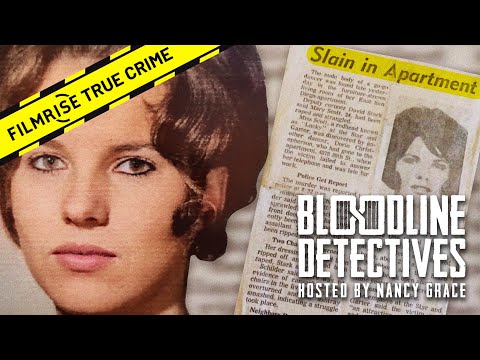
Bloodline Detectives - Season 2, Episode 14 - The Hunt for Precious Jane Doe - Full Episode
Episode Description
In August 1977, the body of a young girl was discovered by blackberry pickers in Everett, WA. She had been strangled and shot. Investigators launched a two-tiered investigation.
A compelling new True Crime series, hosted by preeminent legal analyst and renowned former prosecutor Nancy Grace, that explores the advanced form of familial DNA testing.
Read the full transcriptHide the full transcript
- [PERCUSSIVE MUSIC] NANCY GRACE: August 1977, Everett, Washington, just north of Seattle.
- A gruesome discovery-- the body of a young woman found, her face disfigured with multiple gunshot wounds.
- KEN SEDY: That's a sight that I never want to see again. Sorry to say it was all maggots, flies,
- and there was no facial feature left on this little lady. It's just horrible that a human being can
- do this to another human being. NANCY GRACE: Police can't even identify the victim, though investigators do their very best.
- The case grinds to a halt. KEN SEDY: We got a victim here we can identify, and we've tried everything we had at our disposal
- to try and identify this young lady. And we just come up with nothing. NANCY GRACE: Years later, in a review of cold cases,
- the investigation gets a new life. JANE JORGENSEN: We just treated it like a brand new case
- and we started over from the beginning. NANCY GRACE: This is the story of a victim
- police cannot identify, a victim they name Precious Jane Doe. And it's the story of how revolutionary
- new forensic techniques four decades later helped police identify her. I'm Nancy Grace.
- This is "Bloodline Detectives." [THEME MUSIC] It's a scorching hot day, mid-August 1977,
- when a group of residents in South Everett, Washington, come across the body of a young woman.
- JIM SCHARF: A couple of people were picking blackberries in the blackberry bushes up a gravel road, just
- north of Mariner High School, when they discovered this body. She was face down and she was decomposing because it
- was really hot that week. The girl was wearing pastel striped top with spaghetti straps and real short cutoff blue jeans
- and Mr. Sneeker boys' tennis shoes that were blue. NANCY GRACE: They immediately called police.
- Detective Ken Sedy's one of the first officers on the scene, finds the female victim face down.
- KEN SEDY: You could tell that this body was deceased at the time, due to the flies, and the markings on the body
- was turning color. You could see that there was a large hole in the back of her head, and that was a telltale right there that she'd
- been deceased for a while. NANCY GRACE: Detectives immediately sweep the scene for any and all evidence they can find.
- We checked for empty casings, beer cans, beer bottles-- anything we could find. NANCY GRACE: But detectives find no solid evidence.
- The local coroner arrives. So when they rolled the body over-- KEN SEDY: That's a sight that I never want to see again,
- because we were hoping we had some facial to look at and work at. But it was-- sorry to say, it was all maggots, flies,
- and there was no facial features left on this little lady. NANCY GRACE: In 1977, modern day DNA technology does not exist.
- Police have very few investigative tools to use. JIM SCHARF: They process the crime scene, finding
- as much evidence they could, which really wasn't anything there. And they recovered the body and took it to the coroner's office
- for an autopsy. KEN SEDY: After the coroner took her, we went back out the next day with rakes and raked the area,
- hoping to find some casings or-- you know, find something. We're not finding much.
- NANCY GRACE: Autopsy results confirm what police already know is the cause of death.
- JIM SCHARF: At the autopsy, they realized that she'd been strangled and that she
- had been shot in the head approximately seven times. However, only five bullets were found in her skull.
- JANE JORGENSEN: She had been laying there about a week, and it had been a 90 degree temperature week, so there had
- been some post-mortem changes-- decomposition, some insect activity. So she was not identifiable.
- The heat speeds up the decomposition process, so she had turned color. The skin gets very dark, green to black,
- and the skin starts sloughing off, the hair starts sloughing off. The flies lay eggs in the natural orifices--
- the eyes, the nares, the mouth, sometimes the ears, and also any points of trauma, so bullet holes,
- for example. So she was mostly skeletonized in the face by the time we got her. It was determined that this person was probably, oh,
- 25, 30 years old, with what we had to work with. That-- her teeth were immaculate.
- And that was put out nationwide. NANCY GRACE: Police go door to door and beg the public for help, hoping
- they can identify the victim. JIM SCHARF: You begin by going to the news media and try to find out if anyone saw this girl in the area.
- They found somebody that gave them a composite drawing that they made from a Smith and Wesson identikit,
- and they canvassed the area, trying to see if anyone recognized who this girl could be
- and where she'd come from. And they didn't have any luck at all. NANCY GRACE: Everett police are stumped.
- They've got a dead body-- a woman murdered, grotesquely disfigured, and no clues to her identity.
- As we see next on "Bloodline Detectives," investigators will need time and science to solve this case.
- [PERCUSSIVE NOTE] August 1977, Everett, Washington. State police trying to establish the ID of a young woman who's
- found shot dead. Her face is gone. It looks like a calculated killing. There are numerous bullet wounds to the head.
- Investigators go door to door and to local media, but still, they're struggling to ID the female victim,
- and leads are slim to none. The few forensic tools available at the time are not much help.
- KEN SEDY: We had to send the fingerprints to the FBI because they were deteriorated so bad, and come up negative.
- Couldn't identify the body at that time through fingerprints or missing people. And we were looking for a missing person,
- is what we were looking for. NANCY GRACE: Police have a victim, that's true. But practically nothing else to go on.
- And soon, the case predictably goes cold. Then 11 years later, investigators reopen the case with the help of forensic odontologist Dr. Gary
- Bell. JIM SCHARF: And when he looked at this body, he realized that the two upper front teeth were actually
- broken off and restored, which hadn't been noticed before, back in the '70s when she was found.
- So this was a new piece of information that we publicized, but it didn't get us anywhere, either.
- NANCY GRACE: Then, out of the blue, police get a break. KEN SEDY: I'm at the office and I get a call
- from Detective Reed at the time, from the Seattle Police Department. And he's asking me questions about, do you have a body,
- and stuff like that. And he says, well, I got a young fellow in here that has described the scene
- pretty much like my scene. Detective Reed said, do you want to talk to this guy?
- I said, yeah, I want to talk to him. NANCY GRACE: Investigators meet Detective Reed and the man who could identify a legitimate suspect.
- His name? David Roth. KEN SEDY: He was kind of a friend of Roth at the time. And apparently David says, you know, what would you think
- of me if I killed somebody? And he wanted the informant to go with him to remove the body
- from where it was, and they were going to take it some-- he was going to take it someplace else.
- Well, he didn't want to go out with him when he picked it up, so he says he doesn't
- want nothing to do with that. So he was dropped off at Roth's parents' place. He was gone for a while, and he'd come back
- and there was other people in the house. David made the com-- comment, it's gone.
- NANCY GRACE: The informant leads detectives to David Roth. Now they finally have a suspect for the 1977
- murder of Precious Jane Doe. KEN SEDY: We knew that the police department up in the east had impounded a rifle.
- And so we got a search warrant for the property room so we could get it into our evidence,
- and it turned out it was a Marlin with so many twists and stuff like that. So it was determined it was the--
- a rifle that would-- had the right characteristics, as far as ballistics go. And then we did a search warrant.
- We impounded his car. We found his car and impounded the car and took that to the garage, where we went through it
- and tore it apart, and found peacock feathers and .22 shells and .22 casings. And-- and apparently, he had gotten mad at himself
- for something and he shot his car up, too. So we had bullet fragments in the car, too.
- So now they were excited that they had a great lead of what happened to this girl
- and who did it. NANCY GRACE: Police have a strong lead and a name to go with it, but they still can't find suspect David Roth.
- JIM SCHARF: They put the word out they were looking for him. They knew that he had had an arrest for a drug charge,
- so they flagged the warrant. In case he was ever picked up, they'd be notified. And everything kind of went by the wayside then.
- You know, OK, we can't find him. We don't have enough manpower to send out a fugitive squad like they got nowadays to track him down.
- NANCY GRACE: Investigators give up on finding David Roth, and then another break comes their way.
- They get a call from Port Orchard police, about 50 miles southwest of Everett. That's next, on "Bloodline Detectives."
- [PERCUSSIVE NOTE] 1988, Everett, Washington. Police have a murder victim shot so many times
- even they can't identify her. They are now pursuing a suspect in her murder, a man named David Roth.
- And they finally get a call with news of his whereabouts. KEN SEDY: It was two years later I got the phone call from Port
- Orchard that says, we got David Roth in jail on your marijuana charge. Do you want him?
- He says, I don't know how, you know-- he bailed out on that charge. I says, I'm on my way.
- JIM SCHARF: David was like 6 foot, 5 inches tall, and had a violent history, so they made sure that they sent
- two officers over to get him. KEN SEDY: He's scary, put it that way. I was told by the informant that he's torn cupboards
- off the wall in the kitchen. He could bend a steel bar with bare hands and stuff like that.
- So if he would have went crazy on us, I don't know what would have happened. JIM SCHARF: And they handcuffed him and put him
- in the backseat of the patrol car that had a screen in it, like a cage. But one of the detectives rode in the backseat with him
- to try to talk to him on the way back. NANCY GRACE: The fastest route between Port Orchard
- and Everett is by ferry. JIM SCHARF: The ferry ride would take at least a half an hour,
- so they got him talking by giving him some cigarettes to smoke. NANCY GRACE: It looks like Roth is
- prepared to open up about what happened in August 1977. By the time we got across the ferry, he'd admitted to the--
- the killing. NANCY GRACE: David Roth is very clear as he remembers what happened.
- JIM SCHARF: He saw this girl walking down the street on the Bothell-Everett Highway,
- and she was hitchhiking. So he thought, well, I'm going to go see if I can give her a ride.
- So David picks her up and says, do you want to go have a beer with me? And she agrees to do that.
- So he was able to buy some beer and take her down this gravel road that was in between the store
- and Mariner High School, and they drank some beer. He claims he tried to get her to have sex with him
- and she said no, so that made him angry. And he went in the trunk of his car, he got a couple of peacock feathers,
- and handed them to her to distract her while he grabbed a black bungee cord. KEN SEDY: And while she was sitting
- in the passenger side, he put the bungee cord around her neck and-- and strangled her.
- Well, I guess one of them broke, so he had to get another one. And he drug her off into the blackberry bushes.
- And she was thrashing around, so he was afraid that she wasn't dead. KEN SEDY: That's when he decided he was going
- to go back and get his .22, which had a seven-shot magazine clip. And went back and emptied the clip in the back of her head.
- [EERIE MUSIC] NANCY GRACE: Prosecutors have a confession and what they think is a slam dunk case to try David Roth for murder.
- JIM SCHARF: When he went to trial, he got convicted of first degree murder and was sentenced to life in prison.
- But after a few years, he started asking to be paroled. And after 26 years, they felt that it
- was safe to release him back out into society, so they did. NANCY GRACE: Roth is imprisoned and then eventually released.
- But that still doesn't solve the identity of the victim. KEN SEDY: We got a victim here we can't identify.
- We've tried everything we had at-- at our disposal to try and identify this young lady.
- And we just come up with nothing. Nobody still had any idea who this girl was. They were just at a total loss, and they
- were hoping that someday, somebody could identify her. NANCY GRACE: It's unbelievable that a self-confessed killer
- prosecuted for murder, sent to prison, gets out of prison, and neither he nor the investigators
- can identify his victim. Will investigators ever be able to give her her own name back?
- That's the challenge now, and that's what's next for "Bloodline Detectives." [PERCUSSIVE NOTE]
- 2008. Everett, Washington. Investigators still cannot identify a young woman brutally shot, even disfigured,
- 31 years earlier. This is even though they've got a confession from her killer, David Roth, who's already served 26 years
- behind bars for her murder. He's even been released. But Ross says he did not know who the victim
- was when he killed her. We still weren't coming up with any identification. And then I got a call from Detective Scharf,
- and he says, I'm working this case and we're doing this and doing that. NANCY GRACE: While reviewing evidence for new leads,
- cold case detective Jim Scharf gets a call from a non-profit, the DOE Network. They try to connect missing people
- to police investigations. The network has been looking into the whereabouts of a missing woman named Cherry Greenman, last seen Waterville,
- Washington, September 14, 1976. When I was contacted by the DOE Network to see if she was
- Cherry Greenman, I had a fingerprint examiner compare Cherry's fingerprints to see if it was her,
- and it wasn't. So at that point, I contacted the University of North Texas Health Science Center, and they were the agency in the country
- that was trying to identify bodies and compare them to missing persons' relatives that put DNA on file.
- So I contacted them, and they recommended that I get a long bone, like a femur, and send it to them,
- and they could try to get a profile that they could put into CODIS. So I contacted my supervisor and asked
- if we could exhume her body. NANCY GRACE: Jim Scharf gets permission to exhume the remains, and they are sent for examination.
- JANE JORGENSEN: When we exhumed her in 2008, we just treated it like a brand new case, and we-- we
- started over from the beginning. We had the late Dr. Kathy Taylor come and do her forensic anthropology exam, and she
- told us that Precious Jane Doe was a Caucasian female. In 2008, we sent a femur to the University of North Texas,
- and they obtained an SDR profile that was put in CODIS. And so her DNA ran in CODIS from 2008, but there were no hits.
- Initially, the investigators believed that this girl was probably 25 to 35 years old, so they had assumed
- that she was maybe around 30. When we exhumed the body, Dr. Kathy Taylor examined it and said, no, this girl is more likely 14 to 21.
- And she said that she believed that she was probably actually 15 to 19. I realized that, you know, this was just a young girl.
- She was probably mixed up and just starting out in life and was trying to find herself.
- And to me, a girl that was in that situation, that was strong enough to tell somebody
- no when they were asking for sex, to me, that was remarkable. And I thought she was just precious
- for being able to do that, so I named her Precious Jane Doe. [INTENSE MUSIC] JANE JORGENSEN: At the same time that Dr. Taylor did
- her examination, we had a forensic artist, Natalie Murry, come and do a new facial reconstruction of Precious Jane
- Doe because just like other science, there are advancements and studies in forensic drawing.
- So we thought it couldn't hurt to get a new, updated forensic drawing. So Natalie Murry did that for us.
- NANCY GRACE: The sketch gets a lot of public reaction, and police began to rule out many
- of the possible missing women. JANE JORGENSEN: Do they have dental records on file that we can compare?
- Do they have DNA on file? Do they have fingerprints? So it's just a slow process of looking at each-- each person
- and either ruling them in or ruling them out, or saying we need more information
- to rule this person in or out. NANCY GRACE: Unfortunately, the sketches are not as
- helpful as investigators hoped. Now detectives decide to try a new groundbreaking
- forensic science brought to them by a pioneering genetic genealogist, Dr. Barbara Rae-Venter, known for solving
- the Bear Brooks murders and identifying the Golden State Killer. JANE JORGENSEN: So in 2018, Barbara Rae-Venter
- told us about Dr. Ed Green. JIM SCHARF: And he had learned how to get DNA out of just a strand of hair.
- I trusted Barbara and she said, we need to get some hair and send it to Dr. Green.
- Well, out of sheer luck, for some reason, we had her hair mass in the sheriff's office property room.
- JANE JORGENSEN: There had been no hits in CODIS, so I thought, why not? It was actually not known that there was
- nuclear DNA in the hair shaft. It was known there was mitochondrial DNA, but it was always thought that there was no nuclear DNA,
- the reason for that being that as the hair shaft grows, the cells actually go through a process called apoptosis.
- And in that process, the nuclear DNA gets chopped up into little tiny pieces. What Dr. Green had discovered was that actually, there
- was nuclear DNA. It's just that the fragments were too small to be detected by traditional PCR technology,
- which is what's usually used. So they arranged to have the hair samples sent to our lab,
- and we took this case on like we take many cases on, not really knowing the details of it that were
- not relevant for what we do. Most of the details of the crime and the police-y aspects of it
- aren't necessary for us to know, so we purposefully don't know them. NANCY GRACE: When hair belonging to Precious Jane Doe
- is analyzed, it gives scientists some positive clues to help ID her. ED GREEN: DNA in hair, it's a fantastic environment
- because it is water insoluble. It's a great preservation environment for DNA. On top of that, hair, an individual hair,
- is a discrete biological unit that can only come from one person. You never get a mixture of DNA within a single hair.
- So we were hopeful about retrieving and sequencing DNA from hair. In practice, we've retrieved DNA from hairs
- that are hundreds and even thousands of years old. BARBARA RAE-VENTER: So he actually
- uses a process called whole genome sequencing to basically put the genome back together again.
- And then from there what he has to do is he has to then run an algorithm which then identifies
- the SNPs that would be on a chip if he was doing a step array. So he's pulling out the same SNPs that
- would be on an Ancestry chip or a FamilyTreeDNA chip, and then that file that he then creates
- is then uploaded to, say, GEDmatch or to FamilyTreeDNA, and then the matching algorithm looks
- for matching folks in the database. NANCY GRACE: The case of Precious Jane Doe is all time consuming.
- JIM SCHARF: So it took Dr. Green about a year and a half to keep working with the different algorithms
- that he was developing to try to get a profile that could be uploaded to GEDmatch.
- ED GREEN: The forensics community forever basically has this one way of looking at DNA.
- And when it fails, the conclusion can be that there's just no DNA in that sample.
- Oftentimes, that's true, but for hair, for rootless hair, there is DNA in the sample.
- It's just that it's too short to work with that assay. BARBARA RAE-VENTER: When we first ran the file that we got
- from Dr. Green for Precious Jane Doe, we didn't get particularly good matches. And so we tried to work with them and-- and a part of it
- is you don't know whether it's the file, because you're starting off with a very unusual file, namely hair,
- or, you know, what-- what the problem is. Maybe we just didn't have people from her family
- had-- who'd done DNA testing, and so we weren't finding very much. So we did build out some trees, however.
- I think we went through like three or four different files, so sort of like we did when we were first working
- on this technique, we went through trying to optimize the files that we were getting.
- One of them might be preferentially binding to files that had been uploaded from people who were tested
- at 23andMe instead of Ancestry, and if you were seeing way more 23andMe matches than Ancestry matches,
- that makes you question it, because the biggest database is Ancestry. So then we'd go back and now rerun the file.
- And so then we got a new file from Dr. Green, and we had identified some potential most
- recent common ancestors. And this is-- this is an important step in doing investigative genetic genealogy, because what you know
- is that when you've identified some common ancestor-- so let's say we've got people who were matching as second cousins.
- And then our unknown person also matches as a second cousin. So we got three people matching each other,
- and all matching as second cousins. We know that there is a common set of great-grandparents.
- And we further know that the person we're trying to identify, since we've got an unknown--
- unknown person in this mix, must be a descendant of that set of great-grandparents.
- And so the first step in doing any of this is identifying who those common ancestors are.
- JIM SCHARF: Barbara kept in touch with me that point and said, hey, you know, we've got a profile now
- that we've uploaded that tells us that this is probably a great-great-granddaughter
- to a woman named Rachel Elder. NANCY GRACE: Investigators finally have a family name to pursue, but will it
- lead to a breakthrough? That's next, on "Bloodline Detectives." [PERCUSSIVE NOTE]
- April 2020. Snohomish County, Washington State. Police inching closer to discovering
- the name of the woman murdered by a man named David Roth, August 1977. A breakthrough looks close, thanks
- to revolutionary forensic technology developed by Dr. Ed Green. His new technique enables identification
- of DNA-based forensics from rootless hair and other difficult sources. Dr. Green and Dr. Barbara Rae-Venter
- now collaborate for answers. We often don't have enough raw data at the specific positions
- that we want to know to accurately call all of those positions to make a genotype file that's
- good enough for Barbara to do her stuff. So instead, we rely on data which is available-- a complete genome sequence from thousands
- of people around the world. The piece that was-- was really helpful in solving the case was that there were two women who
- were sisters who had tested. So one of the sisters had tested at both 23andMe and at Ancestry, and she had uploaded
- a file from both of those. And then her sister had only tested at Ancestry and she'd only-- of course, she'd only uploaded that file.
- And what we saw was that the 23andMe kit was matching at a lot higher level than the two kits
- from Ancestry. And so it helped us that we-- we were seeing this in a real example where
- we knew that the amount of matching DNA from their Ancestry kits was lower than it should be.
- And so we were able to use the information from the kit from 23andMe to then finally figure out who our person was.
- It was kind of exciting, because we actually had three different lines in our tree
- coming together in one spot. So this was basically X marks the spot. So we go back to our tree to see who's at that spot,
- because this is going to be who our Jane Doe is. And we have three little boys. NANCY GRACE: Dr. Venter knows this tree is incomplete.
- So there were three little boys. Their last name was Elder. And so obviously, we had somebody missing from our tree.
- We had a little girl missing from our tree, because we were looking for a Jane Doe.
- So we spent some time trying to figure out, OK, how are we going to come up with this missing person?
- And we'd actually, for a while, we had wondered if she was maybe somebody who was adopted,
- because it was so difficult to build out trees for her. So one of the ladies who happens to be very good at finding
- things in obscure places on the internet found this one website where a family member, not even a close family member,
- had a tree for the Elders. And in that tree were the three little boys and there was a little girl.
- NANCY GRACE: The genealogy tree is now built from a woman called Rachel Elder. JIM SCHARF: It was about April of 2020
- that Barbara told me that she thought that this was going to be a great-great-granddaughter
- of Rachel Elder. And we were working pretty hard for a month and a half or two months until June came around
- and Barbara calls me and says, hey, I'm sure we've identified the parents of this girl.
- It's Stanley Elder and Mary Ganard Elder. And it has to be a daughter, but we can only find that they have
- three sons We can't find that-- that they had a daughter. But our genealogy shows us that it has to be her.
- So she started looking on the relatives of that couple, and she was able to learn the next day that she found
- on another genealogy site that they maybe had a girl by the name of Elizabeth Marie Elder,
- but she didn't know how old that girl was, whether she was older than the three sons or younger
- than the three sons. But that was the next big clue that she came up with. [DRAMATIC MUSIC]
- BARBARA RAE-VENTER: How are we going to figure out who-- who she is? How are we going to confirm that we have the right family?
- And so it turned out that in talking to the family, Detective Scharf learned that in fact, the mother had had
- another child out of wedlock. So before she had gotten married to Mr. Elder, she had actually had this other child who had also
- been given up for adoption. And so the detective was able to track him down and, because he
- was an adoptee, like a lot of adoptees, he was looking for his biological relatives.
- And so he had done DNA testing. I had gotten a phone call from-- from my sister Carol, and she said she was contacted
- by Detective Scharf and that he'd been working on this cold case involving a girl that had--
- they had found before some years earlier, and that he wanted to contact me and see if--
- if I'd be willing to do a DNA test. And so I told my sister, sure. I'd just done Ancestry a couple of months prior and--
- and had it all, you know, worked up already. So he gives me a call about an hour
- later and next thing turned into a three-way conversation with-- with Barbara and him and myself.
- And we worked out the arrangement of-- of downloading my stuff from Ancestry so Barbara can work on the data files and stuff.
- And yeah, within three, three and 1/2 hours, they had a match. NANCY GRACE: Progress now is much faster.
- JIM SCHARF: So immediately, I called Carol and I told her the whole story. And she says, well, my mom told me
- that she had a daughter named Elizabeth that she gave up for adoption, and I was always
- hoping to meet that girl. I told her that I was sorry that if this is that girl, that she
- was a murder victim in 1977. There were a lot of emotions that-- that had been ignored for so long,
- and it's still taking time to let those out. I mean, my brother and I, we-- we talk,
- but we don't always talk about this particular situation and how we feel about it.
- And the reason for that is it's very surreal. We didn't know her and we both feel
- very robbed about the possibilities that will never exist. NANCY GRACE: Now Detective Jim Scharf
- must deliver the news to Elizabeth Elder's biological dad-- his daughter is dead.
- JIM SCHARF: Initially, it was like it didn't register to him. So by me explaining a little bit more to him,
- he finally said, oh yeah, yeah. I-- it's been, like, 43 years ago that she ran away from home.
- He told me how the school that she went to was kind of rough and that she'd had problems in school,
- and she was maybe hanging around with some people that they didn't really approve of.
- And one night, they found a little baggie with some marijuana in their yard and they asked her about it.
- And she ended up going out with some friends that night and just not coming home.
- So he went down to the Roseburg police department the next day and reported her as a runaway.
- They took a report, which they no longer had, and for some reason, they inadvertently took her
- out of missing status the same day they entered her, which was July 25, 1977. Nobody has any explanation for how that could have happened
- or why. KEN SEDY: It's bothered me for 20 years while I've been with the sheriff's office, basically.
- And after that, after I retired, Jim was keeping me up to date on what was going on.
- And he-- he felt good about it. I mean, the things that he did wasn't at our disposal
- when I was in the sheriff's office. JIM SCHARF: Any time that I have a case that I'm trying
- to solve, I get focused on it. And even though I get distracted with other cases,
- I always come back and try to pick up where I left off and keep moving the case forward until it's resolved.
- This is a case that it took me 12 years to resolve, but I had so much help all along the way from--
- everyone that heard the story wanted to help us figure out who she was. NANCY GRACE: Investigators finally know who
- Precious Jane Doe really is. She's Elizabeth Marie Elder. Elizabeth finally has her name returned to her.
- Took a new technology. It took a new approach. As often is the case in any discovery,
- a new tool comes along and we can do what we couldn't do before. We have an amazing human strength inside of us to--
- to push forward to find answers, and this genealogy is something that-- that allows us to get the answers that we
- couldn't get in any other way. I don't believe this case could have been solved without investigative genetic
- genealogy. There was no other way to get to who she was. We're solving cases that basically
- are unsolvable by other means. Possibly there's no better example of collaboration
- between investigators and scientists than this case of Precious Jane Doe. They are the bloodline detectives.
- Without their combination of investigative expertise and science, the family of Elizabeth Marie Elder,
- and so many other families, would never get the answers they deserve. I'm Nancy Grace.
- Thanks for joining us here on "Bloodline Detectives." [CLOSING THEME]
Brief Summary
The episode reveals how advanced forensic techniques identified Precious Jane Doe as Elizabeth Marie Elder, a murder victim from 1977.
Key points
- A Gruesome Discovery. In August 1977, the body of a young woman is found, disfigured and unidentifiable.
- The Case Goes Cold. Despite extensive efforts, police struggle to identify the victim, leading to a cold case.
- A Break in the Case. Years later, a new lead emerges when police receive a tip about a suspect.
- Confession of a Killer. David Roth confesses to the murder during a ferry ride back to Everett.
- The Search for Identity. Even with a confession, the identity of the victim remains a mystery.
- The Breakthrough in Forensics. Thanks to revolutionary forensic technology, investigators inch closer to identifying a murder victim from 1977.
Episode highlights
- A Gruesome DiscoveryIn August 1977, the body of a young woman is found, disfigured and unidentifiable.“A gruesome discovery-- the body of a young woman found, her face disfigured.”0:19Jun 1, 2022
- The Case Goes ColdDespite extensive efforts, police struggle to identify the victim, leading to a cold case.“Everett police are stumped. They've got a dead body and no clues to her identity.”7:06Jun 1, 2022
- A Break in the CaseYears later, a new lead emerges when police receive a tip about a suspect.“Then, out of the blue, police get a break.”9:15Jun 1, 2022
- Confession of a KillerDavid Roth confesses to the murder during a ferry ride back to Everett.“By the time we got across the ferry, he'd admitted to the killing.”14:40Jun 1, 2022
- The Search for IdentityEven with a confession, the identity of the victim remains a mystery.“It's unbelievable that a self-confessed killer... cannot identify his victim.”17:31Jun 1, 2022
- The Breakthrough in ForensicsThanks to revolutionary forensic technology, investigators inch closer to identifying a murder victim from 1977.“A breakthrough looks close, thanks to revolutionary forensic technology developed by Dr. Ed Green.”29:52Jun 1, 2022
- Identifying the UnknownDetective Jim Scharf learns the identity of the victim, Elizabeth Marie Elder, after years of investigation.“Investigators finally know who Precious Jane Doe really is.”39:42Jun 1, 2022
Tension
75/ 100High tension