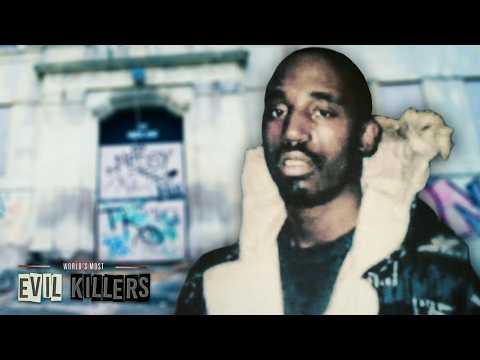
Mugshots: Kenneth Bianchi & Angelo Buono - The Hillside Stranglers
Episode Description
Click here to watch great FREE Movies & TV: http://filmrise.com
Body after body is discovered in Los Angeles – a serial killer is dumping naked women’s bodies along hillsides.
Read the full transcriptHide the full transcript
- [Music] Next on Mugsh shot, 10 women murdered in five months leaves Los Angeles reeling.
- He always made sure he could restrain them. He made sure he could silence them. He made sure he could blindfold
- them. He then made sure they were at a place where they knew they were going to die. A lint brush was picked up. Off
- this lint brush came fibers from the house and hairs from one of the girls. The killer is caught, but would his
- bizarre confession lead to his freedom? This broad I killed these two ants will kill. This captain is the broad you
- killed. You say, I go too fast. He ain't bunch of them, Pat. I'm not that smart.
- He did the crimes premeditatively. He knew it. He knew he was driven to do more. And he continued,
- Kenneth Bianke, the hillside strangler. I fantasized then and I could do it today. I fantasized shooting him right
- where he sat. [Music] Unicorn. [Music] [Music] The series of murders that would panic
- Los Angeles began with little notice. On October 17th, 1977, a 19-year-old prostitute named Yolanda Washington was
- picked up off the street in Hollywood. Her strangled body was found the next day near Warner Brothers
- Studios. When she was picked up, this was where they went. She had sex in the back seat
- and then he strangled her and they took her along here and then eventually dumped her over the side. Author Ted
- Schwarz covered the case and became familiar with the killer's methods, including impersonating police. They
- would approach somebody who looked young and they would pretend to be Metro Squad
- and they would, in quotes, arrest the person, uh, very often handcuffing them and then take them for the murder.
- Two weeks later, the second victim was grabbed on the Sunset Strip. The next morning was Halloween.
- Detective Frank Solerno of the Los Angeles Sheriff's Department responded to a report of a dead body in a
- middle-ass neighborhood in the town of Lac Cresenta. One of the first things I noticed
- obviously was the ligature marks that were quite predominant on her ankles, wrists, and and around her neck. She
- appeared to be a teenager, totally nude. There appeared to be no trauma to her whatsoever. She looked like she had been
- placed there, not just tossed randomly. My first impression was that possibly two people had placed her there.
- Detective Solerno studied the scene for evidence. As I looked at her face, which
- was turned in one direction, I noticed a small tuft of white fiber. It was the fiber was about as big around as the tip
- of your finger. um and it was uh hooked or attached to her eyelid. The victim would be identified as 15-year-old Judy
- Miller. The coroner said she too had been [Music] strangled. A week later, on November
- 6th, the body of a third strangulation victim was found near a country club in a Los Angeles suburb.
- She was identified as 21-year-old Lisa Casten. Judy was still there at the corner's office because she hadn't been
- identified. And we pulled her body out on a gurnie. We pul placed it next to Lisa Casten's. And that's when uh uh Joe
- Choy, who was our deputy coroner at the time, made the comment that they looked like they came out of the same Xerox
- machine. The ligature marks on the ankles, wrists, and and neck were exactly the same.
- On November 20th, the fourth and fifth bodies were found near Dodger Stadium. 14-year-old Sonia Johnson and Dolores
- Sapeda, 12, were the youngest victims. They'd been abducted outside the Eagle Rock Plaza shopping mall and
- strangled. They were children. They went to a Catholic school. They didn't seem the part, but again, they looked 17.
- That same night, a sixth body, 20-year-old Christina Wckler, was found in nearby Highland Park. Both the way
- she was abducted and her injuries matched the previous killings. Christina was an art student who had just returned
- home from classes, was in her driveway when she was, in quotes, arrested for curfew violation. And she went along
- with it not fearing them, thinking they were legitimate police. That that puts a
- little panic in the city because uh every day uh citizens are pulled over by policemen. Three days later, police
- found victim number seven, Jane King. Her body was discovered alongside an exit ramp of the Golden State Freeway.
- She was a wannabe actress. She was 28. She was the oldest victim. She looked 17. She looked much younger than her
- years. With the situation spinning out of control, investigators from the LAPD, Los Angeles Sheriff's Office, and the
- Glendale Police formed a special task force. November 29th, Lauren Wagner's body was found at 1200 Cliff Drive.
- The 18-year-old business student was the eighth confirmed victim. She had bizarre
- burns in the palms of her hands, indicating a new kind of torture. They tended to handcuff them as an
- arrest situation, used rope when they were going to rape them. There often were indications of fibers in the mouth,
- things that would indicate that they were silenced. Uh they've been blindfolded. In this case, I believe
- there were about 10,000 clues that were called in suspects. Loose, that's a loose fitting term. There were hundreds
- of them. By this time, the media had dubbed the serial killer the hillside strangler, and the entire city was
- gripped by fear. On December 11th, victim number nine, the body of Kimberly Diane Martin, a
- 17-year-old call girl on a hillside in Echo Park. Rumor had it that the body was
- deliberately laid out to face Los Angeles City Hall. She was up off of Alvarado on a hill,
- for lack of a better term, the classic hillside dump. And it was a classic shot that was in all the newspapers from a
- helicopter showing this nude body on the side of a hill spread eagle uh looking down towards city hall.
- Meanwhile, the task force was piecing together even more evidence that indicated there were two killers. When
- the Kimberly Martin case uh came about, uh I felt and this is in looking back that this was the case we were going to
- break it on because there were so many more things we had. Uh we had a location where she was last seen uh which was the
- Tamarind Apartments. There was the last phone call that was made to the outall service from the library. Uh there were
- witnesses to the two suspects that were seen there. Uh, as it turned out, there were fingerprints, a number of them, uh,
- that were never matched up till, uh, a year later or so. Everything that had occurred, uh, we had, um, many
- more solid leads on that case than than we'd had on all of the cases put together before that. Uh, and they all
- seemed to fizzle. They just, uh, went away. What they really were looking for is a magic phone call. So, they were
- just hoping somebody had seen something, overheard something. There were no more
- bodies through Christmas, New Year's, Valentine's Day. Not until February 17th, 1978. That day, north of the city,
- police found an orange Dodson in a ravine off the Angelus Crest Highway. In the trunk was the body of
- 20-year-old Cindy Hudsbath, naked, strangled, with liature marks in all the same places. Victim number
- 10. Uh we had a an individual that uh came forward that identified uh a suspect driving what we thought was
- Cindy's car up Anggeles Highway after she had been abducted. Uh we felt we were close to solving this thing. Um and
- and again the leads just petered out. They just we worked through them and and and nothing nothing developed.
- Now, what the police don't know is that their killer has left town. When Mugsh shots continues, two murders in a town
- 1,200 m away finally unmask the hillside strangler. [Music] By the spring of 1978, the hillside
- strangler had killed 10 women in 5 months, terrifying the people of Los Angeles from the beginning been
- baffling. Uh the evidence has been meager. Uh we have used uh the resources that we have available
- to us and we simply have not been successful. 11 months after the last victim of the
- hillside strangler was found, two young college roommates, Karen Mandic and Diane Wilder, were reported missing in
- Bellingham, Washington, 1200 m north of Los Angeles. About January 12th, 1979, the Bellingham
- Police Department got a report from a young security officer that his girlfriend was missing and a friend of
- hers was also missing. One girl worked at Fred Meyers and she had told her boyfriend that she was going to do a
- special security job for one of the local uh security agencies and that uh a man by the name of Ken Bianke was the
- person she was going to work with. He had a job where he needed a house sitter that there was u there'd be a 2-hour
- period when the alarm system was being changed. Somebody had to be in there. the they were paying $100 for two hours
- for each person. Kenneth Bianke was a trim, muscular man with dark hair and a mustache. He lived on North Street with
- his longtime girlfriend, Kelly Boyd, and their infant son. Two sergeants made contact with Mr.
- Bianke, and at that point, he denied any knowledge of knowing the girls or having
- contact with them or any connection at all to the girls. Ken became u a suspect almost
- immediately. Police visited the girl's home. They found a hungry cat and the exact address of the home on Bayside
- Road where the two of them were to housesit. The chief of police, Terry Mangan, decided to put a public
- broadcast uh use the radio stations to put out the information that these two girls were missing, a description of
- their car, and uh asked that anybody that happened to see the car called the Bellingham Police
- Department. A lady had called in and told us that there was a Bobcat matching that description parked in this
- particular culde-sac that we're standing in right now. When we came in, the vehicle was parked uh right just about
- where that basketball hoop is now, but one one vehicle width out. And when you looked into the car, all you could see
- uh laying in in the car was actually one body and a portion of another body. I had the locksmith drill the lock out of
- the trunk and myself and one of my crew started to remove the bodies uh one at a
- time uh onto Gurnie where they were uh taken away to be autopsied. Prosecutor Dave Mckran joined Bellingham
- detectives at the culdesac. I remember thinking when we had gotten there and I spoke to Bob Kudson and uh he mentioned
- that he felt this individual had done this before and we both agreed that that was the case. When we took the uh first
- body out, it appeared to be uh almost traum. Uh very little that we could see immediately. uh was a liature mark
- around the neck, but that was all. Even before the bodies were sent to the morg,
- police ordered that Kenneth Bianke be picked up for questioning. Police went to Biankey's
- home on North Street that night. His girlfriend, Kelly Boyd, could not believe what police had to say. The
- relationship between him and his live-in and child was apparently good. She wouldn't believe that he was a killer.
- She couldn't believe that uh the person we were describing and and dealing with was according to her was completely
- different. Yet Robert Kenudson and his team had gathered three key pieces of evidence that would link Bianke to the
- crimes. At the culde-sac when we took in the bodies, there were carpet fibers off
- the bodies. Uh these carpet fibers were matched to the carpet fibers in the house. Even more telling was evidence
- from his home at his residence. The search that was done there, a lint brush was picked up. Off this lint brush came
- fibers from the house and hairs from one of the girls. But most damaging of all was evidence found on one of the bodies.
- We removed the bodies from the car. They were placed in clean sheets before they
- were taken to the autopsies. Uh the one sheet from Diane Wilder, when that was submitted to the
- lab and examined, there was a pubic hair found in that sheet. It was matched to the pubic hairs of Ken Bianke. There was
- also another connection. We ended up connecting Ken Bianke to LA uh rather rapidly. Uh but it comes about by just
- good police work. One of the detectives took his driver's license, which was a California license, and ran it to
- California. Ultimately, through the calls, we got connected with the Hillside Stangler Task Force, and uh
- Detective Solar was one of those people. It was the first time we'd had anybody that uh had so many connections and the
- first check they did was through DMV and that connected him to the Garfield locations. So we had Bianke connected to
- two victims. He'd been an LAPD reserve applicant. Uh he lived on Tamron and we just started connecting him by going
- through the files. So we called Bellingham back. We told him we were going to fly up there.
- Solerno went to Bellingham and talked with Kenneth Bianke's girlfriend, Kelly Boyd. We found out that his best friend,
- quote, almost soul male companion was Angelo Bono, was a cousin. Serno had his partner check in with Angelo Bono, who
- they suspected of being involved in the crimes. Bono was a 46-year-old car upholsterer with a shop not far from
- many of the hillside crime scenes. I believe he acknowledged the fact who Kenneth Bianke was, but the original
- interview with him was very with him was very short. Uh, and uh, he was uncooperative.
- Meanwhile, more details about Kenneth Bianke began to emerge. He lived in Los Angeles with Kelly Boyd and followed her
- north when she decided to return home to Bellingham with his newborn child. When
- he got here, uh, he worked at Fred Meyers as a security officer there and ultimately got hired by, uh, the local
- security agency as a captain in charge of of a lot of the security. Police were certain they had a strong case against
- Bianke. But as he waited in the Watcom County Jail in Bellingham, Bianke maintained his innocence. In March 1979,
- Biankey's attorney decided to have a psychiatrist examine him. Without informing prosecutors or police, the
- attorney brought in Dr. John Watkins, an expert in hypnosis and multiple personalities. If Bianke was found to be
- incompetent to stand trial, he could at the very least escape the death penalty.
- My original idea was to see if I could break through what appeared to be an amnesia. simply he didn't recall what
- happened back there. In these extraordinary videootapes, Dr. Watkins had hypnotized Bianke and got him to
- talk about the crimes. Killing a broad doesn't make any difference to me. Killing anybody doesn't make any
- difference. Maybe it didn't kill any of those. I don't know. Oh, hey, no wrong, man. Hey, I killed a couple of these.
- Which one? You think you did, right? I killed her. Angelo killed her. They mean the Wagner when Angelo killed This
- broad I've never seen before. Martin. This broad I never seen before. Hudpath. You never saw them at all. Nope.
- This broad I've never seen before. Robinson. This broad I kill. These two Angelo
- kill. Johnson. This one I've never seen before. Angelo killed. Huh? This one I've never seen before. This broad I
- kill. Barome never seen before. This captain is the bride. You killed, you say? Am I going too fast? Yeah, a bunch
- of them pass. I'm I'm not that smart. So, Bianke had admitted to the murders in Bellingham and Los Angeles and
- implicated his cousin Angelo Bono. But the whole time, Bianke was confessing in the character of a person
- named Steve Walker. This led Dr. Watkins to determine that Bianke was not acting
- as himself and therefore was not competent to stand trial. To this day, Watkins stands by his multiple
- personality diagnosis. You're going to watch the difference between the personalities of uh Ken and
- of Steve. And you're going to see the two personalities. Uh you're going to see Ken go into Steve. And then you're
- going to see uh Ken emerge back again out of Steve. Would you excuse me a second? I've got to go to
- the head. Okay. Excuse me. Are you Ken? Do I look like Ken? I'd like to talk to Ken now. What's my
- rosary doing on the table? Didn't you put it on the table? No. No. I hit it, my father.
- I thought you put it on the table. No. No. Oh, okay. What do you think happened?
- Steve again I gave him two diagnosis. Kent was normal or normal neurotic and Steve was uh a uh
- dissociative reaction sociopathic. Investigators on the case were outraged. They believed Bianke was faking.
- Absolute phony. Absolutely defense. This is [ __ ] In order to prove Kenneth Bianke was competent to stand trial,
- detectives would have to find evidence that he was faking. For that, they turned to his
- childhood. Next on Mugsh shot, the making of a [Music] murderer. As Kenneth Bianke awaited a
- court ruling on his competence to stand trial, investigators searched deeper into his background.
- Kenneth Allesio Bianke, the man who would strangle a dozen women, was born on May 22nd, 1951 in Rochester, New
- York. His mother was a hard-rinking prostitute who gave him up at birth. The baby was adopted by Francis Bianke and
- her husband Nicholas, a manual laborer. They were so delighted to have a child, they were terrified they'd lose him. So
- Mrs. Bianke saw a lot of medical problems that didn't exist. She focused on urinary tract infections which he did
- not have. The testing they had to do was very much uh like a rape. If if someone's ever had
- catheterization, there's a very humiliating factor to this. And for a small child, it had to be very
- difficult. His mother is reported as having constantly yelled and shouted at him and hit him. and that it was also
- reported and I can't verify it that she used to punish him by taking his hand and putting it on the hot electric stove
- and burning it. That that was her ways of punishing him. As Kenneth Bianke grew up, his
- family was constantly on the move. They lived in more than a dozen homes in Rochester and while Kenneth was in first
- grade, a brief spell in Los Angeles. At Holy Apostles Grammar School, Kenneth had some success at creative writing and
- artistic and verbal skills. And while he had an IQ of 116, he remained a constant
- underachiever. His mother accused him of being a chronic liar and he was easily angered and prone to
- tantrums. Kenneth Bianke was 13 years old when his father died in 1964. His mother went off to work and
- Kenneth entered Gates Chilai High School. He didn't apply himself at all, although he was a bright young man. He
- certainly brighter than the average uh student and yet he finished very close to the bottom. His rank was over 400,
- 400 and change out of uh maybe 420 students. When Ken reaches 18, he's troubled by what he's seeing. goes to a
- psychiatrist, goes three sessions, doesn't like what he's finding, and never goes back.
- After graduation in 1971, Bianke had a brief marriage to a girl his own age. But his true love was police work. Ken
- enrolled in the Monroe Community College in in liberal arts and then switched over to police science. Ken had always
- tried to get on police departments. He wanted to get into law enforcement. In 1972, Kenneth Bianke applied to the
- Monroe County Sheriff's Department in Rochester. Psychiatrist David Barry interviewed him as part of the screening
- process and saw the warning signs almost immediately. He denied on the testing all of the usual human failings, the
- things that we all uh are less than perfect in. You see that in in patients who've been made to feel guilty for any
- transgressions. Dr. Barry also noticed a great deal of hidden anger in Bianke. He was certainly repressing a lot of it
- toward his mother and uh and she very definitely exercised a great deal of uh influence and and a lot of it turned out
- to have considerable negative impact. It certainly did leave a a bad taste in his
- mouth for uh for women and it could very well have have generalized uh from there. Based on Dr. Barry's
- recommendation, Bianke was rejected. 3 years later, his problems with women led to his first brush with the law. In
- February 1975, he was arrested in a Rochester suburb for sneaking into the home of a woman he had been trying to
- date. His apology was apparently so charming that the woman dropped the charges. Everything's going wrong. His
- marriage has fallen apart. But it was just time to move on. And with a cousin in Los Angeles and the excitement down
- there, it seemed the perfect place to go. He expected to find his wife. He expected to find his future. He just
- went down there very optimistically. Now, Los Angeles is a fantasy town. In late 1975, Kenneth
- Bianke packed up for a new life in Los Angeles. He moved in with a cousin, Angelo Bono, 16 years his senior. Ken
- attempted and failed to get a job as a police officer. Eventually, he got a job working for a title
- company. He used his first paycheck to get his own apartment at 809 East Garfield Avenue in Glendale and a 1972
- Cadillac sedan. At a party, he met Kelly Boyd, a hospital worker who had come to Los
- Angeles from Bellingham, Washington. Each of them has had their own troubled pasts. Each of them has had uh problems
- within their families with loss. Each of them came down to uh Los Angeles to find
- their way and they begin living together. But while he lived with Kelly, Kenneth Bianke led another secret
- life. Armed with a bogus PhD, he set up a phony psychological counseling business and actually gave therapy to a
- number of patients. Investigators believe that it was then that he developed many of the techniques he
- would later use to fool psychiatrists. And he continued to hang around with his cousin Angelo Bono. Ken
- Bianke is interesting because he was the instigator. Angelo, if he is a sociopath, got into something
- that gave him pleasure. Bono had a reputation as a ladies man and seemed willing to involve his cousin in his
- sorted world. At some point in Bianke and Bono's relationship, they recruited two young females that were underage.
- They were running sort of a mini outall service with these two uh young females.
- They provided them to some local politicians. Both girls, Sabra Hannon and Becky Spears, eventually ran away.
- One theory has it that Bianke and Bono chose their first victim, prostitute Yolanda Washington, as an act of revenge
- against these girls. In any case, the killings began on October 17th, 1977. After his arrest in Bellingham,
- Washington, Bianke detailed the killings in sessions with Dr. John Watkins. hands are tied and then they're taken
- into the spare room next to the bathroom. That's when um there was sex with with the girls. Everything was made
- ready getting the rope uh to kill them with. Bianke claimed the killings were not the work of himself, but a
- personality named Steve Walker. Five more experts would be brought in to assess Biankey's condition. Robert
- Kenudson of the Bellingham Police worked the video camera. What's it been? 23 years and I can still feel
- [Music] it. A reaction of of just wanting to uh I fantasized then and I could do it today. I fantasized
- shooting him right where he sat. One of the experts prosecutors brought in was psychiatrist Martin Or who demonstrated
- that Bianke was faking his hypnotic state. When Dr. Or expressed surprise that Bianke exhibited only two
- personalities, a third promptly surfaced. What is your name? Billy. All right, Billy. Finally, Bianke overplayed
- a hypnotic suggestion, pretending not only to see, but to touch someone who wasn't there. Hey, Dean. How you doing?
- Meanwhile, detectives in Los Angeles would find college transcripts Bianke had forged for his phony psychotherapy
- practice. Transcripts that were stolen from the real Steve Walker. We had connected Biankey's name to Steve and
- Steve was his multiple years before and how he had obtained it and Kenny changed
- his plea at that time and dropped his multiple personality. So, we broke his multiple personality defense. Next on
- Mugsh shot, the case takes strange new twists as prosecutors move to dismiss the charges against Angelo Bono and
- Bianke plots a new murder from jail. [Music] [Music] In the fall of 1979, Kenneth Bianke made
- a deal with prosecutors in order to avoid the death penalty. He would first plead guilty to the murders of Karen
- Mandic and Diane Wilder. He would then plead guilty to five of the Los Angeles murders. Finally, he agreed to testify
- against his alleged partner in the crimes, Angelo Bono. I can't find the words to express the sorrow I feel for
- what I've done. Kenneth Bianke appeared remorseful. In no way can I take away the pain that I've given to
- others, and in no way can I expect forgiveness from anybody. He appeared to be intent on bringing his partner in
- crime to justice. to even begin to try and live with myself. I have to take responsibility
- for what I've done and I have to do everything I can to get Angela Bono. It is a judgment of
- the court that Mr. Kenneth A. Bianke will be sentenced to uh prison in the state of Washington for
- the rest of his natural life. Bianke's behavior caused many to doubt his sincerity. The thing that bothered me
- about him, he was such a phony. Um, in the courtroom, he uh he cried uh at the guilty plea and um we all felt that was
- just rehearsed and something that he he could do or not do whenever he wished to
- do it. When he got out of the courtroom, he was laughing with the jailers and uh
- he just was uh he was a kind man. Myself and Detective Noly, we were assigned to
- take Ken out of the courtroom. As soon as we got out of the courtroom, it was a different person. It was, "Ah, the heck
- with it. Let's go have a smoke. I'm ready to eat." You know, this kind of a thing. And
- uh there was no remorse. There was no real remorse. The investigators in Los Angeles were
- counting on Biankey's testimony and were waiting to move in on Angelo Bono. And Ken told the story, explained what
- happened, named Angelo. The minute he did, there was a telephone call to Los Angeles. Uh they were all in position to
- get Angelo and he was immediately arrested. We found uh some upholstery material in the shop that uh was similar
- and matched the Judy Miller case. With Angelo Bono in custody, Kenneth Bianke was immediately flown to the Los Angeles
- County Jail. But as soon as prosecutors began to interview him about Bono's role
- in the murders, Bianke began to change his story, claiming memory lapses and innocence, a clear breach of his plea
- agreement. Bianke was entertaining himself. Uh, and they would go over there and and talk to him two, three
- times a week, and every time they go over and talk to him, he would tell him a different story.
- Then came a bizarre twist in the case. Early in June 1980, a 23-year-old playwright and aspiring actress,
- Veronica Lynn Compton, contacted Bianke in jail. She told the Hillside Strangler
- that she identified with him. Bianke and her set up this plot that would show that the real hillside strangler was
- still out there. She was going to go about the country and kill people. supposedly smuggled out some body fluids
- to where uh after one of the murders, she was going to make it look like a rape.
- Veronica Compton traveled to Bellingham, Washington. She lured a woman to the Shangla Motel and attempted to strangle
- her to death. She tried to overpower the woman, tie her up, and then she was going to set a scene and kill her. this
- short, seemingly weak uh woman who worked at a bar, had a primary job as a tree surgeon working for the parks and
- recreation. Powerful as anything, got away, Veronica was arrested. Bianke's scheme to create a perfect alibi
- backfired as Veronica Compton was tried for attempted murder. She also testified and had claimed
- earlier that she'd been an actress and uh her testimony didn't portray any ability she had. Uh and she was
- convicted, but it was a very unusual case indeed. The next shocking development in the case occurred in July
- 1981. The district attorney's office was relying on Kenneth Biankey's testimony against his cousin. But Bianke's wildly
- conflicting statements so worried the prosecutors that they made a motion to dismiss all charges against Bono.
- Changes in in his story do have a uh a disruptive influence on the people's case, a majorly disruptive influence on
- the people's case. Most of the time when the prosecutor makes a motion to dismiss, um the judge pretty much
- automatically dismisses. And in this case, uh Judge George didn't. And he started uh reading what his decision was
- going to be and the reason for it. And subsequently, he said, "I'm going to submit it or refer it to the attorney,
- state attorney general's office for prosecution." When Mugshots returns, the long- aaited trial begins and Kenneth
- Bianke is called to the [Music] stand. In the spring of 1982, the California Attorney General's office put
- Angelo Bono on trial and called Kenneth Bianke as a witness. When Bianke gave testimony that
- conflicted with prior confessions, Judge George pointed out that he was reneggging on his plea bargain
- agreement. Bianke briefly changed his tune. But on defense cross-examination, he continued to give contradictory
- testimony. because of Bianke going all over the place, the early interviews of him where he cooperated insignificant
- details of what he had done and when he had done it. And u that's what came into
- play is that we showed that when we originally interviewed him, he hadn't lied to us, that he's lying now.
- Among the long string of witnesses were Becky Spears and Sabra Hannon, the two girls that Bono and Bianke had run as
- prostitutes and had brutalized. They testified about Bono's sadism. Then an eyewitness came forward. And Marcus
- Camden, uh, as it turns out, actually witnessed the abduction of Judy Miller. Uh, he was with her the last night she
- was alive. Uh he walked her down to uh Carney's hot dog stand there on Sunset Boulevard. Uh he had seen a Cadillac
- with an individual who he identified eventually as Angela Bono uh pick her up and drive to a location to uh where
- Kenneth Bianke said uh that he got in the car and handcuffed her and they they took her to Bono shop. Another piece of
- crucial forensic evidence was a clump of fibers matching those found on the body
- of Lauren Wagner. Fibers from the same chair in Bono's house where Bianke claimed she'd been attacked. There was a
- lot of evidence because it was done in his workshop. They found fibers that were consistent with materials in that
- shop and not consistent with fibers anywhere else the girls were known to have been. Then they introduced a
- powerful piece of forensic evidence that Sheriff's Detective Frank Serno had discovered.
- We found the same type of material uh in Angelo Bono's upholstery shop that we matched up as being similar uh to the
- tough that was on Judy Miller's eyelid. As a matter of fact, uh, in interviewing
- Bianke up in Bellingham, um, he told us that they had used some upholstery material from Bono's shop to
- blindfold the victims. A woman testified she was terrorized by Bono in the Hollywood Library the night Kimberly
- Martin was murdered. This testimony connected Bono to the pay phone used to summon Kimberly to her death. Then it
- was the defense's turn. I was brought in by the defense council for Bono. Uh even
- though the prosecution knew I was convinced of his guilt and once they asked me my opinion, I could bring up
- things that Ken Biyaki had told me that would have been questionable if it hadn't been my opinion.
- Inexplicably, defense attorney Katherine Mater then decided to put Biankey's girlfriend, Veronica Compton, on the
- stand. She testified that she and Bianke conspired to frame Angelo Bono. I think
- it'd be unfair to call it a circus in the fact that uh um just what was accomplished in it, but it was a very
- long trial. After more than 250 witnesses, a thousand exhibits, and more than 2 years, the case went to the jury.
- The first of the guilty verdicts came back on Halloween 1983, 6 years after Detective Frank Serno found Judy
- Miller's body. My recollection is the first one that came in was the Wagner case and the second one that came in was
- the Hudsmith case, which were our two strongest cases uh with or without Bianke. Obviously, we were quite elated
- with that. And then uh the rest of them came in with the exception of Yolanda Washington which was the very first case
- involved in the string of murders. And that wasn't a total surprise. That wasn't something that was shocking. U
- but but the nine out of the 10 um was something I expected. Bono was sentenced for nine murders.
- Bianke was also sentenced for the five Los Angeles murders he plead guilty to. They gave him multiple life sentences.
- Ken was given five life sentences for the Los Angeles cases. He was given the two for Bellingham, Washington. So, he
- has seven life sentences. But Judge Ronald George wasn't finished. He had a surprise for Bianke, whose behavior
- added months to the trial and little to the cause of justice. what occurred because of Bianke uh going
- back on his word to be truthful, the judge told him that he had not upheld his part of uh the agreement and uh he
- was sentenced to his time in Walaw Wallala, Washington where he's currently serving and uh when and if he's ever
- parrolled up there, he will be shipped back to California and uh do his time here. When Mugshots returns, inmate
- Kenneth Bianke 20 years [Music] later. After a 2-year trial, Kenneth Bianke was sentenced to five life terms
- in a Los Angeles courtroom. The case of the hillside strangler was over, but Bianke's motives remain a
- mystery. I wish we had an idea of what sparked it. Uh, that's a question we always try to
- get into the mind of the individual, the mind of the murderer, as they say. Uh, if they'll talk to you. Bianke could
- never, he'd never tell us. Couldn't, wouldn't, or whatever. Bono never talked to us, so we never got that opportunity.
- Um, some people uh guess or that that they had been uh wronged by some prostitutes
- uh and that's what started it, but I don't think anybody really knows. 20 years after he pleaded guilty to the
- hillside stranglings and the murders of two women in Bellingham, Washington, serial killer Kenneth Bianke is inmate
- number 266961 at Walaw Wala Penitentiary. He wrote almost a book trying to prove that
- he's innocent. And in the book, his stress is that that the everything was uh stacked
- against him. And also, as I understand it, he got a law degree uh by uh one of these bail order law degrees because he
- wants to argue his case. But what he wants to argue is that he's innocent, not that he's a psychiatricist. Dr. John
- Watkins, who proclaimed Bianke a victim of multiple personality disorder, has kept in touch with the killer. I'm not
- sure whether he is still a multiple personality. One of the guards uh reported that the men in the ward were
- complaining because they couldn't sleep at night because they heard two voices arguing with each other in his cell. I'm
- smiling because I'm glad he's in prison. Prosecutor Dave Mckran of Bellingham, Washington hears from Bianke every few
- months. He sued us a number of times and uh sued some of the officers. So, we have had a continual ongoing situation
- over this time period. Retired Bellingham police investigator Robert Kudson is often named in Biankey's
- unsuccessful lawsuits. It usually is based on the fact that he feels that I as me as an individual
- uh falsified the evidence. Uh I planted the evidence. Uh that it's totally my fault that uh he's incarcerated, that
- he's in jail. Former Los Angeles Sheriff's Detective Frank Serno has not heard from Kenneth Bianke since he was
- put away. And that's fine by him. Bianke was the front man. By that I mean he was the one that went out uh
- contacted the girls, did the talking cuz he was very glib, had a real line of BS.
- Uh and uh even some women described him as being handsome or good-looking. So he
- was the front man. [Music] Author Ted Schwarz, who got to know Bianke while he was held in Bellingham,
- kept in touch with the killer until a few years ago. He says Bianke still has hopes of getting out of prison one day
- and cashing in with a book deal. It's hard to say that Ken Bianke is not a monster. He killed 12 women
- premeditatively. He did it in a horrible way. He's a cold-blooded killer. It's as
- simple as that. Kenneth Miani is nothing more than a cold-blooded killer and uh if he was released uh there's no doubt
- in my mind he would kill again. Bianke declined an interview for this program. Far from providing insight into
- his motives today proclaims his complete innocence. I think he's an extremely dangerous
- person, an evil person, and I'm very happy he's where he is. He belongs to be [Music]
- there. Heat. [Music] Heat. Heat. Heat. [Music] [Music] [Music] I'm
Brief Summary
Kenneth Bianke, the Hillside Strangler, murdered ten women in Los Angeles, leading to a complex investigation and trial.
Key points
- The Hillside Strangler's Reign of Terror. In just five months, ten women were murdered, leaving Los Angeles in panic.
- Detective Solerno's Investigation. Detective Frank Solerno discovers the chilling patterns in the strangulations.
- The Discovery of Victims. The bodies of young women are discovered, revealing a horrifying pattern.
- Bianke's Arrest. Kenneth Bianke is linked to the murders through crucial evidence.
- The Hypnosis Confession. Bianke's attorney brings in a psychiatrist to examine him under hypnosis.
- Kenneth Bianke's Guilty Plea. Bianke pleads guilty to multiple murders, expressing sorrow but raising doubts about his sincerity.
Episode highlights
- The Hillside Strangler's Reign of TerrorIn just five months, ten women were murdered, leaving Los Angeles in panic.“The killer is caught, but would his bizarre confession lead to his freedom?”0:24Jul 29, 2014
- Detective Solerno's InvestigationDetective Frank Solerno discovers the chilling patterns in the strangulations.“My first impression was that possibly two people had placed her there.”3:02Jul 29, 2014
- The Discovery of VictimsThe bodies of young women are discovered, revealing a horrifying pattern.“They looked like they came out of the same Xerox machine.”4:02Jul 29, 2014
- Bianke's ArrestKenneth Bianke is linked to the murders through crucial evidence.“We ended up connecting Ken Bianke to LA rather rapidly.”14:11Jul 29, 2014
- The Hypnosis ConfessionBianke's attorney brings in a psychiatrist to examine him under hypnosis.“To this day, Watkins stands by his multiple personality diagnosis.”18:12Jul 29, 2014
- Kenneth Bianke's Guilty PleaBianke pleads guilty to multiple murders, expressing sorrow but raising doubts about his sincerity.“I can't find the words to express the sorrow I feel for what I've done.”28:58Jul 29, 2014
- The Trial of Angelo BonoBianke's conflicting testimonies lead to a motion to dismiss charges against his cousin.“Changes in his story do have a disruptive influence on the people's case.”33:09Jul 29, 2014
- Bianke's Life SentencesBianke receives multiple life sentences for his crimes, but his motives remain unclear.“The case of the hillside strangler was over, but Bianke's motives remain a mystery.”39:38Jul 29, 2014
Episode quotes
Tension
75/ 100High tension