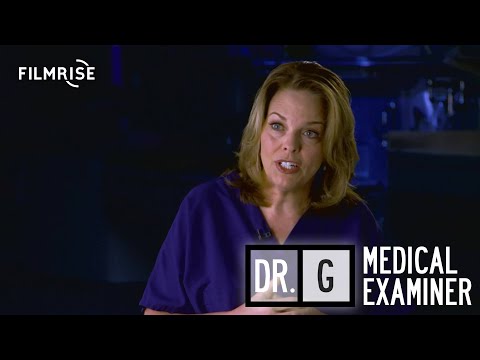
Dr. G: Medical Examiner - Season 4, Episode 3 - Shock To The System - Full Episode
Episode Description
Police discover the dead body of Andrew Hopper clutching a syringe and covered with blood. The body is in Dr. G’s hands, as are the clues to solving the case.
A Florida medical examiner takes viewers through puzzling cases while explaining procedures and conclusions.
Read the full transcriptHide the full transcript
- [OMINOUS MUSIC] [DRAMATIC MUSIC] NARRATOR: An anonymous call leads police to the dead body
- of a 60-year-old man lying in an empty field and surrounded by sinister clues. A straight razor, a syringe.
- There was blood on his face. NARRATOR: All the signs point to murder. What's he doing in the middle of that field?
- If Dr. G finds evidence of murder, it then launches into a much deeper investigation.
- NARRATOR: And then a horrific highway crash leaves a semi in flames, with the driver trapped inside.
- They have a completely charred body in the cab of the truck. NARRATOR: The cause of the crash is a mystery.
- Could it have been alcohol? Could he have fallen asleep at the wheel? NARRATOR: And the evidence may have gone up in flames.
- The more destroyed the body, the less I'm going to be able to say and do. NARRATOR: Altered lives, baffling medical mysteries,
- shocking revelations. These are the everyday cases of "Dr. G, Medical Examiner."
- [GUITAR MUSIC] I'm cutting downstairs today. It's my day to be in the morgue, and we have about six bodies
- down there. We're going to go over the cases that we did yesterday at our morning meeting with the other doctors.
- So that one went he hit her left chin, hit her tongue, back of the neck, hit C1, C2,
- and through the spinal cord and out the back of the neck. Through her chin? I have oodles of paperwork to hope to get out some old cases,
- then I'm going to have to dictate the cases that I did. I don't think I'm going to be done downstairs
- until about one or two. Then I've got to come back up and dictate. It's a crazy morning, but they all are.
- [SOMBER MUSIC] Today, I have a 60-year-old man who was found face-down in an empty field.
- The problem is it's in a bad part of town. NARRATOR: According to the investigator's report,
- yesterday morning the Orange County Sheriff's Office received a disturbing tip. The caller refused to give his name,
- but urged police to go to a wooded area near the city's edge, because someone needed their help right away.
- Dispatch sends a nearby patrol car to check out the area. At first, the grassy field appears undisturbed.
- But then in a secluded spot about 30 feet from the nearest roadway, they find a man lying face-down with his arms
- folded underneath him. He is cold and has no pulse. Immediately, the officers call for homicide detectives, who
- in turn request a medical investigator from the morgue to join them at the scene.
- They're not quite sure here if it's foul play, if it's just collapse. They don't know what's going on.
- NARRATOR: And the case grows stranger by the minute. In a neighborhood frequented by the homeless,
- the man seems out of place. Just his overall appearance did not seem to be consistent with what you normally
- see transients wearing. He's dressed in a short sleeve, you know, shirt with khaki colored
- cotton slacks, some shoes and socks, and so he's nicely dressed. NARRATOR: As soon as they roll over his body,
- they discover a startling array of clues. A straight razor that was open also. In his hand, he was clutching what looked like a syringe,
- and there was blood on his face. [THUD] NARRATOR: Once all the evidence is cataloged,
- and bagged the body is immediately transported to the District 9 Morgue. Now, it's up to Dr. G to piece together
- the strange set of clues. He's definitely not your typical found dead in bed kind of guy.
- NARRATOR: Fortunately, a driver's license identifies the man as 60-year-old Andrew Hopper,
- and police are soon able to track down his daughter Marilyn in North Carolina. [PHONE RINGING]
- MARILYN: Hello? NARRATOR: At first, she refuses to believe that the man found dead in a sketchy neighborhood could possibly be her father,
- but she comes around when she hears about the syringe in his hand. She explains that her father used a syringe every day
- for good reason. His daughter said he is diabetic. NARRATOR: Hospital records confirm her claim.
- He takes insulin, and he also has no history of any illicit drug use, alcohol use.
- Doesn't even smoke, according to his records and his family. NARRATOR: Confronted with her father's strange and sudden
- death, Marilyn finds herself wracked with feelings of guilt and remorse. [DRAMATIC MUSIC]
- She'd been worried about his state of mind in the wake of a recent divorce and impending retirement.
- But now, she desperately regrets not having approached him with her concerns. JAN GARAVAGLIA: He has had some problems.
- NARRATOR: Given this new information, Dr. G wonders if Andrew had simply searched out a desolate spot in order to commit suicide.
- You know, the hair on your back, your neck starts to rise up a little bit when you see a razor
- and you see blood. Maybe he is trying to kill himself somehow. NARRATOR: But what concerns detectives is the specter
- of violence, and there are no witnesses to Andrew's death except possibly the anonymous caller.
- The area where the victim was found is a high-crime area. The important thing is to first treat this
- as though it is a homicide. He could have been really taken by surprise from behind, possibly.
- NARRATOR: If Andrew had been attacked, police have a killer on the loose. But they can only launch a full-scale investigation
- after Dr. G determines his cause and manner of death. Homicide, suicide, natural, or accident?
- Everything's up for grabs here. [DRAMATIC MUSIC] Tom, could you hand me a male chart please and an internal?
- Yeah. NARRATOR: The first thing that Dr. G notices on Andrew Hopper's body is the object
- clutched in his palm. It's interesting he still has an insulin syringe in his hand.
- The needle's a little bent. NARRATOR: She immediately removes the syringe and then inspects his hands and wrist for any signs
- of a suicide attempt. He had a razor blade underneath the body. I'm looking, maybe there's hesitation marks.
- I've had that many, many times, those kind of deaths where they start out with a razor
- and decide that's not the way to go. NARRATOR: But Andrew's arms are devoid of both cuts and scars.
- I don't see anything. SANDY: No? NARRATOR: She turns her attention to the bloody wounds
- Andrew does have-- Oh, poor guy. NARRATOR: --on his face. One of his eyes, both the upper lower
- lids are very swollen. It has the appearance of somebody hitting him in the eye.
- It could be just from him falling face down, but I'm not sure at this point. NARRATOR: She leans in for a closer look at the injuries.
- Tiny details catch her eye, and they're moving. Definitely some ants over all his body,
- which is very typical dying in an open field. NARRATOR: This finding confirms that the attack
- on Andrew's face was not inflicted by human hands. The aunts here in the South, we have fire ants.
- And so they will actually start eating away and cause these little kind of excoriations
- that really can look like you've been beaten up. [ROCK MUSIC] NARRATOR: But then, just as a possibility
- of a homicidal attack seems to be fading, Dr. G makes an alarming new discovery.
- Oh, what's going on here? I just saw that. This isn't looking good. [OMINOUS MUSIC]
- NARRATOR: Dr. G spreads open the lids of Andrew Hopper's right eye. The normally white parts are bloody red.
- He's got little burst capillaries from an increased pressure in those tissues. NARRATOR: This bleeding, known as a subconjuctival hemorrhage,
- can occur spontaneously when a person coughs or sneezes. But in forensic pathology, seen in decedents,
- it often indicates something much more ominous-- strangulation. We're going to hold this.
- Because you have stopped the blood, pressures build up to the point where those capillaries can burst.
- NARRATOR: Dr. G can see no contusions, cuts, or other signs of trauma on Andrew's body.
- But decomposition could be camouflaging the more subtle hints. The skin is starting to slip, a little bit of discoloration,
- so I'm going to have to interpret that more on the inside. If Dr. G finds evidence of murder,
- it then launches into a much deeper in-depth investigation. NARRATOR: Justice for Andrew and his daughter
- could be in the hands of Dr. G. [SINISTER MUSIC] OK, Sandy. All righty. I'm going.
- NARRATOR: Slicing from shoulder to sternum, she makes the Y incision. JAN GARAVAGLIA: So the first thing I need to do
- is rule out trauma. I open up the chest cavity. I open up the abdominal cavity. NARRATOR: The internal organs come into view,
- and on first glance, they look undamaged. I take the chest plate off. I don't see any broken ribs.
- I don't see any free blood anywhere. So if there's trauma, it's going to be in the head or the neck.
- NARRATOR: Her first stop is the neck. I'm looking for trauma. That's why I'm doing the neck.
- But you have to be really careful underneath that furrow, because you're more apt to cut the skin.
- NARRATOR: If Andrew was asphyxiated, this is where the killer would leave the evidence.
- Yeah, so you want to make sure you don't cut the carotids to far out, and so they
- can still embalm the face. [ROCK MUSIC] NARRATOR: But after a thorough search of the area,
- Dr. G is left with a surprising conclusion. And I do a layerwise neck dissection,
- and I don't find any hemorrhage. He has absolutely no trauma to his neck, no evidence
- of fracture, no hemorrhage. And I don't see any broken hyoid bone, which is where your tongue's attached.
- That often breaks with strangulation, or other trauma to the neck structure. NARRATOR: It appears that Andrew's eye
- hemorrhage was unrelated to any foul play after all. That could be from him falling and then lying there.
- NARRATOR: She needs to examine the head before completely ruling out a homicide.
- But with that likelihood fading, Dr. G must now consider the possibility of death
- by natural disease. And she knows exactly where to start looking. People with diabetes have a much higher risk
- of dying from heart disease, and it has to do with the effects of the diabetes on their cardiovascular system.
- NARRATOR: In some diabetics, the excess glucose or blood sugar can attach to proteins in the walls of blood vessels,
- making them thicker and stiffer. This, in turn, constricts the blood flow. When that blood sugar has been high for that long,
- it affects your large vessels and your small vessels. NARRATOR: If Andrew had developed this condition,
- his heart muscles could have died from a lack of blood and oxygen, resulting in a fatal heart attack.
- Usually diabetics, when we see them dying suddenly, it's usually from heart disease.
- NARRATOR: To explore this theory further, she first removes the heart from the chest cavity.
- I weigh it. It's very enlarged, at least twice what it should be. NARRATOR: Next, she dissects the organ,
- cutting all the way through to his arteries. And here, the case takes another curious turn.
- As expected, he has narrowing to the blood vessels that supply blood and oxygen in the heart.
- NARRATOR: But the narrowing is barely at 60%. It looks relatively mild. We really often see it when they die suddenly closer to 70%, 75%
- or beyond. NARRATOR: And there's another problem. Dr. G can find no signs of a major heart attack,
- like areas of pale, dead muscle. You know, like, there's no little sign that says,
- this trumps everything else. NARRATOR: Nearly halfway through the autopsy and with no hard evidence to speak of, Dr. G finds
- herself back at square one. I've really got to, again, put the pieces together and see how everything fits.
- NARRATOR: Now, she reconsiders two clues that could add up to a cause of death--
- Andrew's diabetes and the empty syringe. And it looks like he died maybe right after he
- gave himself the insulin shot. [DRAMATIC MUSIC] NARRATOR: Insulin is a hormone that allows the body to control
- glucose or blood sugar levels. Without insulin, glucose levels can get too high and lead to complications.
- Many diabetics need insulin shots because their bodies don't produce enough insulin, or their bodies have
- become resistant to insulin. But too much insulin can also have a catastrophic and sudden
- effect. You worry about hypoglycemia or insulin shock. Your blood sugar is really low to the point
- where your brain can't function. Your brain needs sugar. And if you don't have it, you can go into a coma.
- NARRATOR: To help determine whether this scenario is likely, she will examine one organ in particular.
- The stomach contents are interesting to me, because people who get in trouble with hypoglycemia
- means that maybe they haven't eaten. NARRATOR: If Andrew hadn't eaten, his blood sugar was probably already low,
- and an insulin injection on top of that could easily have been fatal. She cuts open the stomach and peers inside.
- And it's completely empty. Most likely, Andrew had not eaten for three or four hours before his death.
- So the fact that I find in his stomach no food really makes me worry that maybe this is a hypoglycemic attack.
- Blood sugar is getting lower and lower. He's starting to feel it. He misreads his symptoms, and he ends
- up giving himself some insulin. The insulin actually causes the blood sugar to go even further,
- and he collapses and dies from the low blood sugar. NARRATOR: Unfortunately, this scenario is nearly impossible
- to prove, because post-mortem changes in the blood can throw off toxicology analysis.
- Hypoglycemia is very difficult to diagnose post-mortem, because as you die, your glucose goes down anyway.
- So oftentimes, people have a glucose of zero, but when they died, it was perfectly fine.
- NARRATOR: With no way to know for sure, Dr. G must press on. JAN GARAVAGLIA: So then I do the rest of the exam,
- just looking to see what I can find. NARRATOR: As she dissects the other organs,
- she does detect hints of illness. Some, she expected from his diabetes. Kidneys definitely show some signs of chronic disease,
- most likely the combination of the diabetes and high blood pressure. NARRATOR: Some come as a surprise.
- His lungs show signs of emphysema. Usually we definitely see it with somebody who smokes, although his family says he doesn't
- have a history of smoking. I bet at some time in his life, he probably did. NARRATOR: But none of the remaining organs
- reveal anything definitive about Andrew's sudden death, not even the brain. I reflect the scalp.
- I remove the brain. A stroke is another possibility, and I don't see any evidence of a stroke.
- I don't see any evidence of trauma. [TENSE MUSIC] NARRATOR: At the end of the autopsy,
- she can finally eliminate trauma and homicide as the cause and manner of death. But the remaining clues still point in different directions.
- He still could be hypoglycemic, or if he died from his heart, it would be a cardiac arrhythmia.
- NARRATOR: And Dr. G isn't convinced either is the answer. What's he doing in the middle of that field?
- It just doesn't make any sense. NARRATOR: For now, she gives police a brief update.
- Andrew was not murdered. I'm going to say the cause of death is pending, because I just don't have one.
- Typically, it's at that point that we'll close our investigation. NARRATOR: But for his daughter, closure is yet to come.
- What I'm going to do is pend the case until I can tell what really is going on. [OMINOUS MUSIC]
- [ORCHESTRAL MUSIC] JAN GARAVAGLIA: Okie-dokie, Ashley. We're ready, right? NARRATOR: Dr. G draws blood from Andrew Hopper's
- body for toxicology testing. But there's something that blood drawn from a dead body
- can't be tested for-- glucose levels. So Dr. G next inserts a two-inch needle into Andrew Hopper's eye
- and draws clear fluid to send off to the lab. After completing the autopsy, she still
- doesn't know what killed him. ASHLEY: We are good on tox. OK. NARRATOR: Toxicology is her last hope.
- Hopefully, he's got a clear cut cause of death and we lay all these suspicions to rest.
- If he doesn't, this may be an albatross around my neck for months to come. [OMINOUS MUSIC]
- NARRATOR: Six weeks later, the results arrive. So his first thing I look at is his eye fluid for glucose.
- If I have a very high glucose level, at least I'll know for sure he didn't die from hypoglycemia,
- the low blood sugar. NARRATOR: She finds the number right away, but it is not good news.
- And his glucose is zero. So now, I don't know if he's hypoglycemic. He may have been normal, or he may have been low.
- NARRATOR: A glucose level of zero doesn't reveal anything, because glucose levels continue to decrease after a person dies.
- Fearing that she may never be able to pinpoint a cause of death, Dr. G scans through the rest of the report,
- and suddenly in the blood test result, she sees something incredible. A 60-year-old man, I'm expecting
- them to inject insulin, because he's diabetic and he's on insulin. But lo and behold, the 60-year-old fella has
- a super high level of morphine. It's certainly in the lethal level. [OMINOUS MUSIC]
- NARRATOR: A powerful opiate, morphine is medically used for pain control. But as far as Dr. G knows, Andrew
- has no reason to be on it. The family tells me he doesn't use any illicit drugs.
- The guy himself told the hospital on his last admission he doesn't use illicit drugs.
- Does he have a tumor? Does he have chronic pain? I don't have any history of that.
- I certainly didn't find a tumor. Why is he taking morphine? What's he up to? NARRATOR: The answer, she discovers,
- is on the last page of the toxicology report, trace evidence on the syringe. That syringe came back as diacetyl morphine,
- which is heroin. [OMINOUS MUSIC] So he is injecting heroin. In your body, heroin breaks down the morphine,
- and it's the morphine that you're getting the high from with heroin. You know, I'm shocked by this.
- Now, why I should be shocked after these years in forensic pathology, I don't know.
- But a 60-year-old man, you know, I'm a little bit surprised. So although he has a bad heart, although he has diabetes,
- none of that is what killed him. He died from a high level of morphine from injecting heroin.
- NARRATOR: The anonymous call, the bad neighborhood, even the razor blade all suddenly makes sense.
- Now, Dr. G can finally, explain how it all fit together in Andrew's mysterious death.
- [TENSE MUSIC] Tuesday, 6:30 PM, Andrew Hopper steps into a rundown neighborhood 30 miles outside of Orlando.
- Most likely what's happening is that day, what forever reason, he probably goes ahead and buys some heroin.
- NARRATOR: Dr. G believes Andrew next found a secluded spot, though possibly not alone.
- He's with some people most likely shooting up in this field, and they're probably using that razor to divide the drugs up.
- NARRATOR: As for Andrew, he brings a tool that he normally uses to treat his diabetes--
- the syringe. He's got the insulin syringes anyway, and he went ahead, and mixed the heroin,
- and injected it into the syringe. [WHOOSH] NARRATOR: The heroin courses through his veins,
- quickly transforming into morphine. In a matter of seconds, the morphine attaches to receptor sites in his brainstem,
- causing his central nervous system to immediately shut down both respiratory and cardiac functions.
- He has a sudden cardiac arrhythmia, sudden respiratory depression, and he goes down very quickly, probably
- with the syringe in his hand, and he's probably dead by the time he hits. NARRATOR: Maybe the others shake him, check his pulse,
- but they quickly realize he's gone. And, of course, the other people scatter. [OMINOUS MUSIC]
- You know, they know why he died. If they're around and if they call the police, they're implicated, and they're implicated for drug use.
- NARRATOR: Alone in the field, Andrew's body begins to attract ants. Only the anonymous caller saves him from more indignity.
- With all the information now in hand, Dr. G can officially rule Andrew Hopper's death an accident.
- Most people don't commit suicide in the middle of an empty lot with drug paraphernalia.
- Could it be? I doubt it. NARRATOR: Her only remaining question is how the family will reconcile Andrew's
- tragic and shocking death. If they didn't know about it, I am sure this was a complete shock to them.
- But believe it or not, they could have just lied to us. NARRATOR: All she can do is communicate her findings
- and be there to support them, whatever their reaction to the truth. I let the death certificate speak for itself.
- I wait until they get it and see if they have any questions for me. [INAUDIBLE] or her body, which is concentrated--
- I never got a call. [ROCK MUSIC] NARRATOR: A series of strange clues helped lead Dr. G to the truth behind Andrew
- Hopper's tragic death. But after a fiery crash, all the clues to a truck drivers death
- may have gone up in flames. [SIRENS] At this point, they don't even know who the truck belongs to,
- it was so badly burned. [OMINOUS MUSIC] [BLUES MUSIC] NARRATOR: 7:30 AM, every morning,
- like more than 140 million Americans, Dr. Jan Garavaglia drives to the office. As a veteran medical examiner, however, she's
- developed a particular habit. A lot of times, I don't necessarily want to listen to the news, because that really will
- tell me what my workload is. NARRATOR: But sometimes, there's no avoiding it. One memorable morning back when she was working at the Bear
- County Morgue in San Antonio, Texas, every radio station was abuzz with breaking
- news of a local death. And it was a huge fire on the side of the freeway. It made all the news.
- They had the helicopter, so it's-- it was a much more horrific sounding accident than our typical bread and butter accidents.
- [THUD] NARRATOR: As expected, the crash victim's remains arrive at Doctor G's morgue.
- Her investigator's report gives her the real scoop on the story. Huh. At least he had his seat belt on.
- NARRATOR: According to the first trooper on the scene, the emergency call came from the southbound interstate
- shortly before dawn. The crash occurred at approximately 3:45 AM. You can see that there was an obvious fire, vehicle fire,
- as a result of the crash. NARRATOR: The full impact of the devastation is staggering.
- An 18-wheel big rig has run off the freeway, and the flames have simply devoured it.
- It was a huge tractor trailer full of cotton, and so it just burned, and burned, and burned.
- NARRATOR: Just 3 and 1/2 months on the road, Trooper Evans has never seen anything like this.
- This was the first 18-wheeler crash that I had worked since graduating the Patrol
- School Academy in Austin. NARRATOR: Quickly, he learns that no one has emerged from the truck.
- But with the fire at full force, his hands are tied. It would have been impossible to rescue
- or attempt to rescue a driver. [CRACKLING] NARRATOR: Firefighters quickly arrive on the scene.
- After a few tense minutes, they managed to tame the blaze, but not in time to save anyone caught inside.
- Through smoke and steam, rescuers approach the charred wreck. The tragic sight is enough to rattle even the most seasoned
- of them. [PIANO MUSIC] [THUD] There was a subject that was sitting in the driver's seat,
- or what was left of the driver's seat. They have a completely charred body in the cab of the truck.
- NARRATOR: Now, it falls on Dr. G to answer a multitude of questions surrounding this dramatic deadly crash.
- Was it a case of mechanical failure or reckless driving? Could it have been alcohol?
- Could he have fallen asleep at the wheel? An immediate concern of ours was that the driver might
- have been possibly intoxicated. NARRATOR: But whether or not the driver was drunk,
- Dr. G must determine the official cause of death, though it seems pretty cut and dried.
- Looking at the crash scene, it was obvious that the driver died from the crash itself
- or from the following fire. I think they'd already made up their mind that he probably
- ends up with a lot of trauma, and then dies of his injuries, and a fire ensues. NARRATOR: But before looking into what killed the driver
- or what caused the accident, Dr. G has an even more urgent mission. She must first find out who the driver is.
- At this point, they don't even know who the truck belongs to, it was so badly burned.
- NARRATOR: Putting a name to the remains will require an extraordinary two-pronged effort.
- On their end, police will investigate the wreck. In a truck-tractor-trailer combination,
- the problem is that they're-- typically, your drivers are not always the owner of that vehicle.
- NARRATOR: But if they can salvage a license plate or vehicle tag, it could lead them to a trucking company.
- Once they figure out who owns the truck and who should have been driving, we're going to have to match characteristics to see
- if it could be the same person. NARRATOR: She'll put all her efforts into building the victim's biological profile, a list
- of physical characteristics that can be used for identification. Height, weight.
- Is it a male or female? Certainly, there's a lot of female cross-country drivers.
- NARRATOR: Her findings will be critical, because there's no guarantee that the driver on call
- was actually behind the wheel. Who should be driving that truck may not necessarily be who was driving that truck.
- NARRATOR: Somewhere out there, a family is missing a father, a mother, a son, and only Dr. G can help reunite them.
- [TENSE MUSIC] To document the condition of the body, one of the morgue technicians photographed the remains
- as Dr. G prepares to take a closer look. I'm expecting maybe a vertebrate and some charred remains.
- Oh, brother. NARRATOR: But on her gurney, she's got much more than she bargained for.
- He's pretty much intact. He's just very badly charred. It is horrific to look at.
- Some of this bone is black. There's exposed bone here. NARRATOR: Still, 90% of the body surface is destroyed.
- Clearly burnt beyond recognition. NARRATOR: Dr. G begins searching the body for clues that could indicate the decedent's
- sex, ethnicity, age. Fortunately, she makes a quick discovery. Although charred and burned, I can still
- see external genitalia on him. You can clearly see that his male. Burnt, but there.
- NARRATOR: She next takes basic measurements. Six feet tall, weighs at least 275 pounds, probably even
- a little heavier, since he's lost some fluids during that charring. NARRATOR: Simple observations like these carry great meaning.
- If they tell me the driver is five-foot-six and weighed 150 pounds, I would say, no, because this
- guy is six feet tall and 275. NARRATOR: But here, things get trickier. With so much damage, there's no way to verify
- ethnicity through skin color. You really truly cannot tell one charred body from a next,
- as far as visually identifying them. NARRATOR: Even the shape of the body is that
- of the classic burn victim, with fingers drawn in and elbows bent. We call it a pugilistic stance, a fighter stance,
- because during the fire, their muscles start to contract, and they look as if they're in a boxing stance.
- And that's what he had. NARRATOR: A DNA analysis would provide the most reliable and irrefutable proof.
- But for Dr. G, it's not a viable option. The DNA may take weeks. I know TV shows get it back in, you know, five minutes,
- 10 minutes, but that's not the real world. The real world is there is such a delay in getting the DNA back
- that it's not usually useful for us in cases like this where we need a relatively quick answer,
- and that the families would like the bodies back. NARRATOR: Doctor G's best bet is to examine
- the toughest, most durable part of the body, the teeth. [DRAMATIC MUSIC] The teeth will be the last things that are usually
- consumed in the fire, and that's usually a great way to identify somebody. But I have to know really who we think you are,
- but I'm expecting that from the trucking company. NARRATOR: When investigators provide a potential name
- for the driver, Dr. G can simply track down any existing x-rays and dental records
- for a possible match. Carefully, she pries apart the jaw and peers inside. But what she finds is not at all what she expected.
- I can't come up with these stories. I couldn't make up the interesting twists and turns.
- [THUD] [OMINOUS MUSIC] NARRATOR: Dr. G taps on the charred teeth she finds in the mouth of her unidentified crash victim.
- For a moment, it looks like she has a full set to examine. But then she realizes they're not teeth at all.
- He's got dentures. He doesn't have any teeth. So teeth is not going to be the way I identify this fella.
- NARRATOR: The dentures do suggest he was not a young man, but she still does not have a clear ID.
- Her only option now is to try to uncover some other unique characteristic that may shed
- light on the victim's identity. We're going to look for if he's had any surgeries, if he's
- had any old trauma to the bone that may compare to a history of old trauma. NARRATOR: Her only hope is that the inside of his body
- survived the inferno. [ORCHESTRAL MUSIC] But then, just before making the Y incision,
- Dr. G gets breaking news from the police. The driver was identified by the company as Robert
- Clark of Appomattox, Virginia. NARRATOR: Robert Juan Clark. We found out that he was around six feet tall, that he
- did weigh roughly that amount. He did wear dentures. NARRATOR: Given the circumstances
- and the matching characteristics, she is fairly confident that the decedent from the crash
- is indeed Robert. Death verification was actually made by phone by me later that morning.
- NARRATOR: Robert Clark, an unmarried man with no children, but he is survived by five siblings and a mother who
- are devastated beyond grief. He was not supposed to die. You know, parents usually die first.
- [SOMBER MUSIC] It was just awful. It was terrible. It was terrible. I couldn't believe it.
- NARRATOR: As the oldest child, Robert naturally took care of his family. He was always there for whoever needed him.
- He was just a very lovable person. Biggest heart there is. You couldn't get a bigger heart.
- NARRATOR: Now, the family is shocked to learn police believe their Robert might have caused this accident by drinking
- and driving, falling asleep at the wheel, or even taking drugs. Absolutely no way.
- No way, no way. NARRATOR: And most of all, they're terrified that he may have suffered terribly in the crash,
- or worse, in the heat and smoke of the fire. That was devastating, to think about he burned
- up and was stuck in that truck. NARRATOR: The nightmare is all too real. But now that the victim has been identified,
- Dr. G can start searching for answers to these difficult questions. Being a medical examiner means you don't get
- caught up in any kind of drama. You just kind of put the pieces together and help sort it out.
- NARRATOR: To her, the facts of the case, an 18-wheeler tumbling off the freeway,
- strongly suggests an answer that doesn't involve fire. We're in a-- a tractor trailer.
- It goes off the road and flips. I am going to certainly be looking for head trauma.
- [RINSING] NARRATOR: With gloved hands, Dr. G feels four injuries on Robert Clark's charred head.
- I see a lot of fracture to the skull. The suture lines have kind of burst open. NARRATOR: Suture lines are remnants
- of where the bones of the skull fused together during childhood and early adulthood.
- The fact that Robert's sutures have burst open indicates that some kind of enormous pressure
- had been exerted on his skull. Yet Dr. G believes they're not from a crash impact at all,
- but rather from the fire's heat. [THUD] The fire will actually cause especially this outer table
- of bone to really fracture. NARRATOR: In fact, the head shows no external injuries that he could have
- sustained during the accident. But she knows trauma, even fatal trauma, can still be hiding inside.
- Normally, she'd reflect the scalp at this point to look for hemorrhage and to prepare for sawing open
- the skull to expose the brain. But with Robert, there's not much for her to remove.
- [SOMBER MUSIC] There's nothing to reflect. The only piece of scalp was a little piece
- on the back lower aspect with a tuft of hair, which was actually burnt, too. NARRATOR: So Dr. G proceeds directly with the next step.
- With an oscillating saw, her assistant cuts through the top of Robert's skull. [SAWING]
- [TENSE MUSIC] All right. Have you got the key? The calvarium's a little more fragile than normal,
- but we can still use the saw. NARRATOR: Gently, with a steady hand, she removes it then extracts the brain.
- The brain is really kind of cooked. It gets a little firm and a little bit shrunken.
- NARRATOR: She dissects it, looking not only for trauma, but anything else that might have
- contributed to the accident. I cut the brain to see if there's any trauma internally
- that I couldn't see externally, any stroke, any hemorrhage, anything that may have explained why he
- went off the side of the road. But his brain looks completely normal, except for the fact that there's some heat effect to it.
- [WHOOSH] NARRATOR: This finding rules out injury to the head as a cause of death.
- But this is just the first step in the hunt for trauma. [ROCK MUSIC] There's a whole host of other things that I could find--
- multiple rib fractures, multiple internal organ trauma, lacerated liver, a lacerated spleen.
- Sometimes even the heart can tear open, so I have to open the rest of his body. NARRATOR: Unlike the brain, however,
- his organs don't have a solid protective shell. If they're as damaged as his skin,
- the entire autopsy could come to a screeching halt. The more destroyed the body, the less I'm
- going to be able to say and do. [OMINOUS MUSIC] NARRATOR: Dr. G puts her scalpel to crash victim Robert
- Clark's charred shoulder. We're ready to open him and now document the injuries internally.
- I do the standard Y incision, just cut through that charcoal, and then cut down the middle.
- Some areas are completely devoid of any type of skin or muscle, but I just try to cut what's left so we can open that up.
- NARRATOR: Slowly, the abdominal and pleural cavities come into view. [OMINOUS MUSIC]
- Surprisingly, she finds that the extreme temperatures from the fiery truck accident had actually spared his organs.
- The burning was just on the outside. The rest of his tissues are still nice, and glistening, and the normal color on the inside.
- His lungs looked fine. His bones of his pelvis are fine, no free blood. I don't see any trauma on him.
- It seems pretty amazing that he could get through this accident and not have any injuries, not even a broken rib.
- NARRATOR: The pristine condition of his organs suddenly puts a very disturbing twist on the investigation.
- Well, he certainly didn't die from trauma. And now, I'm wondering, could he have been trapped in the cab?
- NARRATOR: This possibility haunts Robert's family. I was thinking the worst, you know,
- that he had suffered terribly in the fire. It couldn't happen. It just couldn't happen.
- [CRACKLING] [ROCK MUSIC] NARRATOR: The only way to determine whether Robert did perish in the fire
- is to examine his airway passages. I will often open up the trachea to see if there's any soot or discoloration from the heat.
- And then I'll take out the larynx, and to see if there's any red inflamed look to the mucosa.
- NARRATOR: If there's soot or inflammation in the windpipe, it will be a telltale sign that Robert
- was alive during the fire, and most likely succumbed to either smoke inhalation or a heat-related death.
- [CRACKLING] Much of the muscles are already burnt off, but the trachea's intact.
- So I'll just incise that. NARRATOR: She slices open the trachea and larynx, searching for damage to the airway passage.
- But after a careful examination, she comes to an unmistakable conclusion. This trachea is nice in pain with no evidence
- of soot inside. There's no heat effect at all. NARRATOR: For Dr. G, this rules out the family's worst fear.
- There is really no evidence that he was alive during the fire. NARRATOR: At this point, Dr. G knows that Robert didn't
- die from trauma or the fire. So what did kill him, and what caused the accident in the first place?
- Why did he go off the road? NARRATOR: The police have had their suspicions from the beginning.
- Most accidents on the interstate late at night are drivers falling asleep or crashes that
- involved an intoxicated driver. NARRATOR: Intoxication is one theory, but Dr. G has another--
- natural disease. Is there anything that could have made him pass out prior to going off the side of the road?
- NARRATOR: With the help of her assistant, Dr. G begins inspecting all of Robert's organs one
- by one for evidence of a disease that could have struck suddenly and fatally. She starts with a likely suspect for sudden death, the heart.
- First, she removes and weighs the organ, and this is where the case takes a final left turn.
- The heart, it was over 700 grams. It probably shouldn't have weighed more than 350.
- NARRATOR: Dr. G recognizes the unusual size of his heart as dilated cardiomyopathy, a condition
- caused by abnormalities in the heart muscle. The muscle gets thicker. and then over time, as the heart muscle starts to fail,
- the heart dilates, because it can't effectively pump the blood out. He's in congestive heart failure.
- It didn't fail because of the accident. It didn't fail because he's in the fire.
- His heart's been failing for a while, whether he knew it or not. NARRATOR: And with a disease failing heart,
- Robert was in constant danger of cardiac arrest and death. His heart was a walking time bomb.
- He could have died at any moment. Unfortunately, he just happened to be driving a truck.
- NARRATOR: But to prove to the police that nothing else drove Robert off the road, Dr. G
- must first perform the required toxicology tests. The insides are fine on him, and so I'm still
- able to remove liquid blood. NARRATOR: The results, however, show no trace of alcohol, and only one drug--
- aspirin. Maybe thinking he's not feeling well, he takes some aspirin. That's the only drug we find in him.
- NARRATOR: Now, Dr. G can finally explain what really killed the 58-year-old truck driver and caused his 18-wheel rig
- to go up in flames. [SOMBER MUSIC] [BLUES MUSIC] Wednesday evening, 6 PM, Robert Clark
- hits the road for the last leg of his drive to Laredo, Texas. He's already looking forward to his next trip,
- if only he could shake off this nagging cold. He probably thought he had some type of a chest cold.
- NARRATOR: Roberts shrugs off the symptoms with some aspirin. He has no idea he's actually suffering
- from a serious, life-threatening disease. For whatever reason, possibly high blood pressure,
- his heart's enlarged. And then as he's driving, his heart's failing. NARRATOR: At around 3:45 AM, Robert is speeding
- down a quad stretch of freeway. Then in the blink of an eye, his heart simply stops beating.
- He has a fatal cardiac arrhythmia, goes off the side of the road. Even the jarring of going off the side of the road
- doesn't wake him, because he probably died very suddenly. [CRACKLING] NARRATOR: The vehicle goes up in flames.
- But long before the fire consumes his body, he's gone. [GENTLE MUSIC] So there, he's got his eyes closed, but a real smile on him
- anyway. NARRATOR: Robert's family is grateful that Dr. G could save his reputation,
- and above all, reassure them that he had a quick, merciful death. It relieves the whole family's mind
- to know that he did not suffer. [FOLK MUSIC] And I hope that gives them some comfort that he
- didn't experience that-- that fire. MAN 1: (SINGING) So my better judgment is lost,
- to leave a message for my boss. JAN GARAVAGLIA: I'm sure they wished it was in another 20 years, but he did
- die quickly and without pain. MAN 1: (SINGING) Drive away. We won't miss a thing.
- You know, this is just life anyway. [TENSE MUSIC] MAN 2: Atlas.
Brief Summary
Andrew Hopper's death linked to heroin use; Robert Clark died from heart failure in a truck crash.
Key points
- A Mysterious Death. An anonymous call leads police to a dead body in a field, raising questions.
- Shocking Discovery. Toxicology reveals Andrew's death was due to a high level of morphine from heroin.
- Robert Clark's Tragic Death. Robert Clark, a truck driver, dies in a fiery crash, raising questions about the cause.
- The Heart of the Matter. Dr. G discovers Robert's heart condition led to his fatal accident.
- A Sudden Death. In an instant, his heart stops, leading to a tragic accident.
- Family's Relief. Dr. G reassures Robert's family about his quick and merciful death.
Episode highlights
- A Mysterious DeathAn anonymous call leads police to a dead body in a field, raising questions.“What's he doing in the middle of that field?”0:34Jun 10, 2021
- Shocking DiscoveryToxicology reveals Andrew's death was due to a high level of morphine from heroin.“He died from a high level of morphine from injecting heroin.”22:01Jun 10, 2021
- Robert Clark's Tragic DeathRobert Clark, a truck driver, dies in a fiery crash, raising questions about the cause.“He was not supposed to die.”36:24Jun 10, 2021
- The Heart of the MatterDr. G discovers Robert's heart condition led to his fatal accident.“His heart was a walking time bomb.”45:58Jun 10, 2021
- A Sudden DeathIn an instant, his heart stops, leading to a tragic accident.“Then in the blink of an eye, his heart simply stops beating.”47:37Jun 10, 2021
- Family's ReliefDr. G reassures Robert's family about his quick and merciful death.“It relieves the whole family's mind to know that he did not suffer.”48:17Jun 10, 2021
Tension
75/ 100High tension