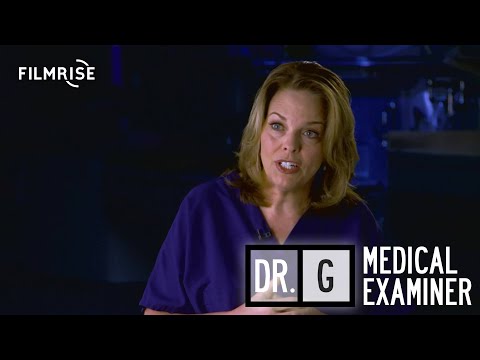
Dr. G: Medical Examiner - Season 1, Episode 12 - Dying to Be Young - Full Episode
Episode Description
A healthy 53-year-old woman is found dead in bed. After performing an autopsy and taking blood and tissue samples, Dr. G cannot find the cause of death.
A Florida medical examiner takes viewers through puzzling cases while explaining procedures and conclusions.
Read the full transcriptHide the full transcript
- [MUSIC PLAYING] NARRATOR: A vibrant woman in her 50s goes to bed but never wakes up.
- Feeling fine one minute, then dead in bed the next. NARRATOR: And the deeper Dr. G digs, the more bewildered she
- becomes. It bothers me if I don't know what happened. NARRATOR: Is this death the mystery
- that even Dr. G can't solve? Then, a 60-year-old carnival worker rides off into the darkness after a night of drinking
- and is never seen alive again. Oh, gosh. NARRATOR: Will the truth behind his death cast doubt on
- evidence gathered at the scene? I don't believe anybody until I get my findings and I see what fits.
- NARRATOR: Altered lives, baffling medical mysteries, shocking revelations. These are the everyday cases of "Dr. G, Medical Examiner."
- [MUSIC PLAYING] To 53-year-old Sandy Gromlich, her hometown of Orlando, Florida, is a virtual playground, a place
- to indulge in a carefree, child-like approach to life that warms the hearts of those close to her,
- especially her husband Alan. She made me feel great as a person. Everything about her was what I was looking for.
- NARRATOR: But on a dreary Monday morning in April of 2004, Sandy is anything but carefree.
- While picking up a new car from a dealer, she begins to argue with the salesman and erupts into a fit of rage.
- It's an event that underscores a sharp change in Sandy's personality that has been manifesting
- over the previous few months. She was really getting stressed out a lot. She'd be irritable.
- And a lot of times, she will be looking for something and she couldn't find it. Then she'd really get upset about it.
- NARRATOR: The next day Alan rises early and heads off to work, careful not to wake his sleeping wife.
- Later that morning, he phones from work. But it's not Sandy who picks up the phone.
- ALAN: It was my neighbor answered the phone. I thought I had the wrong number at first.
- She asked me if I could come home. I said, why? You know? And she just said, just come on home.
- NARRATOR: Worried and confused, Alan heads straight home. When he arrives, an ambulance and a police cruiser
- are parked outside. There is a deputy in the front yard and everything. And he started telling me that he had some bad news for me.
- NARRATOR: The deputy tells Alan that his wife Sandy is dead. I felt like I just wanted to scream and yell.
- I couldn't do anything. I just-- you know, I says, well, I need to see her. He took me in house.
- She was laying n the bed, just like she was sleeping. I just went into shock, just about.
- I don't know. I mean, I just couldn't believe it. NARRATOR: And Alan isn't the only one who considers
- his wife's demise a mystery. The morgue's field investigators find no clues that even
- begin to explain the death. DEAN SMITH: Non-smoker, non-drinker, takes no drugs.
- There is nothing suspicious at the scene. It's just a sudden, unexpected death. NARRATOR: Sudden and unexplained, the death of Sandy
- Gromlich becomes the business of Chief Medical Examiner, Dr. Jan Garavaglia, better known as Dr. G.
- This morning, we have a 53-year-old woman. No medical history, no major complaints.
- Nothing really to go on, except the circumstances of death, of just feeling fine one minute and dead
- in bed the next. NARRATOR: But the report does give Dr. G a picture of Sandy's final night.
- She goes to bed with a hat on, to cover her ear and head and to prevent the AC from hitting her.
- And she wears plastic teeth covers to prevent her from grinding her teeth. I used to have that problem.
- NARRATOR: Nothing seems unusual until she reads about something that happened after Sandy fell asleep.
- At 2:30 AM, Sandy's husband, Alan, is awakened by an odd sound. [COUGHING] ALAN: I heard a noise.
- She was coughing or something. And I wasn't sure what it was. I was still half asleep.
- I thought she was snoring. NARRATOR: Dr. G theorizes that the sound Alan heard at 2:30 AM
- may have been Sandy's dying breath, a small piece of information that could indicate
- the exact time of her death. Supposedly, he just left for work. And when a-- I don't know.
- He probably didn't know she was probably already dead. NARRATOR: As she continues the exam,
- Dr. G finds no bruises or injuries. No anterior wrist scars, no vascular scars. Nostrils dry, no vomitus or blood in the mouth.
- NARRATOR: Given the peculiar circumstances of Sandy's death, she isn't surprised that the external exam
- produces no leads. OK. We ready? You took her picture? NARRATOR: It's during the internal exam
- that she expects to find the cause of Sandy's death. Dr. G uses a Y incision to cut through the chest
- and expose the abdominal cavity. Her blood is kind of clotted, but it looks postmortem.
- And the heart is 350. The rest of her concerns don't look so bad. NARRATOR: As the internal exam progresses,
- an unusual scenario is taking shape. Dr. G can find nothing to explain Sandy's death.
- Yeah, we're not finding much, unfortunately. NARRATOR: Of the nearly 6,000 cases that are referred
- to the morgue each year, less than 1% fail to reveal the cause of death. Will Sandy Gromlich be one of these cases?
- Coming up, Dr. G embarks on one of the longest investigations of her career. It was just getting to be a mystery
- why this woman just died. NARRATOR: And later, a toppled bike, a dead body, no witnesses.
- What or who killed William Manning? When "Dr. G, Medical Examiner" continues. [MUSIC PLAYING]
- After performing a complete physical autopsy on 53-year-old Sandy Gromlich, Dr. G still
- doesn't know what killed her. The lack of clues is disheartening for Alan Gromlich, Sandy's husband,
- who desperately hopes to find an explanation behind his wife's sudden death. I needed some kind of answer, the cause her death.
- And it wasn't helping me not knowing what the problem was. [MUSIC PLAYING] NARRATOR: With the physical autopsy complete,
- Dr. G turns to the microscope. Sometimes we find things under the microscope that we don't expect.
- So you certainly have to do complete microscopic examination. NARRATOR: Tissue samples taken by Dr. G during the autopsy
- are mounted on slides by the morgue's laboratory for further investigation. She is especially interested in the samples of Sandy's heart.
- I put in maybe 20, 30 slides of just her heart, because that's one area that can cause you to die suddenly.
- NARRATOR: But after hours of scrutiny on a microscopic level, Sandy's heart yields no clues.
- For Dr. G, it's another dead end. There is only one other avenue left that might provide some answers--
- the toxicological screening. I was hoping toxicology would give us the answer, because I
- didn't have the answer. NARRATOR: But to Dr. G's surprise, not one suspicious substance is found in Sandy's system.
- It was just getting to be a mystery why this woman just died. NARRATOR: Dr. G now faces a difficult choice.
- Leave the case open, or declare Sandy Gromlich's death a mystery forever. I want to know what happened.
- It bothers me if I don't know what happened. I feel-- I guess, in a way, I do feel like I'm--
- I don't want to say I'm failing. But I want the right answer! I don't-- I can live with the fact if I don't get the answer,
- but I have to put all my effort into getting the answer. NARRATOR: Before making her decision,
- she phones Sandy's husband to discuss the prospect of declaring the case undetermined,
- and to see if he can provide any insights into her death. What she hears is a man who is still very much in love.
- ALAN: It was fate. I know it was. You know, it was like destiny, that we were supposed to meet.
- I don't know. I just-- we were there for each other all the time. I mean, she was worried about me if I got sick.
- And we both were so close to each other. We loved each other. It's hard to explain.
- I mean, I'd take a half hour saying good night to her, just giving her a kiss, you know?
- DR. G: He is very much in love with his wife. And all of a sudden, she was plucked from him.
- And that's hard enough. But when you don't know why he doesn't have her, it was very, very difficult for him.
- I had to warn him, maybe we could just leave this undetermined. And he couldn't.
- He says, we're going to just keep working and working. And at that point, you just know that he just--
- he needs an answer. NARRATOR: Dr. G decides to keep the case open and to continue talking to Alan, her only remaining lead.
- The decision soon pays off. In a series of phone calls and face-to-face meetings
- over a period of weeks, Dr. G begins to uncover surprising new information never reported in the field investigator's dossier.
- I think he started thinking about what she was like before she died. And he was telling me stories about how normally,
- she was a very sweet woman. And then she would have these outbursts. And in fact, that day, she was having
- crying outbursts for no reason just picking up their car that they had bought. And, you know, the man at the dealership really
- didn't know how to deal with her. NARRATOR: And mood swings are only the tip of the iceberg.
- ALAN: And she had headaches, too. She had insomnia. She couldn't sleep at night.
- She'd lay on her lounge chair and couldn't go to bed for two or three hours. NARRATOR: Then, while examining one of Sandy's photos
- during one of Alan's visits to the morgue, Dr. Jean makes a chilling discovery. DR. G: I said, you know, her hair
- looks so full in this picture. And yet, it didn't look that full at autopsy. He goes, oh, yeah, her hair.
- She was losing her hair. NARRATOR: Losing it so fast, says Alan, that Sandy started wearing a wig.
- But it's Alan's next recollection that proves most disturbing of all. He goes, you know, a few weeks prior to her dying,
- she was having heart palpitations. NARRATOR: It's a stunning revelation that Alan
- thought nothing of at the time. I just thought it was some kind of normal thing,
- because I started to have them, too. NARRATOR: Alan then claimed that his own heart palpitations
- stopped when Sandy died. To Dr. G, Sandy's strange assortment of seemingly minor and disconnected symptoms
- are nothing short of a revelation. Mood swings, insomnia, hair loss, and heart palpitations
- can be the result of a hormonal imbalance. To Alan, the theory that Sandy may have been physically unwell
- seems impossible. He insists that Sandy's health was excellent. He's saying, you know, she's really healthy.
- She's a really healthy woman. There's nothing wrong with her. NARRATOR: As Alan elaborates on his wife's exceedingly healthy
- lifestyle, he inadvertently reveals a clue that could break the case wide open. Sandy took a wide variety of vitamins
- and dietary supplements daily. I go, oh. So we all take supplements of some type.
- Of lot of us take vitamins or-- and then he starts talking more about these supplements.
- And I said, oh, how many supplements did she take? And he said, a lot. NARRATOR: A lot turns out to be over 40 each day.
- 20 in the morning, 20 in the evening, and maybe some at lunch. At this point, I was already convinced
- that these supplements had to play a role, basically by the sheer volume. NARRATOR: Coming up, Dr. G becomes frustrated by the lack
- of medical information about Sandy's supplements, and turns to an unlikely ally to crack the case.
- In this case, I'd had to go back to her husband and start talking to him, because sometimes
- they will give you a clue. NARRATOR: And later, a man riding his bike from a friend's house is found
- dead on the side of the road. They looked at me and told me that he was gone. NARRATOR: Was his death an accident?
- When "Dr. G, Medical Examiner" continues. After four months, Dr. G has made a breakthrough in the case
- of 53-year-old Sandy Gromlich. She now knows that Sandy was taking over 40 dietary supplements daily.
- And she suspects that one or more of them contributed to the hair loss, mood swings, heart palpitations, and-- perhaps
- ultimately-- her death. Now, the only question left is which one. More than half the US adult population consumes some kind
- of nutritional supplements, from basic herbal extracts to human growth hormones.
- But for such a large industry, there is little federal regulation, strict testing, or evaluation
- that traditional drugs must adhere to. That leaves Dr. G with no one place to turn to find information on the 40 substances
- that Sandy Gromlich was taking. So she and Alan decide to proceed on their own. Their first task?
- Determine exactly what supplements Sandy was taking and where they came from. Alan begins by going through receipts.
- As he does, he finds that Sandy had been spending over $200 a month on supplements, purchasing many of them online.
- She's getting some of this stuff from another country you can't even get here. It's outlawed here.
- NARRATOR: Finally, after months of research, one supplement begins to stand out--
- DHEA. DHEA, often referred to as the mother hormone, is produced naturally in the human body
- and reaches peak levels in our 20s, then gradually decreases as we age. It's a naturally occurring substance in your body.
- It's the precursor to making estrogen and testosterone. NARRATOR: Since physical maladies accelerate as DHEA
- declines in the body, some scientists have speculated that DHEA dropoffs may be responsible for many age-related illnesses
- in recent years. Some supplement manufacturers have offered DHEA as a new fountain of youth remedy
- that they suggest may help prevent everything from obesity to heart disease, and even aging itself.
- Apparently, Sandy Gromlich believed exactly that. Sunny Florida! ALAN: She thought it would help her age
- and keep wrinkles down and live a lot longer. The stuff sounded pretty good. I mean, I want to stay young, too.
- NARRATOR: But while Alan's and Dr. G's DHEA research turns up numerous ads and articles
- praising the supplement, they find little information on its negative side effects.
- ALAN: I looked for five or six months for some of them. I couldn't find anything.
- You can find all the hype that tells you how great they are, but it was really hard finding any good data on,
- what are the side effects? NARRATOR: What she does find is anecdotal evidence that larger
- doses of DHEA, especially when taken in combination with other dietary supplements, may actually have serious side
- effects, many of the very symptoms that Sandy suffered in the months prior to her death.
- DR. G: We found something that talked about a man who was fine, not known to have any heart problems,
- and started to get rushed to a hospital because of some heart arrhythmias and palpitations.
- They actually took him off the DHEA and they went away. They actually, then, to see if they'd come back,
- put him back on it. And they did. And the heart arrhythmias came back. NARRATOR: Doctors know that substances like DHEA
- can actually influence the contraction of the heart muscle by causing abnormal electrical signals.
- It's been suggested by some experts that when DHEA is taken in large amounts, especially in combination with other dietary compounds,
- it may trigger the heart to beat chaotically and ineffectively. Such an arrhythmia can be fatal, even the first time it occurs.
- DR. G: If you really delve into DHEA, it is irritable to the heart. It's a loud one.
- NARRATOR: Apparently, Sandy and her husband Alan-- who took DHEA as well-- both complained of heart irregularities
- while using the supplement. But Dr. G's suspicion that Sandy's death may have been
- caused by taking large amounts of DHEA chronically will remain a theory until she can prove whether Sandy had
- abnormal levels of the hormone in her system at the time of her death. She asks the toxicology lab to recheck Sandy's blood.
- The tests come back, but they are not abnormal. DR. G: It was negative. The toxicology was negative.
- But the problem is those results may not be accurate. NARRATOR: The lab informs Dr. G that Sandy's post-mortem blood
- samples have degraded too much to be able to detect DHEA, even if the hormone was in her system at a high level
- at the time of her death. So we're left with we're not really sure, but medicine doesn't always have an answer.
- The science isn't always there to back you up. And just because the science isn't there
- doesn't mean I can't believe it, because the circumstances are also telling me what's going on here.
- So there is definitely an art to medicine. ALAN: Sandy with her t-shirt on. You don't see that very often in December.
- ALAN: That's for sure. [WHOOPING] NARRATOR: Despite the lack of any concrete findings
- in the investigation of the death of Sandy Gromlich, Dr. G believes that she has a strong enough circumstantial
- case to explain what happened to Sandy on the night of her death. In the pursuit of youth and health,
- Sandy becomes obsessed with dietary supplements. It started out maybe 5, 10 tablets a day, you know?
- Then it got up to 40, about. NARRATOR: One of the supplements she consumes daily, at seven times the recommended dosage,
- is the hormone DHEA. She was taking very, very large amounts of it. ALAN: She couldn't swallow them.
- She always had a hard time swallowing any kind of pill, so she would crush them up with pliers.
- NARRATOR: Soon, Sandy is suffering from hair loss, insomnia, heart palpitations, and mood swings.
- All of these symptoms are in evidence on the last day of her life. That evening, Sandy takes another large dose
- of DHEA, along with many other dietary supplements. While Dr. G cannot be certain, she suspects
- that as Sandy slept that night, the excessive amounts of DHEA-- possibly in combination with other supplements--
- finally take their toll on Sandy's heart. Under the influence of DHEA and other compounds,
- the normal contractions of Sandy's heart muscle are compromised. Rhythmic heartbeats become chaotic constrictions.
- And as a result, blood is not pumped. [MUSIC PLAYING] Her body and brain are starved of oxygen
- and Sandy begins to die. At 2:30 AM, Alan is awakened when Sandy makes an unusual noise in her sleep.
- It is likely her last breath. ALAN: She evidently had passed away that morning when
- she made that coughing noise. NARRATOR: For Alan, it is a painful farewell. But the knowledge serves as a warning
- about the lifestyle both he and his wife were leading. Your body is a beautiful thing.
- It regulates itself most of the time. And we don't need to be pumping in massive quantities
- of supplements. NARRATOR: Most importantly, Alan credits Dr. G with helping him finally close the book on the most tragic and heartbreaking
- episode of his life. She's gone out of her way to help me out, to try to find some kind of closure for her.
- I felt that I was her last physician. And if he needed to talk to me about her and about
- what happened, that he could call me anytime. NARRATOR: Eight months after Sandy
- died, Dr. G and Alan meet in person to discuss the case once again. Hi, Mr. Gromlich, how are you?
- Nice to see you. Now, can I prove that she died from this? You understand I can't.
- Right. But I have to go with the preponderance of the evidence. Probable cardiac arrhythmia due to excessive supplement use.
- Just as long as you know that I can't prove it. But I think some things, you just can't prove in life.
- But yet you just kind of know in your heart that it's what it is. That's the way I feel about it.
- I mean, it-- DR. G: The symptoms and the preponderance of evidence really point to a cardiac arrhythmia.
- We have to kind of read in between the lines a little. It's a little bit of a leap of faith, but we--
- I think it's helping her husband cope with this, to understand that this is most likely the explanation.
- ALAN: I still cry every day, really. But by finding this stuff, I think it's going to give me
- some kind of closure. I know Dr. G has really helped a lot on that. I think if you never know, it's difficult to move on.
- And I think, at least, that part can be settled down for him. And he can get on with the grieving and going on.
- NARRATOR: Coming up, a dead body is discovered by the side of a road. It appears to be a straightforward case,
- until Dr. G makes a shocking discovery. What do you think about this break? NARRATOR: When "Dr. G, Medical Examiner" continues.
- A steamy summer evening in June. A perfect time in Orlando to share a few beers with friends on the porch.
- 60 years old and homeless, part-time carnival worker, William Manning, doesn't have his own porch.
- But he's got a few friends who enjoy his company. They know him simply as Shorty.
- We're at my neighbor's house. And Shorty was there to visit him. And I was there.
- We're all socializing, had a few beers. He was doing his laundry. And we're just talking, socializing.
- CINDI: Everybody loved to see Shorty come in, because he was always so sweet and in a good mood.
- He'd make you feel better if you had a bad day. NARRATOR: Four hours later, the get-together is winding down.
- Shorty, a lifelong alcoholic, has had quite a bit to drink. NORMA: Must have been about 10:30 or 11 o'clock.
- I told him I was going in to go to bed. I tried to get him to come in and lie down on the couch.
- I said, Shorty, if you want to spend the night at my house, you're more than welcome to sleep on my sofa.
- But he decided he wanted to go. NARRATOR: Insisting on visiting another friend, Shorty hops on his primary mode of transport, his bicycle.
- He rode his bike at least 10 miles, if not more, every day. He loved that bicycle.
- NARRATOR: With his laundry loaded into the basket, Shorty pedals off into the dark.
- An hour later, the wail of an ambulance cuts through the night. A neighbor who lives just around the corner from
- the get-together has called 911 after making a frightening discovery-- a bicycle lying in a ditch and nearby, a man's body.
- As EMS arrives, the woman recognizes the man. It's Shorty and he's dead. CINDI: They looked at me and told me that he was gone.
- That was their words. He's gone. And then I just couldn't believe it. I just-- probably like a shock thing.
- I just didn't know what to do. NARRATOR: Awakened by the commotion, several of Shorty's friends from the get-together that evening
- come outside, where they learn of the news. I'm thinking no, no. This can't possibly-- this is not true.
- There ain't nothing wrong with him. I just saw him. I just left him. And the next thing you know, he's dead.
- NARRATOR: The scene unfolds with the turmoil inherent in most death investigations-- the police, morgue field
- investigators, and onlookers coming and going, all with questions but few answers
- as to how Shorty died. And one other question lingers as well. Did Shorty have any family?
- My neighbors were coming over and we were trying to figure out how to get in touch with, like--
- if he had any family or anything. Me and another neighbor was the only two people
- that had his name and address for his mom and daughter and everything in New York.
- NARRATOR: Finally, around 1:00 AM, Shorty's only child, Linda, receives the news.
- LINDA: The phone rang. And someone was on the other end of the line, saying that they needed to talk to me.
- And the woman on the other end of the line said that she knew my dad, and that they
- think that they just found him in the ditch down the road. NARRATOR: Within two hours, the police
- and medical examiner's office wrap up their on-scene investigations. And Shorty's body, along with their reports,
- are delivered to Dr. G at District 9. OK, so we have a 60-year-old man who has been an alcoholic
- for years, like 30 years. Initially, Shorty's case appears straightforward. A bike, alcohol, a deadly fall.
- But because no known person witnessed his death, Dr. G can't be sure what happened.
- His death might have been an accident, but it also could have been from natural causes, such as a heart
- attack or even a homicide. I have to worry that-- did he fall off his bike? History of drinking, maybe he fell off.
- Maybe he didn't see the culvert. Maybe he just drove into it. Or could he have been hit by a car?
- Could be an assault. NARRATOR: While the cause of Shorty's fall remains a mystery, one detail about its aftermath
- appears to be clear. According to morgue field investigators, his body was found at the top of the cement culvert,
- or drainage ditch, 10 feet away from his bicycle. The position of a body at the time of death
- offers vital clues that often help Dr. G determine how a person died. In Shorty's case, the separation of bike and body
- suggests two things. One, that he managed to get out of the ditch. And two, that he did not die instantly.
- My investigator, my-- the detective that worked the case, hypothesized that he just fell off of the--
- fell off his bicycle into the culvert, and then crawled up out of the culvert. Possible.
- We can go with that hypothesis. But I have to make sure all the forensic evidence fits that.
- NARRATOR: She will get her first look in the external exam. OK. So he's got this kind of unkempt mustache.
- And I'm really hungry. Ooh, nice and dirty hands. Dirt under the nails. A lot of dirt under the nails.
- A little, tiny kind of ecchymosis, a little bleeding under the skin on his right arm.
- Dirt under his arms. I got to get on that side. OK, let's clean his face up. OK.
- So pretty much his whole body from the neck down is without trauma. Here, I don't see-- he has no surgical scars, no anterior
- scars. NARRATOR: For Dr. G, the absence of trauma on the lower extremities means one thing for certain.
- Shorty was not hit by a car. When a person is struck by an automobile, typically it is the legs and hips that
- sustain most of the trauma. If he had been hit with an automobile on his bicycle,
- we would expect a lot more trauma to the lower half of his body. NARRATOR: But while Shorty's lower
- extremities are without injury, Shorty's head is another story. Oh, yeah, he's got kind of a step
- down from a skull fracture. NARRATOR: Shorty's head injury is obvious, but what remains unclear is what caused him to hit his head.
- You never know. We don't know exactly what happened. We're just assuming, since the bike's not too badly hurt.
- He doesn't have any other trauma. We're assuming he fell off. He is drunk. But I have to make sure something
- else didn't happen to him. When anybody dies of trauma and they're just found outside,
- we just have to make sure there is nothing sinister happened, and that the pieces all fit together.
- NARRATOR: To get to the bottom of things, Dr. G must investigate the body further with the internal exam.
- She makes the Y incision and inspects Shorty's organs one by one for signs of anything amiss.
- She doesn't have to look far. His liver is a little yellow. It's not completely normal.
- NARRATOR: She finds evidence of a life of alcohol abuse and smoking. His lungs are all black and muddled from the smoking.
- Lot of adhesions. Broke his rib. It looks-- oh, yeah, that's an old rib fracture.
- He's fallen down before. He's got two old rib fractures here that are healing. That's consistent with an alcoholic.
- Liver, 1500. NARRATOR: However, she finds nothing potentially deadly within his body.
- So these are good. NARRATOR: Until she examines his kidneys. What has he got here.
- I'm a little worried he might have cancer. As soon as I saw it, I could tell that it was a cancer.
- 3 1/2 by 3 centimeters. NARRATOR: Dr. G will examine samples of the tumor under the microscope for further analysis.
- But from the looks of it, the cancer was not lethal, at least not that night. The cancer was confined to the kidney.
- That wouldn't be something that killed him now. It could have killed him later, if he
- didn't do anything about it. So that was always-- that's a surprise finding. NARRATOR: In order to determine Shorty's alcohol level
- on the night he died, Dr. G collects ocular fluid and blood for toxicology tests.
- And then she turns to examine the inside of Shorty's head injury. Wow. He really hit hard.
- He's just got kind of-- what we call comminuted fractures. There's like 1, 2, 3, 4, 5--
- 1, 2, 3, 4, 5. At least six pieces of-- pieces of bone that are separated from each other.
- He's fractured his bones, his frontal bones. And he's actually lacerated some of his brain tissue
- with these fractures. NARRATOR: This apparently fatal trauma raises a perplexing question.
- I guess the only remarkable thing is the walking aspect after he fell. That's amazing with that brain.
- NARRATOR: If walking or crawling with these injuries appears highly unlikely, what Dr. G discovers
- next is utterly impossible. Oh, my god. NARRATOR: Coming up, another surprising discovery
- deepens the mystery surrounding Shorty's death and challenges Dr. G's faith in evidence gathering.
- I don't believe anybody until I get my findings and I see what fits. NARRATOR: When "Dr. G, Medical Examiner" continues.
- Bicycling in the dark after a night of drinking, transient William "Shorty" Manning
- is found dead by a neighbor. According to the investigator's report, his body was discovered at the top of a concrete culvert,
- his bike at the bottom. But in the autopsy, Dr. G discovers severe fractures in Shorty's skull, raising serious questions
- about how he managed to get out of the culvert before he died. It is a mystery Dr. G will be hard
- pressed to explain, especially after what she finds next. DR. G: Oh, my god. What do you think about this break?
- He's got a fractured neck. We're going to have to look at his spinal cord, because it wouldn't make sense that he
- crawled up out of that hole. NARRATOR: With the organs removed from Shorty's body,
- Dr. G has a clear view of his spine from the inside. And what she finds astonishes her.
- His spinal cord, the soft tissue bundle of nerves that rest within the bones of the spinal column,
- is nearly severed. And the injury is at an especially critical position in Shorty's spine--
- his neck. DR. G: He had a fracture at C4, at the fourth cervical vertebrae. So from the top of the head, counting down four,
- that's where it fractured. If you get an injury severe that actually hurts the spinal cord
- high enough above-- C4 or above, you would be a quadriplegic. NARRATOR: For Dr. G, Shorty's body
- position at the time of his death defies explanation. That's not how he got out of the culvert.
- Just unbelievable. I know, it's unbelievable that he could get out of that culvert after that.
- Based on what I saw at C4, he really could not have crawled up with that injury.
- NARRATOR: At least the riddle doesn't affect Dr. G's basic conclusions. Shorty died of two injuries, brain
- trauma and a lacerated spinal cord at the C4 vertebrae. As for the position of his body at the time of death,
- it remains a nagging mystery for Dr. G. The apparent discrepancy does not sit well
- with Shorty's daughter, either. LINDA: I wanted to know more about what happened,
- and if somebody had done something to him to hurt him, or somebody moved him themselves or something
- like that, you know? It seemed odd. Did-- did somebody try to help him, bring him out of the ditch
- or whatever? Because he couldn't have got out there himself. That was-- that was a little tough.
- NARRATOR: Then, several weeks later, the woman who discovered Shorty's body on the night
- of his death offers new information not gathered at the death scene. Information that finally solves the medical mystery of how
- Shorty got out of the ditch. I got new information to say what I was originally told
- is not the truth. NARRATOR: At last, Dr. G can explain the whole story of Shorty's death.
- That night, Shorty drinks heavily at his friend's house. Toxicology tests put Shorty's blood alcohol level at 0.3,
- more than three times the legal limit, and enough to require hospitalization in some people.
- Shorty's motor skills are shot. His vision is blurred. His judgment is impaired.
- Rather than sleep off the alcohol, Shorty hits the road on his bicycle. But in just a few yards, he turns a corner.
- He likely loses his balance. The load of laundry in his basket probably magnifies the swerve.
- He plummets into a culvert and onto the concrete below, headfirst. The impact shatters Shorty's skull.
- Pieces of bone lacerate his brain. The fall also wreaks havoc on his C4 vertebrae.
- DR. G: He hit really hard. His fracture was so severe that he actually did have a tear, partial transection of the spinal cord itself.
- NARRATOR: The injury stops his breathing and Shorty dies. Approximately an hour later, a neighbor
- discovers Shorty's body not in the yard, but in the culvert beside her home. When EMS arrive, they are the ones
- to pull him out of the ditch in an effort to revive him. Later, police arrive and find the body lying in the yard
- where EMS left him. But because they never see him in the culvert, their final report states incorrectly
- that Shorty was found at the top of the culvert, not in it. This small but critical misinterpretation
- is passed to the medical examiner's field investigator, and, in turn, to Dr. G. The eyewitness, the person who found him, said, no.
- He was at the bottom of the culvert and he was brought up. And that makes a lot more sense.
- And that fits what I found at autopsy. NARRATOR: The scene of a death is full of people
- exchanging information-- witnesses, detectives, police officers, EMS, and the medical examiner's field investigator,
- all observing different things at different times. With roughly 1,500 deaths investigated by Doctor G's
- office alone each year, minor miscommunications and discrepancies are inevitable.
- DR. G: EMS, my investigators, the detectives, the eyewitnesses are all telling me things.
- What I have to do is take all that information and take it with a grain of salt.
- I don't believe anybody until I get my findings and I see what fits. CINDI: I knew someday that my dad would die
- and the cause of the death would be somehow related to his drinking problems. Knowing now that it was--
- that he actually did die in the ditch, and that he was just brought up to help him,
- it is good to know that. But there's nothing really nice about losing someone, you know?
- [MUSIC PLAYING]
Brief Summary
Dr. G investigates the mysterious deaths of Sandy Gromlich and William Manning, revealing the dangers of excessive supplement use and miscommunication in death investigations.
Key points
- The Mystery of Sandy Gromlich. A vibrant woman suddenly dies, leaving her husband and Dr. G searching for answers.
- Dr. G's Investigation. Dr. G embarks on a challenging investigation into Sandy's unexplained death.
- The Role of Supplements. Dr. G discovers Sandy was taking over 40 dietary supplements daily, raising concerns.
- A Heartbreaking Farewell. Alan reflects on his love for Sandy and the tragic circumstances of her death.
- Shorty's Tragic Death. William 'Shorty' Manning is found dead after a night of drinking and biking.
- Dr. G's Investigation. Dr. G uncovers shocking details about Shorty's death, raising more questions than answers.
Episode highlights
- The Mystery of Sandy GromlichA vibrant woman suddenly dies, leaving her husband and Dr. G searching for answers.“Feeling fine one minute, then dead in bed the next.”0:20May 18, 2021
- Dr. G's InvestigationDr. G embarks on a challenging investigation into Sandy's unexplained death.“Will Sandy Gromlich be one of these cases?”6:54May 18, 2021
- The Role of SupplementsDr. G discovers Sandy was taking over 40 dietary supplements daily, raising concerns.“She was taking very, very large amounts of it.”21:56May 18, 2021
- A Heartbreaking FarewellAlan reflects on his love for Sandy and the tragic circumstances of her death.“I still cry every day, really.”25:15May 18, 2021
- Shorty's Tragic DeathWilliam 'Shorty' Manning is found dead after a night of drinking and biking.“They looked at me and told me that he was gone.”28:16May 18, 2021
- Dr. G's InvestigationDr. G uncovers shocking details about Shorty's death, raising more questions than answers.“Oh, my god.”36:10May 18, 2021
Tension
75/ 100High tension