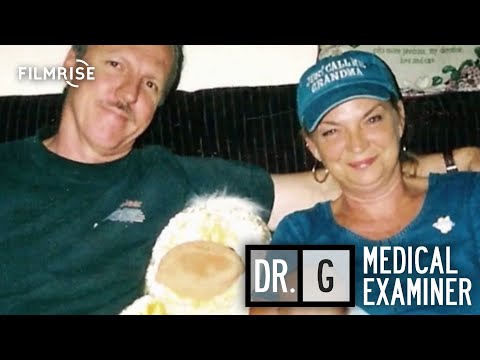
Dr. G: Medical Examiner - Season 2, Episode 12 - Kiss of Death? - Full Episode
Episode Description
After a brief illness, 34-year old Claire Jackson dies suddenly in the hospital from massive liver failure and winds up in Dr. G’s morgue.
A Florida medical examiner takes viewers through puzzling cases while explaining procedures and conclusions.
Read the full transcriptHide the full transcript
- [MUSIC PLAYING] NARRATOR: A healthy woman rapidly succumbs to a virulent illness.
- She gets antibiotics and ends up in the hospital. A week after that, dies. NARRATOR: Her body is covered with dozens
- of raw, oozing sores. DR. G: Well, I looked at the body, and I'm kind of, like, taken aback.
- She's got these vesicles all over her. Oh, gosh. NARRATOR: Can Dr. G identify the deadly disease
- and find its source? I have never seen a case like this, and I know I will never see another case like this.
- NARRATOR: And then a woman helps her husband recover from what appears to be a routine epileptic seizure.
- I said, are you sure you don't want me to call 9-1-1? No, no. No, no. I'll be all right if you just let me sleep.
- NARRATOR: But this time, he never wakes up. DR. G: She felt horrible. I knew that she was going to be dealing with some guilt right
- from the start. NARRATOR: Altered lives, baffling medical mysteries, shocking revelations.
- These are the everyday cases of Dr. G, medical examiner. It's just after 8:00 AM at the District 9 morgue in Orlando,
- Florida, and preparations for the day's work are in full swing. OK. We need-- NARRATOR: When chief medical examiner
- Jan Garavaglia arrives, she and her staff size up the day's cases. We've got three to x-ray.
- NARRATOR: Dr. G's first autopsy will be the case of a 34-year-old woman who died
- a bizarre and unexpected death. Claire Jackson was transferred to the District 9 morgue
- last night after she died in the hospital due to a sudden illness, which appears to have
- caused massive liver failure. We have this woman, and we've gotten her from the hospital.
- And the doctors don't know why she died. She's in fulminant liver failure. It's massive death of your liver, and they don't know why.
- NARRATOR: According to Dr. G's investigator's report, the woman's ordeal began approximately one week earlier.
- Claire Jackson is feeling sick. She visits her doctor complaining of a fever, diarrhea, nausea, and pain in her mouth.
- Her physician suspects she may have a minor infection. He prescribes an antibiotic and a painkiller
- and sends her home to rest, but the treatment is ineffective. A week after she gets the antibiotic,
- she just gets sicker and sicker. She goes to the hospital and they thought she was septic, or, you know, bacteria in her blood.
- NARRATOR: Suspecting that Claire has developed an aggressive bacterial infection called septicemia,
- doctors rushed to treat her with powerful antibiotics. But Claire's condition quickly spirals out of control.
- Within only hours, her vital organs, including her liver, begin to fail, and she is put on life support.
- Barely alive, she begins to develop a strange rash, and by the next day, Claire is dead.
- The hospital is baffled by the woman's swift decline. Their suspicion? She died from septicaemia, a massive and often catastrophic
- bacterial infection in the bloodstream, which caused her liver to fail. So that's what I've got, and they don't know.
- They don't have anything diagnosed, really, in the hospital. NARRATOR: For Dr. G, the death of Claire Jackson
- is a mystery with no easy answers and no clear hypothesis. She begins immediately with the external examination.
- On the exam table, Dr. G gets her first look at Claire Jackson's body, but it's not at all what she expected.
- Well, I walk over to the body and I'm kind of, like, taken back. She's got these vesicles all over her, like-- like blisters
- on her skin. And I'm like, nobody told me about this. I was shocked. I mean, when I'm looking at the chart,
- when I'm reviewing medical records, they don't mention that. They mentioned some kind of crusted thing on her forehead,
- but she's got like 50 of them on her face, on the backs of her arms, on her back.
- NARRATOR: In her 20 years as a medical examiner, Dr. G has rarely seen a body with such
- an unusual affliction. DR. G: She looked really sick. I mean, when I looked at her, she looked really sick.
- Her gums were all red. She had lesions on the gums. Her teeth were actually even falling out of the gums.
- Oh, gosh. She looked very, very bad. NARRATOR: Dr. G has no explanation for Claire's condition or what would cause it.
- But to her, it certainly does not look like a bacterial infection as the hospital thought.
- However, she does learn from Claire's medical records that the victim had her own theory
- about her strange illness, a very unusual theory. According to Claire, two weeks earlier she
- was having a drink at a local bar when she kissed a man she had recently met, and then he bit her.
- Claire believed that whatever made her sick, she caught from the bite. Ugh, you know?
- Is it some kind of assault? What did she die of? NARRATOR: Death from a human bite
- would be highly improbable, but at this point Dr. G needs to pursue any lead she can find.
- First, she carefully inspects Claire's mouth for any signs of a bite mark. Inside of her mouth looked horrible.
- The mucosa was sloughing off. She had these all sort of lesions. Bad teeth. NARRATOR: And yet, Dr. G finds no scarring
- to corroborate Claire's claim. And I'm looking, because I have a history of a bite,
- and I didn't find it. NARRATOR: With another theory apparently off the table, the mystery only deepens.
- But there was another potential culprit Dr. G can pursue. Claire has a history of cervical cancer,
- which required a hysterectomy and genital surgery. DR. G: She's got a large abdominal scar going down
- basically from her belly button down to her bone-- pubic bone. And then we also have that she's got a history
- that the cancer had recurred and was on the outside of her genitalia. They had to do vulvectomy, remove
- some of the external genitalia. NARRATOR: But until she examines the body internally,
- Dr. G has no clear answers as to whether the cancer was Claire's killer. A supposed bite, unusual lesions on the skin, cancer.
- At the close of the external exam, the woman's case remains baffling. DR. G: None of it was making sense.
- What exactly is going on, I wasn't sure. NARRATOR: However, Dr. G believes she might have a viable, albeit tentative,
- diagnosis as to the cause of her strange disorder. Well, you know, I am looking--
- I'm looking at her, and I'm thinking could it-- it might be chicken pox. It might have been chicken pox that killed her.
- NARRATOR: Chicken pox, known clinically as the virus varicella zoster, is typically thought
- of as a benign childhood rite of passage which causes a rash of itchy welts and a fever lasting about a week.
- But for reasons unclear the disease can be exceptionally virulent and even deadly
- for certain individuals. Especially vulnerable, according to Dr. Mark Wallace, are newborn babies and adults.
- The older you are when you acquire chickenpox by and large, the more severe it is.
- Sometimes when neonates acquire it, babies that are born to mothers with chickenpox, that can be quite severe,
- but that's sort of an exception. NARRATOR: Because chicken pox is easily spread by direct contact
- or through the air from a sneeze or cough, Dr. G knows that Claire could have been infected just about anywhere and never known it.
- One way she can test if Claire was infected with chickenpox is to take samples of the pustules themselves,
- and that's where she turns next. I had to do some special procedures, because I wanted
- to know what the infection was. NARRATOR: Coming up, Dr. G inspects slides from Claire's sores and discovers that her death seems
- to defy medical possibility when "Dr. G, Medical Examiner" continues. [MUSIC PLAYING]
- At the District 9 morgue in Orlando, Florida, chief medical examiner Dr. Jan Garavaglia
- is working on her first autopsy of the day, the case of Claire Jackson. Her next step is to collect a sample
- from one of the many sores that covered the woman's body to examine later under the microscope.
- DR. G: I took one of her vesicles and I opened it. I broke it open and scraped it so I could see the cells
- that were inside that vesicle. NARRATOR: The woman died yesterday in the hospital
- after a rapid onset of a bizarre illness that she believed was caused by a human bite during a kiss.
- However, Dr. G found no evidence of a bite mark in the external exam, and she suspects
- instead that Claire's death may have been due to chickenpox. She had an infection that was-- that was killing her.
- It was pretty obvious by looking at her. NARRATOR: But there's also the lingering
- possibility that Claire died from a relapse of cervical cancer. Chicken pox or cancer?
- It's a question that can only be answered by completing the internal examination.
- DR. G: OK, we ready? You took a picture? You did. NARRATOR: Claire's body is opened
- with a Y-incision from the shoulder blades to the pubic bone. Immediately, the extent of her illness is apparent.
- Well, when you open her up, she just looks sick. Sick on the inside, just like she looked sick on the outside.
- NARRATOR: Dr. G draws toxicology samples and then begins her search of Claire's body
- cavity for any signs of recurring cancer. As medical records indicated, Dr. G find several of Claire's reproductive organs
- previously removed as a result of the disease. Internally, she has no uterus, tubes,
- or ovaries, which goes along with her history of cervical cancer. NARRATOR: But she finds absolutely
- no evidence of a relapse. DR. G: There was no cancer. NARRATOR: Dr. G is now confident that the woman's rapid death
- was not due to a cancer relapse. Could it have been from chicken pox? OK. So the right is 500--
- NARRATOR: She isn't sure, but then she sees Claire's liver. DR. G: Her liver was-- had kind of a pitted surface.
- It was somewhat soft and round. Her liver does not look good. NARRATOR: It's obvious that Claire succumbed
- to liver failure, just as the hospital indicated in its records. Dr. G now needs to find a link between Claire's liver
- and chickenpox, but infections like chickenpox can only be positively identified
- through lab analysis. Oh, right. NARRATOR: Dr. G must take tissue samples of Claire's liver
- and send those to the lab, along with the skin scrapings from the vesicles, to have microscopic slides prepared.
- DR. G: So we've got to put it all together. We've got the vesicles. We have the vesicles on her skin,
- the vesicles in her mouth, the mucosa sloughing off. We've got pretty much dead-looking liver.
- And what does it all mean? NARRATOR: She must wait several weeks to find out. [MUSIC PLAYING]
- I just have-- I have the one from today for the death certificate. First thing I got back was I got the slides stained
- of the vesicle that I scraped. Yeah. [INAUDIBLE] And it's-- it's-- you see these kind of--
- these cells almost kind of look like they fuse. It's big cells, and then they have
- a-- like a little glob of kind of pink purple stuff, and that shouldn't be there.
- Your cells shouldn't have these pink purple globs, and the cell's kind of enlarged.
- And they look like several of them together. NARRATOR: Claire's liver samples and blood
- cultures are abnormal as well, and they all point to the same disease. But it's not chicken pox.
- It's something Dr. G never expected. It had the characteristic findings for herpes.
- NARRATOR: But the type of herpes Dr. G finds in Claire's body is herpes simplex type 1, or oral herpes,
- one of the most common viral infections in the world. Unlike genital herpes, herpes simplex type 1
- is not considered a sexually transmitted disease because it is usually contracted through casual contact
- in childhood. Typically, the virus causes only localized cold sores on the face, lips, and gums.
- The idea that such a common virus, which usually remains localized on the mouth, could have spread through Claire's
- entire body and caused her death seems almost impossible to believe. DR. G: Herpes, systemic herpes infection?
- That's-- you know, I'm thinking, that's got to be ridiculous. I've never heard of, you know--
- I mean, she's a healthy woman. I don't-- I don't know why she would get systemic herpes infection.
- NARRATOR: It's impossible, and yet there it is on the slide. For Dr. G, the unbelievable finding begs one question.
- Why? Why does she have herpes all through her body? I mean, I'm like, I don't know.
- NARRATOR: Coming up next, the hunt for answers to Claire Jackson's stunning death
- leads Dr. G to a shocking conclusion. I really couldn't get a handle on why she would be get systemic herpes.
- NARRATOR: And later when an epileptic man dies after a seizure, his wife is stunned
- by what killed him and blames herself for his death. If I'm such a smart nurse, why didn't I notice your symptoms?
- NARRATOR: When "Dr. G, Medical Examiner" continues. [MUSIC PLAYING] In the case of Claire Jackson, Dr. G
- has two findings that seem to contradict medical science, the death of a woman and absolute proof
- that a massive herpes simplex 1 infection killed her. Her herpes took off and went all over her body.
- She has acute fulminant liver necrosis from the herpes. NARRATOR: But now Dr. G might finally
- have a logical explanation. After consulting with her staff and other infectious disease
- experts, Dr. G theorizes that herpes might have become lethal in Claire because her immune system was
- somehow significantly weakened. To me, to-- one reason for her to have systemic herpes
- would-- maybe she's immunosuppressed. In the cases that I could find, the only people
- who really get it systemically are immunosuppressed people, people whose immune system
- can't control this virus. And I thought, well, what could have acutely caused her becoming immunosuppressed?
- Well, AIDS is one of them. So immediately, I order an HIV to see if maybe she's immune--
- has an immune problem. NARRATOR: Dr. G asks the lab to recheck samples of Claire's blood for HIV,
- the virus that causes AIDS. This could be the explanation she needs in the case.
- HIV and AIDS could have inhibited Claire's ability to fight off the infection, rendering
- even the most benign viruses like herpes simplex 1 a potential killer. But when Dr. G receives the results from the lab,
- once again, she's taken aback. DR. G: It was negative. She wasn't-- she didn't have AIDS.
- She didn't have the virus that would cause immunosuppression. I cannot explain that.
- I had experts that I contacted. I cannot explain why, with her, it went all over her body.
- I thought surely she had to be immunosuppressed. I thought surely she must have AIDS, uh, something
- that would cause immunosuppression. And I don't have an answer on why it happened to her.
- NARRATOR: Despite her lack of answers as to why, she does make one shocking inference into how Claire
- might have contracted herpes. After reviewing the entire case, Dr. G believes that Claire was right after all about the bite,
- despite no evidence of scarring at autopsy. We clearly has a history that something happened,
- so it's hard to believe that that didn't play a role. I just can't totally connect the dots
- and totally blame him for this whole thing, because it still doesn't make sense why she got it systemically.
- But it sure sounds about from the timeline that she got that herpes from that bar and from that kiss
- from Prince Charming. NARRATOR: With her long awaited findings in hand, Dr. G can finally speculate about what
- happened to Claire Jackson during her last two weeks alive. Two weeks before her death, Claire Jackson
- stops into a local bar, looking for a drink and some company. She finds both. But unbeknownst to Claire, her impromptu suitor is likely
- a carrier of herpes simplex 1. And tonight, the virus is active in his mouth. DR. G: She kisses someone.
- Probably this someone has a cold sore. And during this kiss, we think that she was bitten either
- on the lip or the tongue. Herpes simplex type 1 is usually acquired from contact
- with saliva, so it's certainly possible that you might be exposed to more virus at one time
- through a bite then-- then through just exposure to a sore or infected saliva. NARRATOR: For unknown reasons, Claire's body
- is unable to fight the usually benign virus and it quickly spreads. DR. G: I don't think anybody has a good answer
- on why a healthy person could then get systemic herpes. It just happens. NARRATOR: By the time she visits her doctor approximately five
- days later, she is nauseous, suffers from a fever, and has diarrhea. She also complains of pain in her mouth.
- Suspecting a bacterial infection, the doctor prescribes antibiotics, but the treatment is ineffective in quelling herpes.
- And then from there she gets sicker and sicker and sicker. NARRATOR: Her decline is swift.
- About two days after visiting her doctor, Claire was rushed to the hospital, critically ill.
- Her body teams with a systemic herpes infection. Overrun with the rampant virus within only 22 hours,
- her liver fails to function. By then, Claire's body has erupted with hundreds of herpes blisters.
- And shortly thereafter, Claire dies. The herpes went into her body and went into her liver
- and actually killed her liver. And she died from fulminant hepatic necrosis. NARRATOR: Amazingly, there have been only 21 people
- in the world not suffering from immunosuppression who are known to have died from systemic herpes infections,
- And Claire was one of those unlucky few. I have never seen a case like this, and I know I will never see another case like this.
- It's just-- I'm never going to see it. Systemic herpes infection in a normal woman is really rare.
- It is frightening. You know, I guess life is just full of uncertainties, and sometimes bad things happen that you just can't explain.
- NARRATOR: Coming up next, did epilepsy kill this man? There was a small subset of people
- who have these major seizures that can die suddenly from them. So what we've got here is a man who has a known
- history of seizure disorder. NARRATOR: When "Dr. G, Medical Examiner" continues.
- [MUSIC PLAYING] Krishell is here looking-- looking pretty today. And because Krishell decided to show up,
- we have a pay statement for her. Oh, thank you. There you go. She was looking rough yesterday,
- but she looks good today. Oh. And she's doing this on camera, Krishell. Oh, yeah.
- That's right. Dr. G was saying such nice things about us yesterday. She was vicious.
- I was not. She put her head in the fan like she was one of those dogs, sticking it out the window for air.
- Yeah. So that's nice. Call me a dog. NARRATOR: Dr. G's next case involves the death
- of a 56-year-old man named Dale Ennis, who has suffered from epileptic seizures since childhood.
- OK. NARRATOR: As her morgue assistant Krishell [INAUDIBLE] prepares the body for examination,
- Dr. G familiarizes herself with the case history. So what we've got here is a man who is a known
- history of seizure disorder. The seizure disorder started when he was a little kid
- after an episode of what they think was meningitis encephalitis. He would sleep for a long time afterwards [INAUDIBLE]..
- NARRATOR: According to Dr. G's investigator's report, yesterday afternoon Dale was discovered by his wife,
- collapsed in the backyard. PAULA: I went outside, and he was down on the ground.
- And I could see that he'd had a seizure. I shook him, and I said, are you all right?
- And he goes, yeah, yeah. I had a seizure. Just let me lay here and sleep for a few minutes
- and I'll get up. And I said, are you sure you don't want me to call 9-1-1? No, no. No, No.
- I'll be all right. Just let me sleep. He's been quite firm with her not to call EMS, not to transport him to the hospital.
- He sleeps for about 20 minutes in his post ictal state, you know, after the seizure, and then he's fine.
- NARRATOR: Paula, a nurse, places a pillow under Dale's head and an umbrella over him
- to shield the sun. Then she waits for her husband to wake as usual. OK. NARRATOR: But 20 minutes pass and Dale is still unconscious.
- Well, you see, something horrible happens this time. He doesn't wake up. NARRATOR: Sensing something is wrong, Paula calls 9-1-1.
- PAULA: The ambulance pulled in. They came over, and she checked him. And she goes, he doesn't have a pulse.
- And I said, what do you mean he doesn't have a pulse? I just checked him. He had a pulse. - No pulse.
- PAULA: And she said, well, he doesn't have one now. Initially they feel a pulse, and then
- he had some jerking movements. And then he-- they lose the pulse and they start CPR.
- NARRATOR: Dale is rushed to the hospital in full cardiac arrest. But only four minutes after his arrival, he is pronounced dead.
- Um, it was just-- you just go into a state of shock. You feel like somebody rips open your chest
- and pulls out your heart and your lungs. And your brain shuts down. NARRATOR: According to medical records,
- Dale had no major health problems, only mild high blood pressure and epilepsy. And at this point, it's his brain disorder
- that concerns Dr. G the most. Epilepsy is a malady where, for unknown reasons, nerves in the brain signal abnormally
- and trigger recurrent seizures. DR. GARY PEARL: Epilepsy is a state where a person has
- enhanced electrical activity. This electrical activity may then spread through other areas of the brain
- and cause the manifestations of the seizure. NARRATOR: But while epilepsy is generally
- considered a manageable disorder, for some it can and does kill. The deadly but mysterious phenomenon
- is known as SUDEP, or Sudden Unexpected Death in Epilepsy. DR. GARY PEARL: SUDEP is a diagnosis of exclusion.
- You have an individual who has a history of seizures who is found dead, most often at home, and no cause of death
- is found. So all we have is a history of seizures and no findings to explain the death.
- So it looked like it was going to be pretty straightforward. I wouldn't find anything, and he was going to be a sudden death
- associated with seizure. NARRATOR: But if SUDEP is Dale's killer, it would leave his widow Paula with a tremendous burden.
- According to investigator Bill Stratton, who spoke with Paula at the hospital, she feels partially responsible
- for her husband's death. When I first met with her, she seemed very upset by his death.
- But she also was concerned that she hadn't called 9-1-1 earlier. It was clear from what my investigators got from the wife
- is that she felt horrible because she followed his directions and didn't call EMS.
- NARRATOR: Could Paula have saved her husband's life by acting sooner? Only an autopsy can tell.
- DR. G: So basically at autopsy, the first thing I look at him is how he came in.
- He's got-- he's got some little minor trauma to him that we could see right away.
- He's got a little abrasion on his nose, some little abrasions on his forehand. And if you feel, you could see that he's got a small abrasion
- on the back of his scalp. He's got a little [INAUDIBLE] a little abrasion up there.
- NARRATOR: On his scalp Dr. G also finds evidence of the seriousness of Dale's epilepsy.
- There was a large scar near his right temple from brain surgery 20 years earlier.
- He's got this craniotomy scar. His seizures were so bad at one point 20 years ago
- that he actually went into a major hospital to get part of his brain taken out. NARRATOR: Most people with epilepsy
- can control their symptoms with medication. But for some, like Dale Ennis, drugs alone are ineffective.
- Brain surgery, the removal of the irregular and localized parts of the brain responsible for seizures,
- is sometimes an effective albeit risky alternative. After Dale's surgery he was free of seizures for many years
- until just several months before his death. PAULA: He loved it. He was thrilled.
- He could go back to work. He could drive again. He was able to just live like a normal person.
- NARRATOR: For Dr. G, the autopsy so far is straightforward, exactly what is anticipated in a case of SUDEP.
- But the internal exam will not be so routine. Coming up next, Dr. G opens Dale Ennis's body
- and discovers that despite what his medical records state, epilepsy was not his only medical problem.
- I said, I have no idea what you're talking about. He's never made any complaints about this.
- NARRATOR: The unexpected findings and their consequences when "Dr. G, Medical Examiner" continues.
- [MUSIC PLAYING] Dr. G is now ready to open Dale Ennis's body. An epileptic since childhood, Dale
- died without warning yesterday afternoon after a seizure. Dr. G believes that Dale might have succumbed
- to a fatal but little known phenomenon associated with the disease, Sudden Unexpected Death in Epilepsy,
- or SUDEP. And his widow, Paula, wonders if calling 9-1-1 sooner would have saved his life.
- PAULA: I was just basically in a wait mode. I couldn't lay still. I couldn't think.
- I just wandered the house and cried. NARRATOR: Once Dale's chest cavity is opened,
- Dr. G gets her first look at his internal organs. And then the chief medical examiner comes
- face to face with a bombshell. Look at the heart. He's got a-- he's got a big heart.
- Right off when we weigh his heart, we see there's something wrong. He's got an enlarged heart.
- Normal heart should-- for him shouldn't be over 400. His is 550 grams. So his heart was enlarged, 550 grams.
- And then I look at the coronary arteries, and he has very significant narrowing to the coronary arteries that they didn't know about.
- His left anterior descending is at least 90% narrowed. His first diagonal is at least 90% narrowed.
- Dilated there's not much left where the blood is supposed to be. NARRATOR: Dale's heart has severe atherosclerosis,
- or clogged arteries, and it is also enlarged from the effects of chronic high blood pressure.
- That heart could have killed him easily from an arrhythmia. NARRATOR: The finding of heart disease
- seems to contradict Dr. G's original hypothesis. However, some physicians theorize
- that the heart might actually be a contributing factor in SUDEP deaths. DR. G: We don't really know the true mechanism
- of why these seizures kill. And one theory is that it affects your heart, and it's possibly the electrical component
- of the heart with the seizure kind of short circuits also. So if you already have a bad heart on top of that,
- that certainly could play into it. Appendix present. NARRATOR: Her tentative conclusion?
- Dale Ennis died from two causes of death. You can't really separate. It'll be sudden death associated with seizure or epilepsy
- with hypertensive and atherosclerotic cardiovascular disease. NARRATOR: It is a finding that comes
- as a shock to Paula, who had no knowledge that her husband had heart disease. I'm like, you're kidding me.
- I said, he has never had any complaints. NARRATOR: But before closing the case, there's one more organ that Dr. G must examine, the brain.
- Will there be any hidden surprises there? OK. I'm coming. NARRATOR: Coming up next, the unpredictable case
- of Dale Ennis takes yet another left turn. DR. G: Well, I reflect the scalp and something
- kind of popped out right away. I'm like, what? I was beyond surprised. NARRATOR: When "Dr. G, Medical Examiner" continues.
- [MUSIC PLAYING] [INTERPOSING VOICES] NARRATOR: At the outset, the death of 56-year-old Dale Ennis
- seemed straightforward, a case of sudden death during an epileptic seizure. But during the internal exam, Dr. G
- has discovered that Dale suffered from advanced heart disease. And she now believes that both his heart and the epilepsy
- contributed to his death. DR. G: I mean, at this point I'm feeling fairly confident.
- But we still have to look at the head, and there's always-- you know. You never know until you finish the head.
- Ew. I reflect the scalp and something kind of popped out right away. I knew going in that he'd already
- had a craniotomy to get part of his brain taken out where the seizure focus was.
- And, you know, they have to take out a little bony window, and then they cut out the brain and then
- put the bony window back and the bone heals very nicely. It's remodeled. I mean, your bone will reabsorb.
- And then the little area that they cut, it grows back and there's union. But in his case, something was amiss.
- It never grew back together. There's a huge non-union, particularly in the area of temporal lobe--
- temporal bone kind of going on the inferior lower aspect, pretty big area. [INAUDIBLE] his part.
- It's about almost an inch and a half, I'd say. NARRATOR: In other words, Dale's surgery 20 years ago
- left him with an actual opening in the temporal region of his skull, an extremely unusual and potentially
- dangerous condition. DR. G: You could have easily put a-- a quarter in that space.
- It was actually very pliable. You could just press on that temporal bone, and it would move back and forth.
- NARRATOR: Moreover, Dr. G discovers that the abrasion on the back of Dale's head, which was first
- noted in the external exam, is much deeper than she originally thought. Now I didn't know what significance that had,
- so I just noted it and then proceeded in having my technician remove the calvarium, the skull cap.
- And then I go and remove the brain. [INAUDIBLE] Oh. Lo and behold, we see a surprise.
- NARRATOR: There was abnormal bleeding in Dale's brain, very close to the non-fused portion of his skull.
- He's got-- Well, you know, it should be nice and white. You notice it's awfully bloody?
- NARRATOR: For Dr. G, the diagnosis is immediately apparent. He's got a subdural hematoma, and that's not what
- we usually see with a seizure. He does have a subdural. NARRATOR: A subdural hematoma is a bleed
- that occurs in the tiny blood vessels between the brain and the dura, the protective sheath that
- covers the brain. Such bleeding can be life threatening as the pooling blood compresses the brain within the skull.
- And it's almost always caused by trauma, not seizures. In an instant, the real cause of Dale Ennis's death is clear.
- He did not die from epilepsy or advanced heart disease. He died from a head injury.
- He actually died from the subdural. PAULA: She said that the vessels in his brain
- were just very friable. You know how old cloth falls apart in your hands? His vessels were just falling apart in her hands.
- I was beyond surprised. I had to pick my jaw up and put it back on my face where it fell off.
- And then I called his family to let them know, and they were surprised. NARRATOR: The question is, how did this trauma occur?
- Dr. G removes the brain to get a closer look. And what she discovers will add yet
- another unbelievable revelation to an already complicated case. When we took the brain out, what
- was interesting is he'd had a previous subdural hematoma. Look at that. And this previous subdural hematoma
- looked a couple weeks old, definitely less than a month. And that was in the area where there
- was non-union of the bone. NARRATOR: And at the dissecting table, Doctor G discovers another abnormality.
- DR. G: Lo and behold, the brain had trauma, too, some contusions or bruising. We've got contusions on the tip of the temporal lobe,
- some inferior frontal. He fell on the right-- also he had a little bit of trauma
- which appeared to be a contusion in the area of the pons or the brain stem, which is a bad area.
- NARRATOR: A history of epilepsy, advanced heart disease, two subdural hematomas and evidence
- of critical brain trauma, a skull that never fully healed from brain surgery. The autopsy of Dale Ennis has been anything
- but straightforward, and has uncovered complex forensic evidence. But Dr. G believes she now knows exactly how Dale Ennis died.
- The intricate findings point to an unusual chain of events, and it's a conclusion that Dale's widow, Paula,
- will find difficult to fathom. Based on findings at autopsy, Dr. G knows that several weeks before his death, Dale
- must have suffered some minor trauma to the right side of his head, the side that had been weakened by brain
- surgery 20 years earlier. DR. G: How he got it, I don't know if we'll ever know,
- but it caused a subdural. And because of this weakness of the bone, it somehow caused the little blood
- vessels that go between the dura and the surface of the brain to tear. NARRATOR: Dale is apparently unaware
- that he sustained a minor subdural hematoma, and in the following weeks the delicate torn blood vessels
- in his brain begin to heal. Subdural hematoma aren't always killers. A lot of people, particularly older people
- because their brains shrink, can have small subdural from some-- from minor trauma that they didn't know they had.
- NARRATOR: Then yesterday, Dale suffers an epileptic seizure and collapses in his backyard.
- He strikes the back of his head on the ground with force, resulting in a contusion to the back of his skull and critical
- trauma to the brain stem. The jarring fall also jostles the weak portion of his skull,
- shearing delicate blood vessels under the dura, including those healing from his previous subdural.
- Problem is with these old subdurals, they get at a vulnerable stage when they're starting to heal
- and can easily be damaged with more minor trauma. NARRATOR: Soon the bleeding begins to irritate
- and compress Dale's brain. When his wife Paula checks on him, she believes he's recovering from a seizure as usual.
- Actually, he's dying of massive head trauma. DR. G: Most likely his brain is starting to swell.
- His brain is irritated from that subdural. So there is just a lot of little findings in his brain
- that it basically gets short circuited. There's trauma there, and he dies. [AMBULANCE SIRENS WAILING]
- NARRATOR: Based on her findings, Dr. G draws one final conclusion. Dale's injuries were not survivable, even if his wife
- had called 9-1-1 sooner. A lot of different twists, but I'll call the wife and tell her.
- I don't think-- I think-- you know, tell her there's really not much she could have done.
- I will always try to look and see, you know, would it have mattered? Do-- could I get some information to tell
- her that said, you know what? You're-- you know, there's nothing you could have done for him or-- it does.
- I mean, it affects me, and I-- it's a one small way I can help the living. You always want to say, was there
- some way that I could have figured out to change this course? And you come to realize at a point in time,
- you couldn't have. [MUSIC PLAYING] (SINGING) You are the pillow on which I rest my tired head.
- My alarm is set, but you're the rising sun that woke me up instead. You're the peaceful sleep I never want to end.
- If you're not mine to hold. Honey, love you. I miss you. I'm sorry you're not here, but I can understand that you're
- a lot happier up there. So there is nothing in this world that I would do to make you come back down here.
- And I let you go. MAN (WHISPERS): Atlas.
Brief Summary
Dr. G investigates a woman's mysterious death from herpes and a man's fatal seizure linked to heart disease and head trauma.
Key points
- A Mysterious Death. Claire Jackson's sudden illness leads to her baffling death, leaving doctors puzzled.
- Unusual Findings. Dr. G discovers shocking lesions on Claire's body that defy medical expectations.
- The Unbelievable Diagnosis. Dr. G uncovers that Claire's death was caused by systemic herpes, a rare occurrence.
- Dale's Seizure and Unconsciousness. After a seizure, Dale remains unconscious, prompting Paula to call for help.
- Paula's Guilt. Paula grapples with feelings of guilt over not calling for help sooner.
- The Heart Condition. Dale's autopsy uncovers severe heart disease that complicates the cause of death.
Episode highlights
- A Mysterious DeathClaire Jackson's sudden illness leads to her baffling death, leaving doctors puzzled.“They don’t know why she died.”2:05Jun 1, 2021
- Unusual FindingsDr. G discovers shocking lesions on Claire's body that defy medical expectations.“She’s got these vesicles all over her.”4:12Jun 1, 2021
- The Unbelievable DiagnosisDr. G uncovers that Claire's death was caused by systemic herpes, a rare occurrence.“Herpes, systemic herpes infection?”14:41Jun 1, 2021
- Dale's Seizure and UnconsciousnessAfter a seizure, Dale remains unconscious, prompting Paula to call for help.“But 20 minutes pass and Dale is still unconscious.”24:54Jun 1, 2021
- Paula's GuiltPaula grapples with feelings of guilt over not calling for help sooner.“It was clear from what my investigators got from the wife is that she felt horrible.”27:40Jun 1, 2021
- The Heart ConditionDale's autopsy uncovers severe heart disease that complicates the cause of death.“His heart was enlarged, 550 grams.”31:31Jun 1, 2021
- The Shocking DiscoveryAn autopsy reveals Dale's death was caused by a head injury, not epilepsy.“He did not die from epilepsy or advanced heart disease. He died from a head injury.”37:30Jun 1, 2021
- The Unexpected FindingsDr. G discovers a previous subdural hematoma, adding complexity to Dale's case.“Lo and behold, the brain had trauma, too, some contusions or bruising.”38:43Jun 1, 2021
Tension
75/ 100High tension