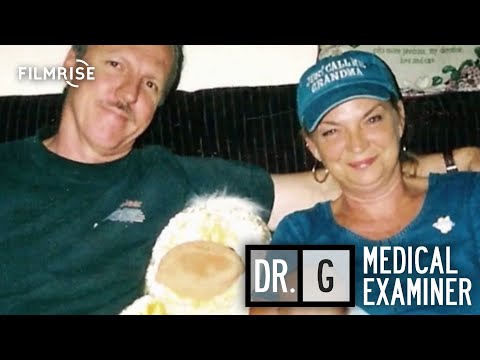
Dr. G: Medical Examiner - Season 5, Episode 12 - Crossing The Line - Full Episode
Episode Description
A teacher excuses himself for a nap after dinner, but he never wakes up. The man has a complex medical history that leads Dr. G on a hunt for an explanation to his mysterious death.
A Florida medical examiner takes viewers through puzzling cases while explaining procedures and conclusions.
Read the full transcriptHide the full transcript
- [MUSIC PLAYING] NARRATOR: A man takes a nap and never wakes up. DR. JAN GARAVAGLIA: We have three really
- deadly things going on here. This sounds like a bad combination. NARRATOR: But when the clues don't add up,
- Dr. G finds herself in uncharted waters. DR. JAN GARAVAGLIA: Sometimes when things don't fit,
- you gotta go with your sixth sense. NARRATOR: And then a woman is stricken with an intense but mysterious pain.
- DR. JAN GARAVAGLIA: Her son said she complained just out of the blue, this stabbing eye pain.
- And then it went away. NARRATOR: But when she dies the very next day, her son fears that he may have ignored a lethal warning.
- The son is absolutely flabbergasted that she's dead. It just really came as a shock to him.
- [MUSIC PLAYING] NARRATOR: Altered lives. Baffling medical mysteries. Shocking revelations.
- These are the everyday cases of Dr. G, Medical Examiner. [MUSIC PLAYING] NARRATOR: As chief medical examiner of the District Nine
- Morgue in Orlando, Florida, one of Dr. Jan Garavaglia's primary responsibilities is to keep
- track of public health trends. Homicides, motor vehicle fatalities, and natural disease, such as obesity.
- DR. JAN GARAVAGLIA: Do you know that there is a 100 million obese or overweight people in the United States?
- And some days I think they're all coming into my morgue. NARRATOR: It's a condition Dr. G understands
- both clinically and personally. You know, I was a fat child, a really fat child.
- Oh, yes. I was, you know, I was the type you made fun of on the bus. SANDY: What?
- Oh my god, yes. [MUSIC PLAYING] DR. JAN GARAVAGLIA: You should see pictures of me.
- I was a really fat child. I lost, like, 30 pounds, I believe, between eighth grade
- and ninth grade. And then I gained a lot of weight after my first child was born.
- I had to lose 42 pounds. SANDY: Wow. - Yeah. And then-- Yeah. And then I gained a lot of weight
- after Eric was born, too. I'm not good with kids, I guess NARRATOR: Today, Dr. G's first case also
- involves a patient who has struggled with their weight, a 43-year-old man named Jeremy Weinberg.
- [MUSIC PLAYING] NARRATOR: The body of Jeremy Weinberg, a beloved teacher at a nearby Orlando high school,
- is wheeled from the refrigeration unit into the exam room. DR. JAN GARAVAGLIA: According to his family,
- according to his principal where he teaches, this guy is a wonderful guy. He's one of those big kind of bear--
- the loving kind of guy. NARRATOR: Jeremy's unexpected death has left his family and friends in a state
- of shock and disbelief. It all started the previous evening while Jeremy was eating dinner with his parents.
- At first, nothing seems out of the ordinary. Then, shortly after the meal Jeremy asks if he can borrow
- a bedroom for a quick nap. But when his parents check on him later that evening,
- they can see right away something is very wrong. DR. JAN GARAVAGLIA: His lips were blue.
- He didn't look good. They tried to see if they could arouse him. They couldn't. Now, he's a very big fellow.
- And they actually try to do CPR with their knee, because he's got such a big chest.
- NARRATOR: Jeremy's parents immediately call 9-1-1, and paramedics rushed him to the nearest hospital.
- They work on him for about 30 to 40 minutes, but they couldn't revive him. Jeremy's sudden death has left his mother and father
- completely bewildered. They have no idea what could have killed their only son in the prime of his life.
- DR. JAN GARAVAGLIA: I mean, to the family he's just still, I mean. To the mom and dad, he's still a baby.
- He's only 43, so they're not expecting him to die. And of course, they're devastated with his death.
- [MUSIC PLAYING] NARRATOR: Seeing someone pass away mysteriously at such a young age is unusual, even for Dr. G.
- But one glance at Jeremy's body is all it takes to start lining up suspects. He is morbidly obese, takes very bad care of himself.
- He's 400 pounds. NARRATOR: Jeremy's morbid obesity alone puts him at risk of dying prematurely from a laundry
- list of different ailments. DR. JAN GARAVAGLIA: You know, this is a fellow that is prime for a lot of natural disease.
- Why is that? Well, people who are that heavy have accelerated atherosclerosis-- plaque.
- They have increased incidence of high blood pressure. We have an increased problem with blood clots
- in the leg, which break off and can cause pulmonary emboli. So obesity can come at your body in many ways.
- NARRATOR: In fact, Jeremy had already developed several conditions related to his obesity.
- He's only 43, but he has severe osteoarthritis wear and tear on his knees. He is already on chronic pain meds for that.
- [MUSIC PLAYING] DR. JAN GARAVAGLIA: He also-- and this is very disturbing-- he has a history of high blood pressure,
- and he stops taking his high blood pressure medicine. And he's got sleep apnea. Sleep apnea is basically where you stop breathing
- while you're sleeping. And about 30% of really obese people will have sleep apnea.
- NARRATOR: The disclosures are troubling. Sleep apnea, high blood pressure, and morbid obesity
- are all risk factors for one fatal condition, heart disease. We have three really deadly things going on here.
- Any three of which could be possibly lethal. I mean, this sounds like a bad combination.
- 400 pounds, not taking medication. It's just a sure ticket to be coming in here at a young age.
- NARRATOR: But as Dr. G continues through Jeremy's medical records, she discovers yet another health concern.
- DR. JAN GARAVAGLIA: He also interesting enough has a family history of atrial fibrillation.
- That's where the top part of the heart quivers and doesn't beat well, although the bottom part
- of the heart continues to beat. Now, that actually has an increased mortality in and of itself if he has it.
- So, you know, for a 43-year-old man, I'd characterize his overall health as pretty bad.
- NARRATOR: But there's only one way for Dr. G to know if Jeremy Weinberg's heart led to his early death.
- [MUSIC PLAYING] DR. JAN GARAVAGLIA: So I do the external examination. The first thing you look at is just his sheer size.
- It's just a huge mountain of a man. And looking at him, he doesn't look well. I can't imagine walking around at 400 pounds,
- and that it would be comfortable. NARRATOR: From the start, Dr. G notes that Jeremy's body shows
- signs of oxygen deprivation, particularly his nails, which are blue in color. DR. JAN GARAVAGLIA: His nail beds were very cyanotic.
- Believe it or not, not everybody who dies has cyanotic nail beds. But his were very cyanotic, as if he wasn't getting
- enough oxygen. But keep in mind, there's about a half hour period, 45 minutes of being resuscitated.
- NARRATOR: Next, Dr. G turns to examine Jeremy's legs. Obesity can cause blood to pool in the lower body,
- leading to the formation of life-threatening clots. DR. JAN GARAVAGLIA: Because of its sheer size,
- we have an increased problem with thrombosis, blood clots in the leg, which break off
- and can cause pulmonary emboli. So that is a possibility. Could you lift the leg up for me when I measure?
- Thanks. OK. That all right? NARRATOR: Sometimes, Dr. G can detect signs of a clot
- by identifying swelling in the calves, but Jeremy's size makes the analysis troublesome.
- OK, he's kind of heavy. DR. JAN GARAVAGLIA: It's just difficult sometimes to do physicals on people who are that big,
- because it sometimes masks some of the physical findings. So a subtle change we wouldn't be able to pick up.
- OK. NARRATOR: By the end of the external exam, Dr. G still has no concrete findings.
- But one thing is clear: Jeremy's obesity has taken a costly toll on his body. Perhaps more than either he or his family realized.
- This is a fellow that is primed for a lot of natural disease. There is a number of complications
- that could have got him. [MUSIC PLAYING] DR. JAN GARAVAGLIA: OK. So I'll tell you what we'll do, is I'll open him--
- SANDY: All right-- NARRATOR: Dr. G is ready to open the body of 43-year-old Jeremy
- Weinberg, who died without warning at his parent's home less than 24 hours ago. They knew he didn't take care of themselves,
- but they certainly didn't expect him to die. And of course they're devastated with his death.
- [MUSIC PLAYING] DR. JAN GARAVAGLIA: So in this fellow, to start the internal, I have to do the Y incision.
- It actually is a little more involved. We have to-- he's so big, we really have to get a little stool.
- Sandy gave me a little stool, and then she's going to take it over in a minute. He's got in some areas over six inches of fat between his skin
- and his muscle. It really is more dangerous for us, because it really is greasy and fatty.
- It's difficult on our backs to get-- because they sit so much higher on those tables.
- And then just trying to get in there and get the organs out and everything is very greasy.
- And it's just more dangerous. [MUSIC PLAYING] NARRATOR: Once the body is opened,
- Dr. G gets her first look at Jeremy's internal organs. DR. JAN GARAVAGLIA: You know, everything's
- in the right place, but it's all surrounded by a tremendous amount of abdominal,
- or what we call visceral, fat. NARRATOR: In fact, the fat is so extensive, it's actually pressing into Jeremy's chest cavity.
- DR. JAN GARAVAGLIA: All that fat in the abdomen it's just pushed up against his diaphragm.
- He's got this tiny little chest cavity. I don't know how he can breathe that way.
- NARRATOR: Dr. G also discovers that he has several broken ribs. I noticed the broken ribs, both right and left side.
- These ribs have very little hemorrhage, and it's associated with trying to do CPR on him.
- NARRATOR: Next, Dr. G cuts through the ribs to get a better look at his heart. And it isn't long before she notices something troubling.
- Whoa. Something here. We've got a big heart. I can see right off that his heart is enlarged.
- It's at least 600 grams. The right side is dilated. The left side's a little dilated.
- And it's thickened. NARRATOR: This finding is exactly what Dr. G feared. Though only 43 years old, Jeremy had already developed
- severe cardiovascular disease. DR. JAN GARAVAGLIA: It's probably a combination of the high blood pressure, which
- he didn't want to treat for some reason, and just the sheer obesity. The muscle was normal and could be
- a setup for a sudden cardiac arrhythmia. At this point, I wouldn't have any problem saying
- that his heart killed him. But if you're going to pin your cause of death on arrhythmia,
- you still have to rule everything else out. NARRATOR: To rule out any other complications in Jeremy's
- death, Dr. G turns next to examine the inside of the atria, the top two chambers of his heart.
- According to his medical records, Jeremy had a family history of atrial fibrillation, a heart
- rhythm disorder in which the atria momentarily flutter instead of beat. This can cause deadly blood clots to form in the chambers.
- People who have atrial fibrillation are at increased risk for having strokes and thombotic events,
- because the blood just kind of sits there and forms a clot, which then can break loose.
- Where's my fancy knife? Eh, it's all right. We'll do this. NARRATOR: Dr. G cuts open the atria,
- but she sees nothing abnormal. DR. JAN GARAVAGLIA: He doesn't have that, and I suspect that he probably didn't have
- atrial fibrillation, even though he's got a family history of it. NARRATOR: As a next step, Dr. G cuts Jeremy's lungs out
- of the cramped chest cavity. OK. NARRATOR: She's searching for any blood clots in the pulmonary artery, the large vessel
- that carries blood out of the heart and into the lungs. Now, obesity could have, you know--
- they're more prone to pulmonary emboli. But he doesn't have any. NARRATOR: And yet, Jeremy's lungs are not at all normal.
- His lungs are remarkable for being very edematous. NARRATOR: The organs are heavy with edema,
- or fluid, which is often an indication that a person died slowly. However, this contradicts her theory that Jeremy may have
- died from a sudden arrhythmia. Now, this puts up a little flag in my brain, that he just didn't maybe die suddenly.
- NARRATOR: Next, she draws toxicology samples from Jeremy's body. Oh, nice full bladder.
- NARRATOR: And here she discovers another clue that Jeremy's death was not sudden.
- DR. JAN GARAVAGLIA: His bladder is very distended, which can be due to him being in a coma for a period of time.
- You know, we're thinking about the heart and thinking a sudden death, but with his bladder being
- distended and his lungs full of fluid, I kind of suspect maybe more of a slower death.
- And now I'm worried maybe he's got something going on in his brain, like a bleed, brought on by his high blood
- pressure that caused his death. So we've got to go to the head. [MUSIC PLAYING] NARRATOR: Morgue technician Tommy Hemphill
- opens Jeremy's skull with a bone saw, and Dr. G immediately begins searching for any abnormalities, such as bleeding in the brain.
- But the findings are not what she was expecting. DR. JAN GARAVAGLIA: There's no evidence of anything
- abnormal in that brain. Right off the bat, I can tell. And I slice the brain, there's no evidence of hemorrhage
- anywhere in that brain. No evidence of any kind of stroke in that brain, which that brain looked normal.
- I don't know if surprised is the right word, and I'm actually a little disappointed that I don't find
- the bleed in his brain, because I thought that would tie things up nice and neatly.
- So I'm a little disappointed that he doesn't have that bleed in the brain. NARRATOR: At this point, only one thing is certain:
- Jeremy had a severely enlarged heart that could have been a ticking time bomb. DR. JAN GARAVAGLIA: You know, I'm done with the autopsy
- and I could assign this out right then and there: his heart. But something tells me differently.
- I don't like the fact that he's got so much pulmonary edema and that distended bladder.
- It just doesn't really fit that sudden cardiac arrhythmia. And, you know, sometimes when things don't fit,
- you've gotta go with your sixth sense. I don't think there's any harm in appending this.
- NARRATOR: Dr. G pends Jeremy's case until toxicology and microscopic results are complete.
- In the meantime, she makes a difficult call to his family. I talk to the family.
- They understood that I wanted to wait. I needed to look at the tissues under the microscope.
- And I wanted to look at the toxicology, because I still have that uneasy feeling in my mind
- that something else is going on. [MUSIC PLAYING] NARRATOR: Several weeks after the autopsy
- of 43-year-old Jeremy Weinberg, Dr. G still doesn't know what killed him. But today she's hoping that microscopic slides of his heart
- and toxicology results will provide some clarity both for her and Jeremy's grieving parents.
- DR. JAN GARAVAGLIA: It's always a trying time for the families, waiting for the answers.
- We always get a lot of anxious phone calls. Is it done yet? Is it done yet? But we have to wait for the lab to finish their tests.
- NARRATOR: Dr. G begins by examining the slides of Jeremy's heart. Sometimes you do get surprised looking under the microscope
- at something you don't suspect. But in this case, there was really no surprises.
- We still have the effects of obesity and high blood pressure. And that could be a setup for a cardiac arrhythmia,
- which certainly could be the cause of death. But I still have that same problem--
- the pulmonary edema, the distended bladder. NARRATOR: To make sense of Jeremy's sudden death,
- Dr. G needs an explanation that can reconcile these conflicting findings. [MUSIC PLAYING]
- But then she gets her first look at the toxicology report, and staring her right in the face
- is a problem she never anticipated. DR. JAN GARAVAGLIA: At this point, this is out of the blue.
- NARRATOR: First, Jeremy had high levels of oxycodone in his blood. The medication he was prescribed for his arthritic knee.
- DR. JAN GARAVAGLIA: He had levels way above therapeutic. He was clearly taking too much.
- NARRATOR: The level of oxycodone alone isn't high enough to kill Jeremy, but it's what Dr. G
- discovers next that reveals the truth behind his untimely death. DR. JAN GARAVAGLIA: Toxicology results
- didn't let me down on this. I think they added a very important piece of this puzzle
- of what's going on. [MUSIC PLAYING] NARRATOR: It's a Sunday afternoon in Orlando,
- and 43-year-old Jeremy Weinberg is on his way to his parent's house for dinner. But his knee is acting up, so he takes
- the edge off what some of his prescribed pain medication, oxycodone. Unfortunately, this isn't the only drug Jeremy
- has been using for pain relief. DR. JAN GARAVAGLIA: Tox finding just came out of the blue for me, in that he had both oxycodone
- and methadone on board. NARRATOR: Methadone is a narcotics often used to treat heroin addiction, but it's also a potent pain
- medicine, and one that Jeremy had been taking without medical supervision. DR. JAN GARAVAGLIA: He does not have a prescription
- for the methadone. The methadone he was getting somewhere else, which is still a mystery.
- NARRATOR: But what Jeremy doesn't realize, is that methadone lingers in the body
- much longer than most drugs. DR. JAN GARAVAGLIA: It's got such a long half life,
- that it stays in your system for a long time and can cause an accumulative effect.
- And then you take more on top of that, and the levels just keep building. NARRATOR: Unbeknownst to Jeremy or his parents,
- the tragic misuse of two powerful pain medications is about to come to a head. DR. JAN GARAVAGLIA: Now, this is a bad combination.
- The way these drugs-- both of which are narcotics, very potent narcotics-- will affect you, Is that their central nervous system
- depressants. And they can decrease your respiration. NARRATOR: By the time dinner is over,
- Jeremy is beginning to feel the full effect of the oxycodone-methadone cocktail.
- He's overwhelmed with drowsiness and lays down for a nap. But it isn't long before Jeremy's
- body, already ravaged by morbid obesity, is pushed over the edge. Now, this is a morbidly obese man that already has problems
- with a small chest cavity not being able to expand his lungs, sleep apnea causing him to obstruct his airway
- to not get enough oxygen. And now we're throwing on top of that, let's throw in a little central nervous system depressant
- so I don't breathe well enough. So what is all that combination do? That combination is going to decrease your oxygenation.
- Well, let's say he's already got a big heart that's sensitive to decreased oxygenation,
- and that's just a setup for death. NARRATOR: While he's sleeping, Jeremy's lungs
- start to fill with fluid. And it isn't long before he slips into a coma. Eventually, his heart gives out, and in the guest bedroom
- of his parent's home, he dies. In medicine, sometimes it's not just one thing. It's piled up.
- Many things piled up on top of each other. And that's probably why this man died, with the coup
- de gras being the drugs. Without the drugs, at that moment he probably wouldn't have died.
- NARRATOR: With the cause of Jeremy's death finally revealed, Dr. G once again calls his mother
- and father to explain the complex chain of events that took their son's life. His parents were totally surprised that he had
- that kind of narcotics in him. Right. OK. They knew he didn't take care of himself.
- They really were surprised, though, that he was taking narcotics. You know, I find cases like this really, really frustrating.
- He leaves in his wake people who are devastated by his death. The kids in his classroom are devastated
- that their teacher dies. All his co-workers loved him. They're devastated that he died.
- His family is devastated. His mom and dad. These are frustrating cases that come through here that didn't
- have to come through here. NARRATOR: Sadly, many of Dr. G's cases have one lesson in common--
- unhealthy choices often lead to premature deaths. DR. JAN GARAVAGLIA: I think a lot of people
- don't appreciate what bad habits can do to your body. And I don't think they see sometimes
- the connection between the habit and the disease. That's something I see every day in the morgue.
- NARRATOR: And on first glance, her next case appears to be no exception. [MUSIC PLAYING]
- NARRATOR: Today, Dr. G and some of her staff are checking on the construction of their future workplace.
- [DRILLING NOISES] (SHOUTS) Welcome to your new home. (SHOUTS) Thank you very much!
- This is the office. My desk is right here, I think. MAN: Yep, right there. It's really going to look really pretty.
- It's unbelievable to see this go up like this. MAN: That's the outside wall. This is the length of a cooler right here.
- This is also where the skeletons will be, so anything that's decomposed or skeleton--
- This is where you bring the stinky ones. DR. JAN GARAVAGLIA: You got it. (CHUCKLES)
- You like doing this part better than decomp? (CHUCKLES) DR. JAN GARAVAGLIA: This has been a lot of fun, Sandy.
- It is much better than doing a decomp. [LAUGHTER] [MUSIC PLAYING] NARRATOR: But Dr. G's work can't wait for the new morgue
- to be complete. Back at the old building, she has a full caseload. And the next one on her list looks
- to be anything but clear-cut. Well, today we have a 53-year-old African-American female who really has
- very little medical history. [MUSIC PLAYING] NARRATOR: Fresh out of college, Justin Bailey
- lives in his own apartment in Orlando, Florida. But he still leans on his mother, Cora,
- for support and guidance. So early one morning when a new job offer comes his way,
- he wastes no time calling his mom for advice. The son tries to call her, she doesn't answer.
- He can't get a hold of her. NARRATOR: Justin continues calling throughout the day,
- but all he gets is his mother's voicemail. Growing more concerned by the moment,
- he leaves work and drives directly to her house. He comes over and knocks on the door.
- She doesn't answer. He walks in and finds her sitting on the couch. [MUSIC PLAYING]
- He sees that she's unresponsive. NARRATOR: Frantic, Justin calls 911, but it's too late.
- [MUSIC PLAYING] DR. JAN GARAVAGLIA: She's clearly dead. This is a sudden, unexpected death.
- The son had no idea what could have killed her. It just really came as a shock to him.
- Because she's only 53, and you shouldn't normally die at 53. NARRATOR: But the initial shock soon gives way to guilt,
- as Justin wonders if he could have saved his mother had he only acted sooner. The one person who can answer that question now is Dr. G.
- Cora's medical report begins with the mention of a common health concern. DR. JAN GARAVAGLIA: She's clearly
- being treated for high blood pressure, which doesn't seem to be too bad, actually.
- NARRATOR: But while the high blood pressure appears to have been under control, that was just the beginning
- of Cora's problems. DR. JAN GARAVAGLIA: She smokes. Number one bad thing you can do to decrease your longevity.
- She's obese. That's the number two thing that you can do to yourself that's going to decrease your longevity.
- And she drinks. She drinks a lot of beer and a lot of liquor. NARRATOR: All these factors can contribute to heart
- disease, stroke, even diabetes. But Dr. G is equally concerned about a strange symptom
- that emerged the day before Cora died. Her son said she complained just out of the blue of this stabbing eye pain,
- and then it went away. NARRATOR: At the time, Justin and his mother simply brushed it off as a harmless event,
- but now Dr. G wonders if this stabbing pain could have been a harbinger of something far more serious.
- DR. JAN GARAVAGLIA: You know, I wonder is that perhaps kind of, you know, pre-stroke kind of symptomatology?
- NARRATOR: Only the autopsy can see for sure. This case could really be anything.
- [MUSIC PLAYING] NARRATOR: Dr. G begins the external exam with Cora's face, and here she gets her first real clue.
- She's got frothy fluid coming out of her mouth, and she's got frothy fluid coming out of her nose.
- That's worrisome. NARRATOR: This is typically an indication of pulmonary edema, an accumulation of fluid in the lungs that can flood
- the respiratory passageways. Dr. G sees it often in cases of drug overdose or heart failure,
- but given Cora's symptoms, there's another possibility that seems to make more sense.
- DR. JAN GARAVAGLIA: We see that when something happens in your brain, like a stroke--
- mind, she'd had some type of pain behind the eye just, you know, a day earlier that she clearly was complaining about.
- NARRATOR: But as Dr. G shifts focus to Cora's torso and lower body, a frightening new possibility
- arises, trauma. She's got a few bruises on her, about four bruises on her leg. A couple on her arm.
- Even one on her abdomen. That's not normal. So it'll be interesting to do this autopsy.
- These are the kind I like. [MUSIC PLAYING] NARRATOR: 53-year-old Cora Bailey was found dead by her son, Justin, yesterday afternoon.
- She had suffered a mysterious pain only a day before her death, and now he feels he may be to blame.
- You know, the son is wracked with guilt because he didn't check on his mom sooner.
- NARRATOR: The pain may have been an early warning sign of a stroke, but the external exam
- has brought another disturbing possibility to the forefront. DR. JAN GARAVAGLIA: We do see multiple bruises on her body.
- I'm worried that she may have fell and hit her head. We see those bruises a lot in our alcoholics
- that come through here. Sometimes it's because their liver isn't making enough clotting factor.
- They tend to bleed a little more readily. They tend to fall more easily when they're intoxicated.
- She's probably stumbling around when she's intoxicated, and certainly falling and hitting her head
- is another possibility. Oftentimes the alcoholics already have somewhat of a shrunken brain,
- and there's a little more room in there for the subdural to develop. NARRATOR: And possible cranial trauma
- points her in one direction. I think we'll go to the head first. [MUSIC PLAYING]
- All right, now. NARRATOR: Dr. G begins by palpating Cora's skull for any abnormalities.
- DR. JAN GARAVAGLIA: I'll feel that head for evidence of a contusion before I open it, but I
- don't feel anything on her. But she has a nice head of hair, and I may be missing it.
- So I will go ahead and reflect the scalp off of the calvarium-- off the bone, off the skull,
- and look for bruising. Good, good, good. And I really don't see anything. NARRATOR: Then, Dr. G's morgue tech, Sandy Ludwig,
- uses an oscillating saw to open Cora's skull. We start to cut the calvarium off,
- and my tech is having a hard time getting through the skull. [SAW BUZZING] NARRATOR: Finally, the skull cap is removed.
- But before she can examine the brain for trauma, something about Cora's skull itself catches her attention.
- DR. JAN GARAVAGLIA: Normally, you know, the skull is very smooth on the inside, but on this the inside was very thick and lumpy, bumpy.
- Very irregular bone. NARRATOR: Dr. G immediately recognizes this as a telltale sign of a bone disorder
- called Paget's disease. DR. JAN GARAVAGLIA: Paget's disease is an abnormality in the bone.
- It is caused by an imbalance of the renewing of our bones. Our bones are living things.
- They are constantly cells dying and cells replacing them. What happens is the cells start to die in an accelerated rate,
- but the replacement bone tends to get over exuberant and try to build up new bone very quickly.
- And then that starts taking over. And you get a lot of irregular bony buildup. NARRATOR: The disease can develop
- in any bone in the body, and usually causes aches similar to arthritis. A lot of times we get a Paget's in the spine, which
- can be painful. And in this case, the exuberant bone growth was occurring in her skull.
- Now, this is a bad place for Paget's. In the skull it causes a lot of problems, because we have a lot of nerves coming up.
- And if you've got exuberant bone growth, they can impinge on some of these nerves.
- That bone that was pressing against the cerebral hemisphere, you could kind of see that indentation.
- NARRATOR: This leads Dr. G to her first conclusion. DR. JAN GARAVAGLIA: So Paget's disease
- could probably explain why she was having some eye pain, possibly. NARRATOR: But while it might account for Cora's pain,
- Paget's is rarely life threatening. And from looking at the surface of Cora's brain,
- Dr. G believes the condition caused no fatal damage. DR. JAN GARAVAGLIA: So at this point,
- it doesn't really explain her death. NARRATOR: In fact, there doesn't seem to be any damage at all, which leads
- Dr. G to her next conclusion. We've ruled out trauma to her head. NARRATOR: She then dissects the brain, looking
- for evidence of a stroke. There's really nothing here. Her brain itself looked OK.
- I don't see evidence of anything that would have caused her death. Everything looks good.
- We've ruled out a stroke. NARRATOR: What's more, with no brain trauma and no stroke,
- Dr. G can't yet make sense of an earlier finding. So after I do the cranial exam, we
- can rule out the brain was not the cause of her pulmonary edema. [MUSIC PLAYING]
- Suddenly, Dr. G finds herself back at square one. Hopefully the answers are going to be
- found in the internal exam. [MUSIC PLAYING] DR. JAN GARAVAGLIA: Well, during my Y incision,
- I don't see anything out of place. From here, I will go ahead and take off the chest plate,
- and I'll turn my attention to the heart and lungs. NARRATOR: She first removes the lungs
- by slicing through the vascular and bronchial connections. Yeah, there's certainly a lot of fat everywhere.
- NARRATOR: Right away, she can tell something is terribly wrong. You can squeeze the lungs and get
- that frothy fluid coming out. Definitely pulmonary edema. All right. NARRATOR: While there are many causes of pulmonary edema,
- one suspect immediately comes to mind. DR. JAN GARAVAGLIA: We see that with congestive heart failure.
- When the heart can't beat strong enough and the fluid starts backing up into the lungs.
- NARRATOR: She slices open the pericardial sac and gets her first look at the heart.
- It's a big heart. It's enlarged, not just by weight. It weighs a little bit heavier than we normally have.
- But what's really remarkable about this heart, is that it's very dilated. So it's almost like filling up a balloon out.
- A big (BREATHES IN) and we've blown it up. NARRATOR: This is a condition known as dilated cardiomyopathy, a type of heart disease
- in which the organ expands, weakening its ability to pump. It's the third most common cause of heart failure
- in the United States, with 500,000 new cases diagnosed each year. As soon as I see her heart in conjunction
- with that pulmonary edema, I know this is why she died. She's dying of some type of congestive heart failure.
- NARRATOR: But this autopsy isn't over. For Dr. G, key piece of the puzzle is still missing.
- Well, you know, I could just say she's got a cardiomyopathy and leave it at that.
- That's good enough for the death certificate-- she died of congestive heart failure and dilated heart,
- but why? We know her mechanism of death, but we still need to put it all together with the reason why.
- NARRATOR: And it's not just Dr. G who needs to know. If Cora's suffered from a fatal genetic condition,
- Justin could also be at risk. DR. JAN GARAVAGLIA: Many a time that I'll do an autopsy
- and something unexpectedly genetic is found out that will have ramifications to future generations.
- [MUSIC PLAYING] NARRATOR: Dr. G is on the hunt for what could have caused a cardiomyopathy that
- killed 53-year-old Cora Bailey. This condition can be hereditary, and if that's in fact the case here,
- her son Justin may suffer from it as well. Some of these things are genetic. I see myself as their love one's last physician,
- and it's part of my responsibility to explain why they died to them. Giving them a knowledge of why they died
- helps them understand why their loved one died, and it may have some implications for the family
- if it's congenital. So it really is our due diligence to look for the underlying cause of death.
- NARRATOR: Dr. G will have to examine the heart tissue under the microscope for any abnormality that
- might explain what caused Cora's cardiomyopathy. She takes tissue samples to be sent to the lab,
- but it will take weeks for slides to come back. But before she finishes examining the heart,
- she looks for one more possible cause of the cardiomyopathy-- coronary artery disease.
- She looks at the vessels by dissecting Cora's heart. DR. JAN GARAVAGLIA: We have to look at the coronary arteries,
- and I'm fully suspecting this is probably why she has this dilated heart, her coronary arteries.
- And this ought to give some people who smoke and who are obese at least some hope,
- her coronary arteries were clean. And there wasn't a bit of atherosclerosis in them.
- NARRATOR: But there's still another very rare condition Dr. G must consider. Paget's-- a really widespread Paget's disease
- could be a possibility. NARRATOR: Paget's could have caused Cora's dilated cardiomyopathy, because the heart must work
- harder to send blood through the blood vessels in the abnormal bone. But this only happens in cases where the disease is severe.
- To find out if the disease is widespread, she digs deeper to examine the spine, pelvis, and collarbone,
- and arrives at a disappointing conclusion. It doesn't appear she's got Paget's disease,
- though, bad enough to have caused her congestive heart failure. So our last hope for a definitive answer
- would be the microscopics. [MUSIC PLAYING] NARRATOR: It's late on a Friday, and Dr. G finally
- receives the microscopic slides of Cora Bailey's heart tissue. Let's see here. NARRATOR: Immediately, she examines the samples
- for anything that might provide a clue about what caused Cora's heart failure, but finds none.
- It's a frustrating turn in the investigation. DR. JAN GARAVAGLIA: I've ruled out the things we can rule out,
- and we're left with an I don't know cardiomyopathy that's caused her heart muscle to dilate.
- NARRATOR: But as Dr. G begins her draft of the autopsy report, she revisits the details
- of the case one by one, and it isn't long before the findings reveal a distinct pattern.
- With this last piece of the puzzle in place, Dr. G can finally confirm exactly how and why Cora Bailey died at the relatively young age of 53.
- DR. JAN GARAVAGLIA: Well, this is something that just didn't occur that night. [MUSIC PLAYING]
- NARRATOR: It's a balmy Sunday evening in Florida, and Cora Bailey is at home enjoying
- the final hours of the weekend. Little does she know, they're also the final hours of her life.
- Unbeknownst to anyone, Cora is dying from heart failure, and Dr. G now knows why.
- DR. JAN GARAVAGLIA: I suspect that ultimately she died at 53 not because of her inheriting something wrong,
- but what she did to her body and not taking care of herself. She's got a lot of bad habits.
- She smokes. She has high blood pressure. She is obese, which in and of itself is a strain on the heart.
- And she certainly has chronic alcohol abuse, which is injurious to the heart muscle itself.
- NARRATOR: All of these things together take a catastrophic toll on Cora's heart.
- Her heart is under a lot of pressure, and over time there is enough damage that it will start to dilate.
- NARRATOR: The heart gradually experiences more and more difficulty pumping out enough blood with every beat.
- And the buildup of blood stretches and weakens the walls of the muscle even further.
- The heart can't maintain its shape anymore, and then that sets up a whole cascade, because if you're not
- pumping enough blood, the pressure start building up, and the fluid part of the blood started going into the lungs.
- NARRATOR: As the night wears on, Cora has a hard time breathing lying down flat in her bed,
- so she moves to the couch. The fact that we find her sitting is probably very important, because oftentimes when
- the fluid starts to build up in the lungs, people cannot lay down. It makes them feel like they're asphyxiating.
- They can't catch their breath because of that fluid, so they need to sit up to sleep.
- And that appears what she was doing. NARRATOR: But sitting up is of little help.
- Filled with fluid, Cora's lungs can no longer deliver fresh oxygen to the rest of her body.
- DR. JAN GARAVAGLIA: And eventually the heart probably goes into an arrhythmia, and then she dies
- [MUSIC PLAYING] NARRATOR: Cora's son, Justin, is stunned to learn that his mother's premature death was a direct result
- of her lifestyle, but he's also relieved to know that there was nothing he could have done that day
- to stop the domino effect brought on by a lifetime of bad habits. It was clearly a preventable death,
- but the only one who could have stopped it was Cora herself. When I talk to them and explain
- that some of her choices in life, like her obesity or hypertension, her chronic alcoholism, they connect the dots then
- and see that she wasn't as well on the inside as they thought she was. I think a lot of people don't appreciate what bad habits can
- do to your body, and I don't think they see sometimes the connection between the habit
- and the disease. That's something I see every day in the morgue. [MUSIC - ABE QUIGLEY, "SOLOMON'S MINE"]
- (SINGING) I found a home here in Soloman's mine.
Brief Summary
Dr. G investigates the deaths of Jeremy Weinberg and Cora Bailey, revealing the impact of obesity and lifestyle choices on health outcomes.
Key points
- A Mysterious Death. A man takes a nap and never wakes up, leaving his family in shock.
- Dr. G's Sixth Sense. When clues don't add up, Dr. G trusts her instincts to find the truth.
- The Deadly Combination. Jeremy's toxicology reveals a dangerous mix of medications that led to his demise.
- The Shocking Truth. Jeremy's death is revealed to be caused by a combination of obesity and drug use.
- Cora's Sudden Death. Cora Bailey, only 53, is found unresponsive by her son, Justin.
- Dr. G's Investigation. Dr. Jan Garavaglia examines Cora's body to uncover the cause of death.
Episode highlights
- A Mysterious DeathA man takes a nap and never wakes up, leaving his family in shock.“A man takes a nap and never wakes up.”0:18Jun 17, 2021
- Dr. G's Sixth SenseWhen clues don't add up, Dr. G trusts her instincts to find the truth.“Sometimes when things don't fit, you gotta go with your sixth sense.”0:34Jun 17, 2021
- The Deadly CombinationJeremy's toxicology reveals a dangerous mix of medications that led to his demise.“This is a bad combination.”22:31Jun 17, 2021
- The Shocking TruthJeremy's death is revealed to be caused by a combination of obesity and drug use.“Without the drugs, at that moment he probably wouldn't have died.”24:26Jun 17, 2021
- Cora's Sudden DeathCora Bailey, only 53, is found unresponsive by her son, Justin.“Frantic, Justin calls 911, but it's too late.”28:31Jun 17, 2021
- Dr. G's InvestigationDr. Jan Garavaglia examines Cora's body to uncover the cause of death.“This case could really be anything.”30:45Jun 17, 2021
- The Cause of Death RevealedDr. G discovers Cora's heart failure was due to a lifetime of bad habits.“It was clearly a preventable death.”48:12Jun 17, 2021
Tension
75/ 100High tension