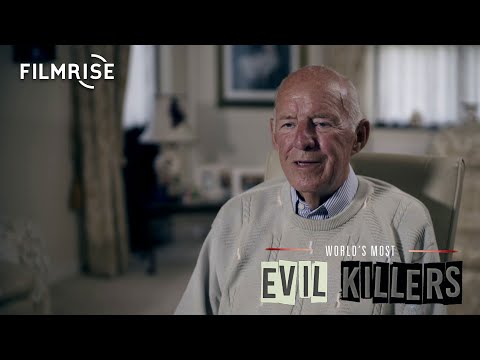
World's Most Evil Killers - Season 4, Episode 16 - Peter Moore - Full Episode
Episode Description
Peter Moore was a sadistic serial killer who killed and mutilated four men in North Wales in 1995. The local cinema owner had an obsession with Nazis and sadomasochistic sex.
An in-depth look at the lives and crimes of some of the world's most evil killers, including Jeffrey Dahmer, Ted Bundy, Richard Ramirez, Cary Stayner, Leonard Lake, Dorothea Puente and more.
Read the full transcriptHide the full transcript
- - MALE NARRATOR: September 1995, Anglesey Northwest Wales, 56-year-old Henry Roberts had returned home
- after having drinks at the local pub. When he heard a noise outside his cottage,
- he went to investigate. Unbeknownst to Henry, it was a deadly trap. - DAVE: Henry came out to see what the disturbance was
- and saw this--this figure in black, he had black leather trousers on, he had black boots, a black leather jacket
- and a black leather slash pea coat. The idea was to look like, uh, a Nazi officer.
- - NARRATOR: The man in black was 49-year-old local cinema owner Peter Moore, who was armed
- with a commando knife. Moore launched an attack on Henry and stabbed him repeatedly.
- - When Peter Moore kills Henry Roberts, he stabs him 27 times, this is way more violence
- than he actually needs to end his victim's life. - GEOFFREY: Moore, in the end, pulled his trousers down and stabbed him in both buttocks.
- The final humiliation, if you like. - DEREK: I mean, it's so astonishing. On the one hand, you have the respectable businessman,
- on the other hand, the cold-hearted killer. - NARRATOR: He was a sexual predator who terrorized men
- in the north of Wales for nearly two decades, and would go on to claim three more innocent lives
- in less than three months. That makes Peter Moore one of the world's most evil killers.
- - ♪ ♪ - NARRATOR: The 25th of December 1995, North Wales, most people were enjoying the festive period
- when news broke that a serial killer had been loose in the sleepy seaside town of Kinmel Bay,
- and he was one of their own. - GARETH: I think people were very shocked for a number of reasons.
- It's the only case of serial killing in North Wales and the fact that all four murders
- were carried out within a short period. The brutality of the--the murders as well,
- uh, it was quite horrendous. - NARRATOR: The man responsible was 49-year-old local cinema owner Peter Moore, who'd killed
- and mutilated four people. He would also admit to nearly 50 attacks on men between 1975 and 1995.
- - ♪ - LEWIS: I've known him 13, 14 years and I'd been to his home, I'd spent time with him
- and I realized that I didn't know him at all, I mean, it was something quite evil there
- and I didn't see the monster because the monster was so well hidden. - NARRATOR: Even seasoned detective, Dave Morris
- was shocked by the depravity of the crimes. - DAVE: It's almost 24 years now since I arrested Peter Moore
- for those murders, and certainly in my police career, we've never had anything like that in North Wales before.
- He presented this persona to the outside world that he was a nice gentleman that would do anything
- for anybody, but deep down he had this dark side to him, um, which eventually took over his whole persona and that
- was just one of the very brutal psychopathic murderer. - NARRATOR: This killer's story begins
- on the 19th of September 1946. Peter Howard Moore was born in St. Helens, in Lincolnshire, in the northwest of England.
- He was the only child of Edith and Earnest Moore. - LOUIS: He was considered somewhat
- of a miracle baby because his mother thought she couldn't actually conceive and she essentially doted on him
- much of his life. He had a close relationship with her. - DR. YARDLEY: She had him when she well into her 40s,
- and I think in this way, he does differ quite significantly from a lot of serial killers.
- Many serial killers, you look at their childhoods, they're full of neglect, but in this case,
- it seems to be the opposite end of the spectrum. This was somebody who was overindulged, essentially.
- This was somebody who never faced any consequences for their actions, he could do pretty much whatever he liked.
- - NARRATOR: Peter had a very different relationship with his father. - GEOFFREY: His father, Earnest Moore
- was a disciplinarian, but he certainly didn't make his son's life easy, so he came to loathe his father,
- and adore his mother, Edith. - GARETH: He made some quite strong comments about his father.
- He suspected that his father was gay, and, uh, there were hints that his father, uh, had been
- violent as well, uh, his father, according to Peter Moore, was an alcoholic, and Peter Moore didn't like alcohol.
- - NARRATOR: In 1952, the family moved to Kinmel Bay, a small seaside town in northeast Wales.
- - The northeast coast is historically, uh, a tourist area, um, in the winter it's, um,
- it's reasonably quiet, in Kinmel Bay, in particular, reversed to a sort of community [unintelligible] atmosphere.
- - GEOFFREY: Moore lived in a comparatively substantial housing. His parents were relatively prosperous.
- They ran an ironmongers, a family business. - GARETH: The family was well respected in the area.
- They provided a much needed service, and, especially amongst the elderly. The didn't have to walk far.
- - NARRATOR: Moore lived a comfortable lifestyle compared to most of the other children in the area.
- - DR. YARDLEY: He was the son of a local shop owner, so I think, this would've given him a sense that he
- was above his peers, he felt superior to them, and this would not of endured him
- to the--the children of this particular part of Wales, many of whom their parents came from working class
- backgrounds. - NARRATOR: At school, Moore was described as being well behaved, but he was a loner
- and his height made him stand out from other children. - DR. YARDLEY: He was much taller than them,
- so, there's that sense of exclusion from the peer group, but there's also a sense of feeling better than them,
- and I think his elevated height was something he accorded with elevated status. He felt that he was above them and looked down on them.
- - GEOFFREY: He also felt that he was entitled to alot of things. He was a boy of vanity and that vanity was to emerge
- as his life went on, and turn itself into a much darker quality. - NARRATOR: Isolated and alone,
- Peter developed a passion for film. - DR. YARDLEY: He had a home cine camera and I think that instilled in him
- this fascination with cinema, with movies, with storytelling. - NARRATOR: After leaving school Moore went to work
- with his father at the hardware shop. For the next 29 years, his passion for the cinema
- was put on old. Peter was gay, but kept his sexuality hidden from his parents. - DR. YARDLEY: It was something that he didn't feel
- able to share because I think at this time in--in a very kind of traditional community,
- being gay was not okay, it was--was something that was heavily stigmatized. - GEOFFREY: Remember, until 1967,
- you could be arrested, convicted and imprisoned for being homosexual in this country.
- Moore was very aware of that, so although there may have been a certain number of covert relationships
- as he was beginning to grow through adolescence and into young manhood, I suspect almost all the time,
- he concealed it as effectively as he possibly could. - NARRATOR: After hours, Moore would frequent gay bars
- in and around Liverpool. He would also travel to London to watch sex shows. It was around this time that he developed an interest
- in sadomasochism. - GEOFFREY: One of the fascinations about sadomasochism is that it can arise
- from comparatively simple things, tying someone up, subjugating them, wanting to be in complete control,
- and so once that had placed itself in Moore's psyche, I think he took it upon himself always to be dominant
- and once more, always to use his dominance. - NARRATOR: Moore also had a fascination
- with Nazi subculture and memorabilia. - GEOFFREY: If you accept that Moore wanted to control,
- there can be no more powerful icon of control than Adolf Hitler in Nazi Germany.
- The two almost go hand in hand, and there was certainly a tendency in the early 60's for there to be a connection
- between Nazism and sadomasochism. - NARRATOR: His appetite to control men would soon turn violent.
- - GEOFFREY: Because of Moore's covert personality, this dominate male, he took great pleasure
- in homosexual encounters in which he would not only attack a submissive male, he would also demonstrate to other males
- just how dominant he was. Moore used his homosexuality in that isolated community
- to become a preying individual. He would prey upon vulnerable homosexuals who didn't
- know quite how to handle their homosexuality. - DR. YARDLEY: I think Peter Moore was well aware
- of the homophobia that existed in society at that time and he knew that there was a sense of stigma
- that the men that he attacked were unlikely to report those attacks, so I think he felt secure
- in--in the knowledge that he was targeting a marginalized group, and the more extreme
- his offending got, he really did feel invincible at this point in time. - NARRATOR: Peter Moore's desire for dominance and control
- was escalating by the day. Soon his need for control would turn violent, and he began to attack random men in the surrounding areas.
- - DAVE: He would go with whichever boyfriend he had at the time, and he would drive round the sort of rural areas
- looking for older men walking home, generally from the pub. He parked further up the road and as they walked past,
- he'd jump from--from behind, normally with rubber cuffs and he'd severely attack them, um, some people were left
- very, very badly injured as a consequence of those attacks. - DR. YARDLEY: They were really brutal,
- people were beaten unconscious, so these were really, really serious physical assaults,
- and they were almost escalating, I'd say, in ferocity as his need to exert control got even greater.
- - NARRATOR: Despite some of the attacks being reported, Peter Moore's name or any of the men
- he was with at the time, never came up in any of the inquiries. - DAVE: We were investigating those all through the 1980s,
- but obviously, we didn't connect Peter as the man we were looking for. Peter didn't have any criminal record.
- There was no reason to suspect him in those days. - NARRATOR: Moore continued with the facade as the son
- of a respectable local businessman, but by night he was a violent predator. In 1979, his father, Earnest, died.
- Moore had already been running the business, but now he was head of the household, too.
- - GEOFFREY: He has to be in command, has to look after his mother, has to run the ironmongers
- and at the same time, wants to make a mark on the local community. As a respected figure.
- - NARRATOR: Moore opened up a video rental section in his shop, which re-ignited his passion for film.
- Eventually, he would close the hardware shop and in 1991, he opened his first cinema.
- In the winter of 1994, he opened a second one in Holyhead as fellow cinema owner,
- Lewis Colwell recalls. - He gave the impression that cinemas were for families and children, and that's what he believed in.
- People liked him, people talked to him. He was very approachable. - DR. YARDLEY: He became a real pillar of the community
- in this regard, so he was the one who brought the glitz and the glamour of Hollywood
- to the rainy, welsh, sleepy villages. - GEOFFREY: There can be no doubt that Peter Moore
- got a great deal of kick out of combining his passion for darkness and his passion for the cinema,
- and he was absolutely relishing the fact that he had a secret life that he kept hidden from the world.
- - NARRATOR: Life was going well for Moore, but in April 1994, tragedy struck when his beloved mother passed away.
- - GEOFFREY: She has been the focus of Moore's life, the focus of tryna keep up appearances,
- he could never have admitted to his mother any of his secret exploits, gay relationships,
- cruising gay areas, but once she was dead, it was quite a different matter. Edith had been the restraint on Peter Moore.
- Without her, he quickly escalated into what he was probably all along. - NARRATOR: With the house to himself, Moore was now free
- to indulge with his sexual fantasies at home. - DAVE: Moore's mother was alive he kept his interest
- in sadomasochism away from the home. After the death of his mother, he brought that side of things
- into his home life and there was, um, all sorts of, um, S&M paraphernalia in the rooms,
- whippings or floggings had taken place on the property. The death of his mother had been like, uh,
- a release valve from, if you'd like, he didn't have to sorta keep a cap on it anymore;
- that side had overtaken. - NARRATOR: In the summer of 1995, Moore opened a third cinema, the Wedgwood in Denbigh and reveled
- in the limelight. - GARETH: The first time I met Peter Moore was when he was about to open a cinema, and he was, understandably,
- looking for publicity and he was always prepared to pose for pictures and always prepared to give a quote.
- - LEWIS: He was hailed a hero 'cuz he came in on a blaze of publicity. The newspapers really, you know, went to town,
- the savior of cinemas, he was on the six o'clock news. - NARRATOR: But beneath the veneer of the successful
- businessman, Moore was financially unstable. - LEWIS: All the cinemas he had were in little North Wales
- market towns, you know, they weren't taking any money, they were just ticking over or even running at a loss.
- - GEOFFREY: Moore extended himself too quickly. Three cinemas all in a short space of time,
- he couldn't allow it to be seen that he was actually struggling, and he certainly couldn't allow it to be seen that he would
- actually close one of the three cinemas, indeed, quite the opposite, he started to say,
- "Oh, I'm gonna open a fourth cinema," which of course, he never did because he was simply
- in financial difficulty. - NARRATOR: With the financial pressure mounting, so was Moore's need for control and violence.
- - Well, what happens in many of these cases is that criminal behavior escalates.
- He's inflicting pain on others and then it becomes more and more brutal, and then it escalates
- to the--the highest form of sadism, and that is actually killing the victim. - NARRATOR: On the 19th of September 1995,
- Moore decided to buy himself a macabre birthday present to celebrate is 49th birthday.
- - DAVE: And he went to a local gun shop in Wales and he bought a very lethal looking, uh,
- double bladed commander knife and a sheath. He--he told me later that he'd--he'd been thinking
- of murdering somebody, uh, for some time, uh, the--the pressure of the--the bank,
- the financial situation, everything, he just felt like he wanted to kill somebody.
- - NARRATOR: With murder on his mind, Moore had his eyes set on his first victim,
- 56-year-old, retired railway worker, Henry Roberts. - DAVE: Henry Roberts lived alone in quite
- a rundown cottage in Anglesey. He was somewhat of a recluse really, he would go to the local pub, that was his routine.
- Peter Moore had a cinema in Holyhead and would drive to 'em in Kinmel Bay. As he was driving along the A5 road,
- he would pass Henry Roberts every evening, and he decided Henry would be a good person to kill.
- - NARRATOR: Moore then set about putting his devious fantasies into action, and paid Henry a visit.
- - DR. YARDLEY: Peter Moore pretends to break down in Henry Roberts' driveway and Henry comes out to see
- if he needs any assistance and the two strike up a conversation. It emerges that they're both interested in Nazi memorabilia,
- so this particular event has given Peter some knowledge about his victim to be able to plan his next move.
- - NARRATOR: A couple of nights later, Moore returned once again to Henry's cottage,
- but this time he was armed with his knife and was dressed for the occasion. - DAVE: He had black leather trousers on,
- he had black boots, a black leather jacket and a black leather slash peacoat. The idea, he said, was to sorta look like,
- uh--uh, a Nazi officer. Peter caused a distraction outside to attract, um, Henry out of the cottage, um, Henry came out to see
- what the disturbance was and so this--this figure in black. - NARRATOR: Moore then launched a brutal attack
- on the defenseless man. - DAVE: And he began to stab Henry, so when Henry realized that he was under attack,
- he turned around and tried to get back to the safety of his cottage. He wasn't very steady on his feet
- and as he scurried back to his cottage, Peter walked behind him and stabbed him repeatedly,
- and he collapsed near to one of the outhouses in the yard and died. - DR. YARDLEY: When Peter Moore kills Henry Roberts,
- he stabs him 27 times, this is way more violence than he actually needs to end his victim's life.
- - NARRATOR: In a final act of depravity, Moore decided to humiliate his victim. - DAVE: After he died, he pulled down his trousers
- and he stabbed him twice in the buttocks and left him in that position. - DR. YARDLEY: So, it's not enough just to kill him,
- he wants to demean him as well. He wants to experience feeling power and control.
- - NARRATOR: Moore left Henry's mutilated body and fled the scene. Four days later, locals of Henry's pub became concerned
- when they hadn't seen him. - GEOFFREY: Finally, one of the regulars went to see what had happened to him, and visited his house,
- only to find Henry Roberts' dead body outside the house. The regular ran back to the pub and told the landlady
- who was cleaning the windows to call the police. - NARRATOR: North Wales' police arrived to investigate.
- - GEOFFREY: Originally, when Henry Roberts' body was discovered, the police suspected a burglary
- that had gone wrong, but then of course, they discovered there was quite alot of money in the house.
- At one point, a 21-year-old was arrested, but never charged, of course because there was no connection to Roberts.
- - NARRATOR: A second man would also be arrested, but later released without charge for the murder.
- There seemed no obvious motive for the killing, and Peter Moore had seemingly got away with murder,
- something that gave him a perverse thrill and would only ignite his desire to kill again.
- - DR. YARDLEY: After that first killing, I think Peter Moore would have felt a sense
- of being back in control. Now that he has externalized that rage, he's taken that out
- on somebody else, he feels that he has some power back, all those other things that were going on in his life,
- his mother dying, his financial issues, they don't matter anymore because he's back in control.
- - LOUIS: Keep in mind, these murderers are sexually motivated and the sexual instinct is very, very strong,
- and so when someone kills and gets sexually gratified in the way Moore did, they wanna do it again.
- - NARRATOR: And that opportunity would come less than a month later in October that year.
- - DAVE: Peter took a night off, he went to Liverpool, drove in his--in his van and he went to,
- um, a club called Paco's, which was a gay bar in Liverpool and I think Edward Carthy was there.
- - GEOFFREY: Edward Carthy was 28, his partner had recently killed himself. Edward was, obviously, deeply upset
- and took refuge in Paco's. It was there that he had the misfortune to encounter Peter Moore.
- - LOUIS: Moore is smart, he's not going after anybody, he's going after only people he thinks he can get over on,
- and he's pretty good at detecting who those people are. - DAVE: Edward, I think he'd had a few to drink
- and he approached Peter and started to speak to him, and Edward asked him if he could have a lift home,
- he said, "Where are you going?" "Well, I'm gong back to North Wales, can you give me a lift back to Birkenhead?"
- - GEOFFREY: Edward gets into Moore's transit van and he falls asleep. Moore decides that he's not gonna take Edward back
- to his flat, instead he's gonna take him to his old hunting ground in North Wales.
- Edward wakes up, and realizes that he's nowhere near Birkenhead, and in fact, he's in rural Wales.
- I think at that moment, Edward feared for his life, and he tries to jump out of the transit van.
- - NARRATOR: Moore pulls into the forest track and stop the engine, he then ordered Edward Carthy
- to get out of the van. - DR. YARDLEY: Edward Carthy starts to--to panic and, according to Peter Moore, he said, "You're not one
- of those Nelson types are you?" - GEOFFREY: And Moore say, barely flinching, "Oh, yes I am."
- And he stabs him four times, and he disposes of Edward's body, hides it off the track
- in the midst of the forest. - NARRATOR: Unlike Henry Roberts, Edward wasn't reported missing.
- - DAVE: The family didn't notice anything unusual 'cuz Edward was quite transient, he would come and he would go.
- - GEOFFREY: In a space of a month, Peter Moore has committed two murders, and got clean away with both of them.
- - NARRATOR: Moore felt invincible, and on the 30th of November, just over a month after killing Edward Carthy,
- he was about to strike for a third time. - GEOFFREY: Late in November, Moore is once again
- on the hunt for another victim. Of all unlikely places, it's on a road--a site of roadworks on the A5,
- the main road across North Wales and into Anglesey. And as he's driving back to his own house,
- he happens to see a caravan with its lights on. - NARRATOR: The caravan was a temporary home
- for 49-year-old, Keith Randles, a security manager from Chester. - DAVE: He got a couple pints in a pub
- and then bought some chips from the chip shop and taking them back to the caravan
- where he'd spend the evening in, watching telly, his and his daughters and just spend the night with them.
- - NARRATOR: Dressed in black, Moore approached the worksite. - GEOFFREY: He bangs on the door of the caravan, Keith wasn't
- expecting anyone to knock at the door on that night. He certainly wasn't expecting a black clad Peter Moore
- standing in front of him. He's barely opened the door when Moore launches an attack
- on him and starts to stab him. Keith fights back, there is a struggle. Moore, in the end, overpowers him,
- brutally, ruthlessly stabbing him repeatedly. Keith had defensive wounds on his hands
- where he tried to stop Moore. - GARETH: And during the attack, Keith Randles was, well,
- according to Peter Moore, asked him why he was doing it, and his reply, chillingly was, "For fun."
- - NARRATOR: Despite Keith putting up a fight, he succumbed to his horrific injuries.
- Moore was unfazed by the vicious attack and calmly left the crime scene, but he'd made a mistake.
- - DAVE: As he went back to his house and was getting ready to go to bed, he realized he'd had a black clip-on tie,
- um, and it'd obviously come off during the fight, so he had to drive back to the murder scene
- to recover his black tie. - NARRATOR: With Keith lying dead outside the caravan,
- Moore decided to violate his victim further. - GEOFFREY: Just as he'd done with Henry Roberts,
- pulled down Keith Randles' trousers and he stabbed him in the genitals. Another act of...humiliation
- to defile the victim, to render them an object, and also to increase Moore's own sexual gratification.
- - NARRATOR: The father of two was found by workmen as they arrived for work that morning.
- - GARETH: It's a very difficult one to understand and it must be very difficult for, uh,
- Keith Randles' family to--to understand why--why you should be subjected to a such a horrific attack,
- just for doing a job and staying where he did. - NARRATOR: The police were now aware
- of two dead bodies in just over two months. The body of Edward Carthy remained undiscovered
- in Clocaenog Forest. - DAVE: Again, there was no obvious motive, there's no direct link, so that made investigation launch again,
- um, so there's two murder investigations running at the same time in Anglesey. - NARRATOR: With no one suspecting the triple murderer,
- cinema owner Moore was free to continue with his deviant desires, and soon had his eyes
- set on his next victim. - GARETH: Tony Davies worked in the crematorium in Cardigan Bay, uh, a family man.
- He left home quite late at night, told his wife he was going to visit his aunt and take a meal to her.
- She'd recently, uh, had an operation, and so he went to Pensarn, which is near Abergele,
- um, where she lived; it was about eleven o'clock at night. - NARRATOR: At some point in the early hours
- of the 18th of December, Moore spotted 40-year-old, Anthony Davies at Pensarn Beach.
- Armed with his knife, he pounced. - GEOFFREY: Anthony was a strong man and didn't give up without a fight.
- - DAVE: Anthony fought back and what happened was, um, the knife had been turned on--on Peter, on his arm
- during the scuffle. - NARRATOR: Anthony Davies was stabbed five times in the chest and once in the back.
- He eventually died from his injuries. The heartless killer then tended to his own wounds.
- - DR. YARDLEY: He took Anthony's coat and wrapped it round his injury and left the scene
- with the coat still round his arm, and when he got home, he washed the coat and he hung it up in his house.
- - NARRATOR: Meanwhile, Anthony's wife grew concerned when her husband didn't return home that evening.
- - GEOFFREY: At about 4:30, now the Monday morning, she rings the elderly aunt and says,
- "Have you seen Anthony?" and the lady says, "No, no, he--he left at 12:30." - GARETH: She, uh, suspected that he--
- her husband had been at the Pensarn beach at a certain time before, and so she asked
- one of his brothers to go to the beach to have a look. - GEOFFREY: The brothers set off to look for Anthony.
- Anthony's wife has not just simply phoned his brothers, but she also phoned the police, and in one of the most
- terrible ironies of this dreadful event, is the brothers and the police arrive almost simultaneously
- at the beach to discover Anthony's mutilated body. - NARRATOR: Police found Anthony's car
- parked in the car park, but it was locked, they then discovered his body on the shore.
- The police knew they had to act fast to catch their killer. Dave Morris was part of the investigation team.
- - DAVE: The scene investigating officer was aware of the reputation of Pensarn beach had
- as being a meeting place for gay men, so made an appeal to the gay community to, um, try and identify who might be the person
- responsible for this--this particular murder in Pensarn. - GEOFFREY: But at the outset, there really wasn't
- much movement until finally the local North Wales police were persuaded to open an anonymous tip line for gay men.
- - DAVE: We had a very good response and, uh, one thing that became quite clear was that
- there was a male who dressed in black leather jacket and black trousers, who had hysterically attacked,
- uh, men on Pensarn beach and robbed them. They--they, he'd--he'd taken property belonging to them,
- watches and the like, and this had been going on for some period of time. Another line of inquiry that we had was a transit van
- had been seen on Pensarn beach at around the time of, uh, the--the murder, certainly over--over that time period,
- so, um, there were two focuses to the investigation, one was to try and identify the driver of the van
- and the other was to try and identify the unknown man in black. - NARRATOR: Dave would finally get a breakthrough from
- an anonymous caller 48 hours into the investigation. - DAVE: Somebody had--had called on the hotline and described
- he'd been picked up on Pensarn beach and taken to a house in Kinmel Bay where he'd been attacked and he describes it
- as being lucky to get away with his life. I followed the loose directions that were given by the caller, and, um, I was able
- to identify Peter Moore's house. I was aware of Peter Moore from my time as, uh, as a uniform police officer.
- Peter was running the hardware shop and we were quite frequently phoned for police assistance,
- uh, I was aware that Peter was a gay man, that he liked to wear black leather clothing,
- so I came back to the incident to the interview room and called them back and reported that, um,
- I believe I'd identified find the house, and the house was owned by a gentleman called Peter Moore.
- - NARRATORR: The police also had a breakthrough with the van that was spotted at the murder scene.
- - DAVE: Two of the detectives came in and, um, they'd established that there was a van hire company
- in Denbigh, who had hired a white transit van to a guy called Peter Moore, and it was at that point,
- a decision was made to, uh, arrest him. - NARRATOR: The police had now identified the man
- in black as Peter Moore. On the 21st of December 1995, they now had a warrant to arrest the 49-year-old.
- - DAVE: Went out in the morning, it's, uh, a team of four, uh, detectives, we went in two vehicles,
- and we approached the house. I saw the van driving away, so we fell in behind it,
- and we, and we began to follow the vehicle. - NARRATOR: Moore was on his way to pick up a colleague,
- unaware that he was being followed. - DAVE: He turned into a housing estate in Abergele.
- He pulled up, um, outside the house, and just sat in the van, so I took the decision
- to get out of the police car and--and approach the van. I opened up the door of the transit van,
- he was quite surprised. I identified myself, um, took the keys out the van, undid his safety belt and asked him
- to come out of the van. We just told him he was under arrest under suspicion of murder of Tony Davies.
- - NARRATOR: Dave would also make a shocking discovery in the front seats of the van.
- - DAVE: There was a holdall bag, and when that bag was seized and searched, um, the murder weapon was found in that bag.
- I was quite surprised by his reaction because, um, I would have expected him to be quite shocked,
- quite, um, inquisitive, asking why he was arrested. He didn't ask any questions, he just totally accepted
- the situation and came with me to--to my police car. - NARRATOR: Dave was tasked with interviewing Moore
- for the murder of Anthony Davies but had no idea he was responsible for three further murders.
- - DAVE: And by now, we'd recovered the coat that belonged to Tony Davies. We'd recovered the murder weapon.
- He still wouldn't agree that he was the murderer, but nonetheless, was-was charged with the murder of Tony Davies.
- - NARRATOR: With the killer now safely in custody, the police made a thorough search of Moore's property.
- - DAVE: A VHS video recorder had been stolen from the caravan that Keith Randles lived in.
- As luck would have it, we actually had the serial number of the VHS video recorder,
- and when the search team searched Peter's house, they found this recorder underneath his [unintelligible]
- and when they pulled it out and compared the serial number, it was the actual VHS recorder that had been stolen
- from the caravan in Anglesey. - NARRATOR: The police also found other incriminating items in his house.
- - DAVE: There was a swastika flag that he'd taken from Henry's cottage as a memento.
- Tony's keys were all found in the fish pond in the backyard so it was property from scenes at the home address.
- - DAVE: He'd also kept the newspaper cuttings from the local papers of--of the investigations,
- so he'd been following those quite closely as well. - DR. YARDLEY: Moore is one of those serial killers
- who keeps things that belong to his victims and this isn't particularly unusual because they want to relive those memories of the suffering
- and--and the murders that they've carried out. It really is incredibly chilling.
- - DAVE: So it puts a whole new complexion on--on the murder investigation, so once I'd finished
- my interview with him, and at this stage there was-- there was no admissions, um, one of the sergeants
- from the interview step forward and said, "You're now under arrest for the murder of Keith Randles,"
- so that took him by surprise, he hadn't expected that at all. - NARRATOR: With the evidence mounting, Moore decided
- that he wanted to start talking. - DAVE: It's 2:30 in the morning, phone call, uh, "Peter wants another interview,
- "he wants to admit four murders to you, will you come in?" Uh, during that-- that initial interview,
- he admitted the murder of Henry Roberts, the murder of Tony Davies on Pensarn, he, uh, also admitted the murder of Keith Randles
- in the caravan in Anglesey, and then, um, told us about the murder of Edward Carthy,
- that at that time we didn't know about. My opinion is that he made the admissions
- 'cuz it was his way of regaining control of the situation. - NARRATOR: The police quickly set about locating the body
- of Edward Carthy. - DAVE: Basically, um, he was given an [unintelligible] certain map of the area,
- which he--he circled where--where the body would be, and initialed the map and then, um, the search team went out.
- - GEOFFREY: On the 23rd of December, badly decomposed, the body is where Peter Moore says it will be.
- He tells the police and I quote, "It's built up over a long time, I must admit, I've always had a tendency towards violence."
- He also tells them that he had a fifth victim in mind, his bank manager, who he said, hadn't dealt with him fairly.
- - NARRATOR: The police continued to question Moore about the other murders and attacks he'd committed.
- - DAVE: He described them as a job well done. The fact that he'd actually murdered four innocent men
- meant nothing to him. During that same interview, as well as the four murders he'd admitted, he also told us that, uh, he'd been attacking,
- uh, lone males that night at-- mainly in the Cymoedd valley, but the whole of rural North Wales
- and parts of rural Cheshire from the 1970s through to the late 1980s. - NARRATOR: Peter Moore was eventually charged
- for all four murders. As he awaited his trial date, he decided to blame the attacks
- on someone else. - GEOFFREY: He tells the police that it wasn't him, it was Jason, his friend.
- He was simply there at the time, but Jason, his gay friend, did it. Jason was named after a character in a movie,
- not surprisingly, "Friday the 13th". - NARRATOR: Meanwhile, news broke that a serial killer
- had been on the loose in the small town of Kinmel Bay, and it shocked the locals.
- - DEREK: In one word, horror. That a man who appeared to be a respectable businessman,
- uh, who'd brought cinema back to life in North Wales could have been killing people and attacking people,
- it was very hard to believe. - LEWIS: You know, you get these people who go around fighting and god knows what,
- you think they might, but this bloke just wasn't just that kind of bloke, he was, looked harmless.
- I never felt threatened, I never felt uncomfortable. When they said, "My God, Peter Moore murdered four--"
- you know, I think, "Oh, my God." My blood runs cold to think I'd been in that house,
- that--you know, on my own with this man. - NARRATOR: The trial took place on the 11th of November 1996,
- at Mold Crown Court in North Wales. The callous killer took the opportunity to revel in the spotlight.
- - DR. YARDLEY: Peter Moore's behavior at his trial really is evidence of his sadism.
- Firstly, that he didn't immediately plead guilty because doing so would have spared
- his victims' families the trauma of a trial, and also because he had silenced those victims,
- he was the one in control of the narrative. He was the one who everybody was looking at
- and--and he was enjoying that. - NARRATOR: The jury were presented with evidence
- taken from Moore's house as well as police footage from the property. - GARETH: The footage was such a strange, incongruous mixture
- of stuff, items such as [unintelligible], German caps, police helmets, sadomasochistic stuff,
- and then, uh, the camera panned to show fluffy toys on--on the pillows, and, um, [unintelligible] curtains
- and, uh, really odd. It just showed then the two completely, uh, separate worlds that Peter Moore operated in.
- - NARRATOR: The heartless killer continued to manipulate the story. - GEOFFREY: Peter Moore presented to the jury
- of eight men and four women, that, um, it wasn't him that was really responsible, it was the mysterious Jason.
- Throughout his time in the witness box, being crossed examined by then Alex Carlile, QC,
- that it was all Jason's fault, and there was a memorable piece of cross examination, in fact, when Carlile said to him,
- "Is Jason in court?" "No." "Okay, can you see him?" "No." "You invented him, didn't you?" "No."
- - In denying what he did to the courts, he was reliving the murders, he would listen
- to the facts again. In--in court, he took pleasure from listening to that. - DEREK: He was enjoying his notoriety,
- and outside court, he didn't mind his photograph being taken. He just failed to realize
- the tragedies that he'd caused, and the heartbreak that, uh, he'd left for families.
- - LOUIS: He played to the media. He showed his handcuffs, he displayed to them when they had the cameras on him.
- Keep in mind, Moore's a nobody, so if he could have national attention, of course he's gonna play the media
- and get his little bit of infamy. - DAVE: The family were there in the publicality
- and they had to sit there and listen for three weeks to--to all of them, um, the details of--of the murder
- of their, of their loved ones, you know, I thought that was very, very cruel. - GEOFFREY: It took them two hours
- and 35 minutes to convict Moore of the four murders. - GEOFFREY: One of Alex Carlile's quotes to him
- about him, "The man in black, black thoughts and the blackest of deeds," and that was what gave
- Peter Moore the nickname that he still has, of the man in black. He was called, and I quote, "A violent and predatory sadist
- who was obsessed by the Nazis," and also, as the judge put it, "One of the most dangerous men ever to set foot in Wales."
- - NARRATOR: On the 29th of November 1996, Peter Moore was sentenced to a whole life tariff
- and was eventually sent to HMP Wakefield. He appealed his life sentence to the European courts,
- but was rejected several times. Even behind bars, he craved attention. - GARETH: I received numerous letters,
- uh, from prison, many of them dealt with his, uh, proposed appeals, others dealt with civil actions
- against North Wales police and, uh, some former friends of his. I think, uh, the letters were really
- a continuation, he liked being the focus of attention. - DR. YARDLEY: Peter Moore was a coward who took advantage
- of a social climate. He took advantage of the vulnerabilities of other people, and he's a very dangerous man,
- and he's exactly where he belongs. - DEREK: It'll be many years before Peter Moore is forgotten
- and I think, when people drive past in Kinmel Bay, they still point to the house where he used to live.
- - DAVE: He still remains the, uh, one of the most brutal killers in--in the history
- of North Wales police. My hope is, we never have another Peter Moore in North Wales.
- He was a very, very, very ruthless man, and to kill people as a form of stress relief,
- I think, says it all. - NARRATOR: He was a sadistic predator who terrorized the north of Wales for two decades,
- preying on those who were vulnerable. He brutally murdered and mutilated four men
- in cold blood for fun, just to satiate his devious sexual desires. Undoubtedly, Peter Moore is one of the world's
- most evil killers. - ♪ ♪♪ - [swishing sound]
Brief Summary
Peter Moore, a serial killer, murdered four men in North Wales, showcasing extreme violence and sadism in his attacks.
Key points
- The Discovery of a Serial Killer. News breaks of a serial killer in Kinmel Bay, shocking the local community.
- Moore's Dark Desires. Peter Moore's fascination with control escalates into violence and murder.
- The Brutal Attack on Henry Roberts. Peter Moore brutally stabs Henry Roberts 27 times, showcasing his violent tendencies.
- Peter Moore's First Victim. Edward Carthy's life is tragically cut short by Peter Moore's violent actions.
- The Brutal Attack on Keith Randles. Keith Randles fights for his life against Peter Moore's vicious assault.
- Discovery of Anthony Davies' Body. The police find Anthony Davies' mutilated body, prompting urgent investigations.
Episode highlights
- The Discovery of a Serial KillerNews breaks of a serial killer in Kinmel Bay, shocking the local community.“It's the only case of serial killing in North Wales.”2:24Aug 17, 2021
- Moore's Dark DesiresPeter Moore's fascination with control escalates into violence and murder.“His appetite to control men would soon turn violent.”9:34Aug 17, 2021
- The Brutal Attack on Henry RobertsPeter Moore brutally stabs Henry Roberts 27 times, showcasing his violent tendencies.“This is way more violence than he actually needs to end his victim's life.”18:47Aug 17, 2021
- Peter Moore's First VictimEdward Carthy's life is tragically cut short by Peter Moore's violent actions.“"Oh, yes I am."”23:06Aug 17, 2021
- The Brutal Attack on Keith RandlesKeith Randles fights for his life against Peter Moore's vicious assault.“"For fun."”25:21Aug 17, 2021
- Discovery of Anthony Davies' BodyThe police find Anthony Davies' mutilated body, prompting urgent investigations.“"The police knew they had to act fast to catch their killer."”29:40Aug 17, 2021
- Moore's ArrestPeter Moore is arrested after police connect him to multiple murders.“"He was quite surprised."”32:49Aug 17, 2021
- Trial and ConvictionPeter Moore is convicted of four murders, shocking the community.“"It took them two hours and 35 minutes to convict Moore."”41:22Aug 17, 2021
Episode quotes
Tension
85/ 100High tension