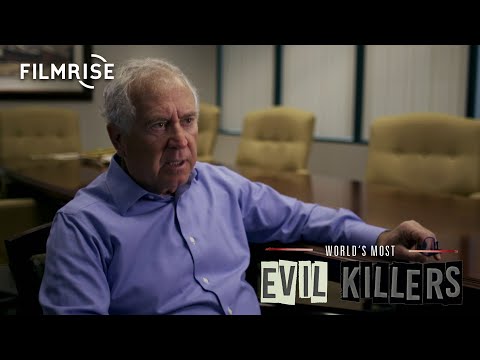
World's Most Evil Killers - Season 4, Episode 12 - Harold Shipman - Full Episode
Episode Description
Once a respected local doctor in Hyde, Manchester, Dr. Harold Shipman became better known as Dr. Death. In January 2000, Shipman was found guilty of murder and sentenced to life imprisonment.
An in-depth look at the lives and crimes of some of the world's most evil killers, including Jeffrey Dahmer, Ted Bundy, Richard Ramirez, Cary Stayner, Leonard Lake, Dorothea Puente and more.
Read the full transcriptHide the full transcript
- - MALE NARRATOR: When 81-year-old Kathleen Grundy was found lifeless in her home
- in Hyde, Greater Manchester, England on the 24th of June, 1998, no one could have foreseen that her death would lead
- to the unearthing of one of the world's most prolific serial killers. - GEOFFREY: This is not a man who's hiding in the woodshed
- with an axe in his hand, this is a man who is pretending to be helpful, and consoling, and compassionate.
- - NARRATOR: A popular local doctor, 52-year-old Harold Shipman, had been killing his elderly
- and vulnerable patients for over 25 years. But somehow he'd remained completely undetected.
- - That generation particularly trusted doctors, held them in great esteem, and would have done anything they asked.
- - NARRATOR: Shipman would eventually be found guilty of 15 murders, but an inquiry
- after his incarceration would estimate the true number of victims to be well over 200.
- - PHIL: You know, he was a doctor, he had power over life and death and somehow he seemed
- to get some kick from exploiting that. I mean, it's very hard to imagine. - NARRATOR: Harold Shipman, the man nicknamed Dr. Death,
- had been unmasked as one of the world's most evil killers. - ♪ ♪♪ - NARRATOR: When Dr. Harold Shipman
- was found guilty of killing 15 women in January, 2000, the nation was in shock. But investigators had merely scratched the surface
- of his murderous career. The respected general practitioner, who was once a pillar of the community in Hyde,
- Greater Manchester, England, had been christened Dr. Death by the British tabloids.
- A 2002 inquiry into Shipman's crimes estimated that the number of deaths he was responsible for
- was at least 215. Detective Bernard Postles led the investigation into Britain's most prolific serial killer of all time.
- - I don't think that Shipman's victims knew that they were going to die. As far as they were concerned, quite often,
- Dr. Shipman was treating them, so people would willingly roll up the sleeve and offer their arm to him,
- and were probably in the process of chatting to him whilst he was actually administering the injection
- or taking a blood sample. But in actual fact what he was doing was, he was administering
- morphine in sufficient quantities to kill them. - NARRATOR: Journalist Mikaela Sitford was working
- for the Manchester Evening News when she first heard about the investigation into the family GP.
- She went to visit him at his surgery. - When I first met Shipman, I remember thinking how
- reedy and weak his voice was and how small he was physically, he wasn't imposing at all.
- And I knew from talking to people later on that he could be quite arrogant and high-handed.
- He knew the effect he was having on people, he was actually enjoying it at times, and I just thought
- that was evil and cruel. And he just broke the heart of the whole community. - BERNARD: As the inquiry went further, as we started
- to investigate more deaths, it was becoming beyond what I could have ever have believed it was going
- to become, which is the largest serial killer that this country has ever known. - NARRATOR: Shipman's story begins
- on January the 14th, 1946 in Nottingham, England. The middle child of three grew up on a council estate
- in a working-class neighborhood. - DR. YARDLEY: Harold Shipman was one of the post-war
- baby boom generation, and this was a real age of opportunity, where working-class kids could
- become middle-class professionals. So when he passed the 11-plus exam and went to grammar school, his mother was very proud of him
- and she pushed him incredibly hard. And I think there was the expectation that Harold
- was the family's gateway to a middle-class life. And I think that pressure that was always there for him
- really bore down on him quite heavily because he wasn't naturally clever, he had to work
- incredibly hard to get where he got. - NARRATOR: Shipman was particularly close to his mother, Vera.
- - DR. YARDLEY: When we look back at the childhoods of serial killers we look at their relationships
- with their parents and very often we see an awful lot of abuse, an awful lot of neglect,
- but in this case it seems to be completely the opposite, Harold Shipman seems to have been targeted
- by his mother for excessive praise and really becoming very enmeshed and invested in him.
- - GEOFFREY: He identified with being her blue-eyed boy, and I'm sure that Vera said to him persistently,
- "You're the one that's gonna make the Shipman name famous." Which in fact he did,
- but for perhaps not the right reasons. - MIKAELA: But when he was in his teens she developed
- lung cancer. And she would sit in the window and wait for him to return from school and he'd come in
- and make her a cup of tea and, you know, they'd have a sit and a chat about their day and, um,
- she just looked forward to that moment. - NARRATOR: In June, 1963, 43-year-old Vera Shipman
- succumbed to cancer. Her doting son was devastated. - DR. YARDLEY: Harold Shipman's mother died
- when he was 17, and this was an incredibly traumatic event for him because his mother had played
- a very significant role in his life, she was quite controlling, she was quite domineering,
- she would always tell him what he should be doing, and suddenly she's not there.
- - GEOFFREY: But significantly, Shipman saw how the local GP administered diamorphine to his mother to help her pain.
- It's also possible that, and this is rather a gruesome way of putting it, that Shipman became fascinated with watching his mother die.
- - DR. YARDLEY: So, you've got this all-powerful GP who's come into the family home
- and taken control of the situation. And I think that, perhaps, did plant a bit of a seed
- for Harold Shipman there, the fact that there's this individual who, who comes in, they have status,
- they have power, they have authority, and nobody questions them. And I think that's something that really did lodge
- in his mind. - NARRATOR: By the mid '60s, Shipman had left Nottingham and headed to Leeds to study medicine.
- While living in Yorkshire, the young student met his future wife. - MIKAELA: Primrose was Shipman's landlady's daughter,
- and he got her pregnant, and so they had to get married, and Shipman's carefree student days
- were over. - GEOFFREY: In 1970, Harold Shipman graduated from Leeds Medical School and got a job
- at the Pontefract General Infirmary in West Yorkshire, he was relatively recently married, he had one child
- and another one was on the way. But what no one knew at that point was that Shipman had a completely different agenda
- from the Hippocratic oath, he wanted to do harm. - NARRATOR: After learning his trade in Pontefract,
- 28-year-old Shipman moved out of a hospital environment to take a role as a general practitioner.
- - MIKAELA: Shipman joined the Todmorden Group Practice, his first job as a GP, in 1974,
- and he was like a breath of fresh air, he was young, enthusiastic, modern, he had all these great ideas,
- and they thought the world of him. - BERNARD: But there were concerns raised by a pharmacy nearby about the amount of pethidine
- that was being prescribed by him. - NARRATOR: When an investigation was launched
- and Shipman was confronted, he claimed to be suffering from depression and said he'd become reliant
- on injecting himself with pethidine, an addictive opiate-based painkiller. - It is not at all uncommon for healthcare providers,
- physicians, nurses, and others that might have access to drugs, to become addicted
- because it's right there. Shipman was basically writing and forging prescriptions for himself.
- - BERNARD: But what he would do would be make prescriptions out in the name of some of his patients, when in actual fact they didn't
- need it, and he would go and take the prescription to the pharmacy himself, and draw it and use it himself.
- - DR. YARDLEY: When Shipman's addiction was discovered, he resigned from the medical center where he worked,
- he was fined £600 by the General Medical Council, but he wasn't struck off. All he had to do was go and partake
- in some drug rehabilitation and that was it. And there was never really any follow-up to that,
- so it was almost swept under the carpet. - I think the view was that he had a personal problem
- and that he wasn't actually a danger to anyone, which was clearly wrong. - NARRATOR: By 1977, 31-year-old Shipman
- was back practicing medicine across the Pennines in Hyde, Greater Manchester. He spent the next 15 years as a GP at Donneybrook House Surgery,
- where he built up a reputation as a trusted family physician. - He had a very good bedside manner, a good ability
- to make people feel good about themselves, and as a result he had a lot, a lot of patients.
- - MIKAELA: They thought so much of him that when he moved from the Donneybrook group practice
- in Hyde to start his own single-handed practice, he poached 3,000 of them and there was a waiting list.
- - NARRATOR: Shipman began his new venture at 21 Market Street, just across the road
- from Donneybrook House, in August, 1992. - He was literally a pillar of the local community.
- Everybody knew who Harold Shipman was. - DR. YARDLEY: Because he would go the extra mile
- with his patients, he would spend time with them, he would sit with them and have a cup of tea,
- he didn't mind doing home visits. So he gave off the impression that he was a GP
- who genuinely cared, and I think that's what makes it all the more chilling when we look at
- what he went on to do. - NARRATOR: For the next six years, Shipman would continue to win praise from his patients
- as a well-respected and well-liked doctor. Despite being a killer disguised as a savior,
- he forged an unblemished reputation as one of the most trusted GPs in Hyde, Greater Manchester, England.
- However, by March 1998, suspicions had been raised about the 52-year-old by another nearby doctor's surgery.
- - MIKAELA: There was a new GP, Linda Reynolds, who joined the group practice across the road from Shipman's,
- and she'd noticed that they were signing many more death certificates for Shipman than any other GP,
- and when she researched it further, she found that his death rate was three times
- that of any other doctor in town. - BERNARD: As a result of that, the matter was reported
- to the coroner, the coroner reported it to the police, and an investigation took place.
- - NARRATOR: This first opportunity to stop Harold Shipman failed due to a lack of incriminating facts
- to support the alligations. - The police investigation only lasted for four weeks,
- and it found that there was no evidence of wrongdoing on Dr. Shipman's part, so that was that.
- - GEOFFREY: It was to prove a tragedy because, had they investigated Shipman more carefully,
- they would at least have found more evidence that things were not exactly as they seemed.
- And perhaps, perhaps, the abandonment of that investigation was the catalyst that saw
- Shipman take that one step too far. - NARRATOR: Shipman had escaped unpunished for now,
- but it was only a temporary reprieve. His real downfall began with the death of the former mayoress of Hyde, Kathleen Grundy.
- Just like Shipman, the spritely 81-year-old was well-known and popular in the small town.
- - MIKAELA: Kathleen Grundy was found dead on the 24th of June, 1998 by two friends who called
- after she didn't turn up to the lunch club she ran with them. The door was shut, but not locked, and they walked in
- and found her laying on the settee fully dressed. - NARRATOR: On the day of her death, Harold Shipman
- had visited Kathleen to carry out a blood test. The news of her passing came as a total shock
- to Kathleen's family, including her daughter Angela, and son-in-law, Phil Woodruff.
- - She distorted my expectation of how an 81-year-old should be, because she was just incredibly fit,
- she was remarkably energetic. - NARRATOR: Kathleen had spoken to her son-in-law about Dr. Shipman during visits
- to Angela and Phil's home in Warwickshire. - PHIL: She thought he was a very good doctor.
- She, I think consciously, moved herself onto his list and encouraged various people, other people, to do so.
- - NARRATOR: After Kathleen's death, Phil finally got to meet this celebrated doctor,
- but was far from impressed with Shipman. - I mean, when we went to see Shipman immediately
- after she died, he--he inferred that she'd been very frail, and infirm, and not well, and that she'd died
- from old age, and we knew that was complete nonsense. He was not very sympathetic, he was rather...
- I don't know--exactly know how to describe it, but, you know, on the basis of Kathleen's report of him
- as such a nice chap, he seemed sort of rather cold and rather detached, should I say.
- So it was a bit strange. - NARRATOR: Despite the family's concerns, Shipman had already filed Kathleen's death certificate.
- - PHIL: It was clear that Shipman was trying to avoid an autopsy. I was naive enough to think that that was for our benefit,
- not for his, so rather stupidly, we went along with that. And then of course, up turns this so-called will,
- which was just ridiculous, I mean--I mean not only the content but the way it was done, it was...it was badly typed
- on--on a typewriter, on a pro forma, you know, the sort of thing you buy from a stationer's,
- and it just was not Kathleen's style at all, uh, she had a much more, kind of, professional approach.
- If she'd really wanted to produce a will that we didn't know about-- and that would be very hard
- to imagine--she would have probably handwritten it because she had beautiful handwriting.
- - NARRATOR: Not only did the scruffy-looking document appear hurried, it also omitted Angela and Phil.
- The will instead instructed that all of Kathleen Grundy's assets should be left to Harold Shipman.
- - PHIL: Angela, I mean, obviously she was distraught, I mean, she was going to say, "Well, look, he can have it,
- he can have it," you know. And I said, "That's ridiculous, that's not your mother's will."
- - DR. YARDLEY: In the will, Kathleen said that she wanted to leave all of her money and her belongings to her GP,
- "To reward him for all of the care that he's given to me and the people of Hyde."
- Now, that really didn't ring true with Kathleen's family and also in the will it said, "My family
- "don't need this money, they don't have that kind of urgency for it." So it really was highly suspicious.
- - PHIL: We initially looked at the signature and compared it with the signatures on--I think we had a driving license
- of hers--it was similar, but clearly not the same, the alignment of the capital G was wrong.
- - NARRATOR: Phil and Angela decided to play detectives, they were certain something was amiss with the will.
- Their initial port of call was to the witnesses who'd countersigned the document,
- both of whom were patients of Dr. Harold Shipman. - PHIL: We showed her the signature and so on,
- and she said, "Well, it looks like my signature, but that's not the way I write my address."
- And she said she didn't know what the document was, she'd just signed the document.
- - NARRATOR: It was a similar story with the second apparent witness. - PHIL: I showed him, not the whole document,
- but just the bit with the signature on it, and his wife or partner sort of looked over his shoulder
- and she said, "Well, that's not the way you sign your name." 'Cause there was a big flourish underneath the signature,
- and as I understood it, that is not what he would have done. So we realized that there was something seriously wrong.
- - NARRATOR: Despite second-guessing themselves, Phil and his wife Angela, a solicitor, had begun
- to believe not only that Shipman had forged Kathleen's will, but that he may well have murdered her.
- - PHIL: At that point, we realized that we needed to involve the police, but we didn't really think it was
- terribly realistic to sort of wander into Hyde Police Station and say, "Oh, by the way, we think that Dr. Shipman
- has killed my mother-in-law." So Angela talked to one of her partners who did criminal work, and he, of course, had contacts
- in the police at Warwickshire. - NARRATOR: After putting their concerns in writing
- and handing it over to the local authorities, the complaint soon found its way to Greater Manchester Police.
- - BERNARD: Having received the report of concern, Greater Manchester Police launched an inquiry.
- What they quickly established was that the signatures on the will and on the letter were forgeries.
- Forensic scientists were able to tell just by the way that the signature didn't flow that it was a forgery in itself.
- They were also able to say the same about the signature on the letter that accompanied the will,
- that purported to have been made by somebody called J. Smith. Again, because the signature didn't flow,
- it was possible to say that that was a forgery. - NARRATOR: The will and accompanying letter were
- sent off for forensic testing, and the results link Shipman to the documents. - BERNARD: What we did find was that the letter
- and the will had been typed on a typewriter, a portable typewriter, and when we'd begun
- the inquiry and executed a warrant at Dr. Shipman's surgery, we seized a typewriter from there.
- It turned out the typewriter from Dr. Shipman's surgery had been the one that had been used to type
- the letter and the will. - MIKAELA: When they asked Shipman about the typewriter
- and the will, he said that Kathleen Grundy had borrowed the typewriter off him, and yet there were
- no fingerprints on there from her. - And this was--was somewhat incredulous, wasn't it, really,
- the thought that the GP is lending a typewriter to a patient, he really is clutching at straws
- at this point in time. But he's so arrogant that he thinks people will believe him.
- - NARRATOR: Shipman was still free to practice medicine as the investigation continued around him.
- The police knew they needed some hard evidence to prove Kathleen Grundy's death was suspicious,
- which led to a difficult decision being made. - No postmortem had taken place before she had been buried
- because Dr. Shipman had issued her death certificate, which would therefore preclude the need for it.
- But the concerns about the beneficiary of the will being Dr. Shipman, the timing of the will being,
- coming to light, all led me to suspect that something wasn't right here. And so on the 29th of July,
- I went to see the local coroner, John Pollard, and made application for a warrant
- to exhume the body of Kathleen Grundy. - NARRATOR: Detectives broke the news to Angela and Phil.
- - PHIL: They both sat on the sofa over behind me and, uh, side-by-side, and told us what was what,
- which is basically that they had been talking to the coroner and got this permission
- to exhume Kathleen's body. - And in Shipman's mind, after he gave them the drugs,
- and after the person died, and after the person was buried, he thought he's home free.
- Who's gonna exhume the body? It almost never happens, but they did in this case,
- and that's how they got him. - NARRATOR: On the 1st of August, 1998, Kathleen Grundy's body was exhumed.
- The postmortem findings by pathologists stunned investigators. - BERNARD: At first they said that they believed that
- there were opiates in the body, but with some more sophisticated testing, they were able to say that
- it had been morphine that had been found in Kathleen Grundy's body. That in itself was a surprise to us, Kathleen Grundy
- had not been suffering from any condition which necessitated her being prescribed diamorphine,
- and she had been fit and well up until the days before her death. - NARRATOR: The postmortem results were staggering,
- but they were only possible due to Kathleen's family going against their late mother's apparent wishes.
- - The fake will had a box ticked where Kathleen Grundy had seemingly stated she wanted to be cremated,
- and obviously this would have removed any physical evidence that Shipman had killed her.
- But Angela wanted Kathleen to be buried near her brother and her parents, and it's because of this that she
- was buried rather than cremated. - BERNARD: If Kathleen Grundy had have been cremated,
- then of course, there would have been no remains to be exhumed, there would have been
- no opportunity to examine tissue, and we would not have discovered that she had died from
- a massive dose diamorphine. - NARRATOR: The net was closing in on Shipman, but he remained a free man.
- Detectives at Greater Manchester Police were trying to keep the investigation under wraps, but the press
- were about to discover what was happening. - MIKAELA: I first heard about Harold Shipman in August 1998,
- our news desk at the Manchester Evening News had got a call overnight that Kathleen Grundy
- had died and her doctor was being investigated for her murder. So I rang the police to see if we could
- get some background on this. - There is no doubt that the reporter who raised those queries, Mikaela Sitford, had most of the story,
- and she then embarked on publishing that story. As a result of the public becoming aware,
- then they raised concerns by ringing the police about the circumstances of the death of their loved ones as well.
- In some cases, they'd harbored these concerns for years, but had been reluctant to raise them
- with the police because they didn't want to challenge what their GP said. But once this came to light, we started to investigate
- those deaths as well. - They came back to me with this statement saying they were investigating 20 deaths,
- and if those 20 deaths were all true, that made Shipman Britain's biggest serial killer.
- - NARRATOR: Time was running out for the popular doctor, with evidence mounting up against him,
- the police finally decided to take action. Five weeks after the exhumation of Kathleen Grundy,
- on the 7th of September, 1998, Shipman was ordered to speak with detectives. - BERNARD: Shipman was arrested by appointment,
- which sounds like a strange thing to do. Harold Shipman was aware of our inquiry,
- there was no surprise element here, there was no early-morning raid like you see on films and the television.
- And so consequently he came to the police station with a solicitor to answer questions.
- There's no doubt that he was confident that he was gonna walk out of that police station
- after a few hours. - MIKAELA: On the day Shipman was arrested, my colleague, Chris Gleave, and I waited outside
- Ashton Police Station, where he was due to turn up to be interviewed. And as we're walking along, Shipman turned back
- and faced us, and he held his arms out, almost, you know, like Christ on the cross, and said,
- "Just go on then, take my picture." And Chris did, and that was the last time Shipman
- was seen outside of custody. - NARRATOR: Detectives questioned Shipman about the death of 81-year-old Kathleen Grundy.
- - BERNARD: Part of the interview involved Dr. Shipman telling outright lies, he sought to...bamboozle the interviewing officers
- with medical terms, he tried to put across that he was intellectually superior to the officers.
- But as far as I was concerned, this was a fairly simple issue. Who had been the last person that had been
- in the presence of Kathleen Grundy? What condition was she in when he'd left her?
- What was the cause of death? And who was most likely to have administered that cause of death?
- And with every one of those questions, you boil down to the answer being Dr. Shipman.
- - NARRATOR: The interviewing officers presented Shipman with evidence of the will tampering.
- - Dr. Shipman denied that he'd ever seen the will, he'd ever been in its presence.
- But what we did find was that his fingerprint was on the back of the will, which made it difficult
- for him to continue with that claim. - NARRATOR: Detectives knew that Shipman had visited Kathleen on the day of her death
- to carry out a blood test, but there appeared to be no proof of it ever taking place.
- - BERNARD: Kathleed Grundy's blood sample that he said to take didn't exist, it had never been received
- at the pathology lab, it still wasn't lying in his surgery weeks and weeks later.
- Where was it? And he couldn't explain those types of things. We concluded at the end of the interview
- that there was sufficient evidence to charge him with Kathleen Grundy's murder, and that's what we did.
- - NARRATOR: The police knew they had a strong case against Shipman, but they were certain that if he'd killed
- Kathleen Grundy, it was possible he'd killed others. - DR. YARDLEY: In order to build a case against Shipman,
- the police needed to get a different type of evidence, and that would involve exhuming some of the bodies
- of Harold Shipman's recent victims to see whether there was substances in those bodies
- that really shouldn't be there. - NARRATOR: The exhumations began on the 21st of September, 1998.
- - We then exhumed the three bodies of Bianka Pomfret, Winifred Mellor, and Joan Melia over three days.
- We got Dr. Rutherford to conduct postmortem examinations on each of them, and we sent the samples off
- for examination. On each of those people Dr. Shipman had issued a death certificate, and each of those death certificates
- suggested that they had died from heart attacks, but there was no evidence of that
- when Dr. Rutherford carried out the examination. - NARRATOR: Between October and December, 1998,
- another five bodies were exhumed, making nine in total. Kathleen Grundy may have been killed for financial gain,
- but it was becoming apparent that Harold Shipman had used his position of power to murder the people
- who trusted him the most just because he could. - BERNARD: Quite often Dr. Shipman would turn up
- out of the blue, people had not sent for him, and within a very short time after they'd been in his presence,
- they were found dead. And they were found dead in odd places, they were sat up in chairs, fully dressed,
- not in a scene of disarray as if they'd fallen over, as if they'd knocked anything over.
- - Most of Shipman's victims were found sitting in the chair, cup of tea by their side, almost recreating the scene
- that used to greet Shipman when he came home from school with his mother waiting in the window
- while he made her a cup of tea and looking for him, and waiting for him to come home from school.
- - LOUIS: Shipman is not a doctor, doctors are people that try to heal others that try to cure others,
- Shipman's a murderer. His goal for the greater part of his career was to kill patients,
- and he did it for his own gratification. - GEOFFREY: And that's what makes it so chilling.
- This was a man who was destroying people's lives for his own amusement, as if he were catching butterflies or crushing insects.
- - NARRATOR: One of the exhumed victims, 73-year-old Winifred Mellor, had supposedly died of heart-related problems,
- but pathologists found no proof of that in the postmortem. - BERNARD: As inquiries developed, it proved that...
- an examination of the computer showed that, uh, Dr. Shipman, in actual fact, had created a false record
- to indicate that she had been suffering from angina over a period of time in order for him to cover up
- the fact that he had administered an injection to her which had resulted in her death.
- - MIKAELA: I don't think Shipman's victims would have suffered, not sure that they would have understood
- that they were dying. The drug he used and the strength he used it at would just send them very quickly to sleep,
- and, you know, that's what you would hope. But I think the last words might have been,
- "Thank you, Doctor." - NARRATOR: Doctoring medical records became a common theme in the investigation into Shipman.
- - MIKAELA: So, for example, Maurine Ward, who he killed when she was just 57, he changed her medical records
- to make it look like she had had cancer, when she'd actually been given the all-clear
- by hospital doctors. - BERNARD: Although on first appearance it would appear that he'd made these weeks before,
- the computer expert that we utilized, when he had a look at them, he was able to examine the transaction login
- within the computer system, and he was able to determine that they'd actually been made after he'd been along
- and murdered these people. - NARRATOR: By the 5th of October, 1998, Shipman had been in custody for almost a month.
- As detectives continued to interview the doctor, cracks in his cold demeanor began to show.
- - MIKAELA: At the end of the second interview, when the computer records showed what Shipman was really up to,
- in no uncertain detail, Shipman asked for a break in the interview, and as soon as the police left,
- he fell to his knees sobbing, he knew it was over. - BERNARD: There's no doubt that he had come to realize
- that, virtually, the game was up, that he had got no answers to these questions where we were
- presenting him with documents and he just couldn't explain things away. - NARRATOR: By February, 1999, 53-year-old Harold Shipman
- had been charged with the murder of 15 women ranging in age from 49 to 81. Postmortems from nine exhumed bodies confirmed
- they were poisoned, while circumstantial evidence linked the doctor to six other victims, all of whom were cremated.
- Despite all the evidence that suggested Shipman was a callous killer, it was difficult to comprehend,
- even for a seasoned detective. - BERNARD: There's no doubt that on a day-to-day basis,
- myself and my deputy, um, questioned ourselves about whether we were interpreting this evidence
- in the correct way. Did we have this wrong? Was there another explanation for this?
- But the more evidence we uncovered, the more it corroborated previous evidence, and there was only one answer that we could come to,
- and that was the fact that Dr. Shipman had killed these people. - NARRATOR: The trial of Dr. Harold Shipman
- began on the 5th of October, 1999 at Preston Crown Court. The entire nation wanted justice served upon the man
- the papers were calling Dr. Death. The 53-year-old general practitioner pleaded not guilty to 15 counts of murder
- and one count of forging the will of Kathleen Grundy. The earliest killing, that of 81-year-old Maria West,
- dated back to March, 1995. - DR. YARDLEY: It's important that all cases that go to court
- have a realistic chance of a conviction. So the threshold for evidence, even for a charge
- to be brought, is quite high. And we have to remember that in this case some of these murders were years and years old,
- the quality of the evidence would have declined to such a degree, that it would be very, very difficult to secure
- a conviction for murder. So there were only 15 counts of murder in this particular trial,
- but that was just the tip of the iceberg. - NARRATOR: Of the 15 counts of murder,
- nine of the bodies had been exhumed, but prosecutors were confident they could still get
- a guilty verdict on the others. - Six of Shipman's victims were cremated, but the police
- were still able to prove that Shipman killed them. This again is down to the computerized medical records
- being changed, added to which there were witness statements, and one of the most moving things about the court case
- was that there were so many ordinary people who'd never seen the inside of a courtroom in their lives,
- and they were having to stand there and give their evidence and remember their last moments with their loved ones.
- And it was because of their strength and their ability to give that evidence and remember what they needed to remember
- that Shipman was caught and stopped. - NARRATOR: Phil Woodruff, the son-in-law of Shipman's final victim, Kathleen Grundy,
- was often in the courtroom during the three-month trial. - PHIL: He did come over as very arrogant, yes.
- He was very full of himself, and I think that, I mean, that was obviously part of his image that he created
- in Hyde, that he was a wonderful doctor, and I think he took great pleasure in presenting himself in this way.
- So, yeah, he had a high opinion of himself. - NARRATOR: It was an attitude that would be
- his undoing. When Shipman came under intense questioning from head prosecutor Sir Richard Henriques, he buckled.
- - BERNARD: He was a worm wriggling on the end of a hook because with each question that was put to him,
- he was really uncomfortable at trying to find answers to some of the questions. And some of the answers that he gave
- were pretty ridiculous. And he appeared to be thinking of some of the answers whilst he was stood in the witness box.
- It was another example of his arrogance, he appeared to decide that he was going to go toe-to-toe with
- one of the leading barristers in the country. And it wasn't--it wasn't a good idea.
- - NARRATOR: On the 31st of January, 2000, Harold Shipman was found guilty of all 15 murders
- and of forging the will of Kathleen Grundy. He was sentenced to life in prison, much to the relief
- of his victims' family members. - MIKAELA: As each verdict of guilty was read out,
- there'd be, like, a fresh wave of soft sobbing or gasps, and it kind of built up, it was really filling the air
- of the courthouse, it was one of the most moving things I've ever seen. - DR. YARDLEY: Harold Shipman was convicted of all 15 murders
- and was sentenced to life in prison. And you would say, to a degree, justice has been
- done here, but actually for all of the other victims whose murders were not having charges associated
- with them, this is, is something that is kind of incomplete. I think that the families of these victims
- don't feel that they got justice. - NARRATOR: In September 2000, an investigation was ordered
- to delve deeper into the career of Harold Shipman. High Court judge Dame Janet Smith led the inquiry.
- - MIKAELA: I think the Shipman inquiry was a brilliant legacy for the families of Shipman's victims.
- They worked really hard, they fought for a public inquiry because for years, a doctor had been able to carry on
- unnoticed, killing people, because of the secrecy and the reverence around the medical profession.
- - BERNARD: It was important to them that somebody carried out that examination and came to some sort of
- verdict about what had happened, and that's exactly what the public inquiry did.
- And I think that in itself gave some families the reassurance that they'd done what they could
- to find out what the true circumstances were. - NARRATOR: The results of the initial inquiry
- were released in July, 2002, and the findings stunned the world. - MIKAELA: The Shipman inquiry have found that
- he's definitely responsible for 215 murders, but there could be as many as 260. Having said that, not every death will have been picked up,
- and I think there were many more than 260. - NARRATOR: With so many victims in such a small area,
- it was perhaps inevitable that the inquiry would reveal some families had lost several relatives
- at the hands of Shipman. Phil Woodruff lost three members of his extended family.
- One of them had only signed on to Shipman's patient list after a glowing recommendation from Kathleen Grundy.
- - I don't exactly know how many people she recommended him to, but she certainly recommended him
- to her sister-in-law Elsie Plant. I remember when Angela said to me, about her mother,
- "Well, you know, old people don't die just like that." And I said, "Well, they do, look at Auntie Elsie, right?"
- So my example was actually of somebody else killed by Shipman. - NARRATOR: The inquiry discovered it was not just
- women, but men who were victims of Shipman, too. As a result of the report, Shipman was given
- a whole life tariff, which meant he would never be released from prison. Although given a chance to confess to his numerous murders,
- Shipman rejected the opportunity to speak with detectives. - BERNARD: So they went to interview him,
- they decided to video that interview. And what that video depicts is Dr. Shipman standing up,
- turning his chair away from them, and just turning his back to them, so that although they ask him the questions,
- he refuses to answer, and he also refuses to look at them. And he never actually disclosed what had occured
- in relation to many of those offenses before his death. - NARRATOR: In a heartless move, Shipman decided
- to take all his secrets to the grave. - Shipman committed suicide by hanging in prison on the 13th of January, 2004,
- um, it was the day before his 58th birthday. So again, it was Shipman being in control and doing
- what he wanted and playing God, deciding who lived and who died and when. - LOUIS: And when you have someone like Shipman,
- with his arrogance, in prison, I'm not surprised at all that he committed suicide, I would be shocked
- if he was gonna live in prison, living the life of an inmate, he couldn't do it.
- He was too grandiose, too narcissistic, way too arrogant, and he just killed himself.
- - BERNARD: Harold Shipman never showed any remorse for the murder of all these people,
- he never discussed his involvement in the deaths, he never apologized to any of the families,
- and he decided to take the circumstances and what had happened with him when he committed suicide.
- - NARRATOR: Even in death, Shipman continued to haunt the country. A sixth and final report was published by the inquiry
- in January, 2005. - MIKAELA: The Shipman inquiry found that he'd begun killing as early as 1971 while he was still
- training as a doctor, he'd not even become a doctor and he was already killing. The inquiry found that he was responsible for as many
- as 15 deaths at Pontefract General Infirmary, possibly including that of a four-year-old girl.
- - NARRATOR: Shipman's suicide in January, 2004 means that hundreds of family members may never know
- what happened to their loved ones. It was the final callous act in a callous career.
- - PHIL: It's always this problem about the word "evil," isn't there, how you attach that to somebody.
- But if anybody's evil, I think he's evil, yes, right. To go around killing people in cold blood,
- apparently just for the pleasure of it. - MIKAELA: It was a doctor, a doctor who's supposed to look after you,
- who's supposed to care for you, who's supposed to save your life, not take it. And I think, you know, as a nation, that really resonated.
- If it could happen in Hyde, such a close-knit community where families still lived next door to each other
- and looked after each other, then it can happen anywhere. - PHIL: Probably there aren't many people who'd lived
- in Hyde for a generation who didn't know somebody who'd been killed by him. - ♪ ♪
- ♪ ♪ - NARRATOR: It is hard to picture Harold Shipman as a cold-blooded killer, but that's exactly what he was.
- He was meant to care for people but instead, he was murdering them, for no other reason
- than his own self-gratification. His insatiable appetite for death spurred Shipman on
- to take the lives of over 215 innocent and vulnerable victims. He is without doubt one of the world's most evil killers.
- - ♪ ♪♪ - [whooshing sound]
Brief Summary
Harold Shipman, a trusted doctor, murdered over 200 patients, exploiting their trust before being caught after Kathleen Grundy's suspicious death.
Key points
- The Shocking Death of Kathleen Grundy. The lifeless body of 81-year-old Kathleen Grundy is discovered, leading to a chilling investigation.
- Harold Shipman: The Trusted Doctor. Harold Shipman, a respected doctor, is revealed to be a serial killer who exploited his patients' trust.
- The Forged Will. Kathleen Grundy's suspicious will surfaces, leaving her assets to Dr. Shipman, raising alarms for her family.
- Exhumation of Kathleen Grundy. Authorities decide to exhume Kathleen Grundy’s body after suspicions arise about her death.
- The Arrest of Harold Shipman. Shipman was arrested by appointment, confident he would walk free. This was not to be.
- The Shipman Inquiry. The inquiry revealed Shipman was responsible for 215 murders, shocking the world.
Episode highlights
- The Shocking Death of Kathleen GrundyThe lifeless body of 81-year-old Kathleen Grundy is discovered, leading to a chilling investigation.“No one could have foreseen that her death would lead to the unearthing of one of the world's most prolific serial killers.”0:15Aug 17, 2021
- Harold Shipman: The Trusted DoctorHarold Shipman, a respected doctor, is revealed to be a serial killer who exploited his patients' trust.“He had power over life and death and somehow he seemed to get some kick from exploiting that.”1:09Aug 17, 2021
- The Forged WillKathleen Grundy's suspicious will surfaces, leaving her assets to Dr. Shipman, raising alarms for her family.“The will... was just ridiculous.”15:17Aug 17, 2021
- Exhumation of Kathleen GrundyAuthorities decide to exhume Kathleen Grundy’s body after suspicions arise about her death.“They had been talking to the coroner and got this permission to exhume Kathleen's body.”21:11Aug 17, 2021
- The Arrest of Harold ShipmanShipman was arrested by appointment, confident he would walk free. This was not to be.“He was confident that he was gonna walk out of that police station after a few hours.”25:25Aug 17, 2021
- The Shipman InquiryThe inquiry revealed Shipman was responsible for 215 murders, shocking the world.“The Shipman inquiry found that he's definitely responsible for 215 murders.”39:05Aug 17, 2021
- Shipman's SuicideIn a final act of control, Shipman committed suicide in prison before his 58th birthday.“Shipman committed suicide by hanging in prison on the 13th of January, 2004.”41:13Aug 17, 2021
Tension
85/ 100High tension