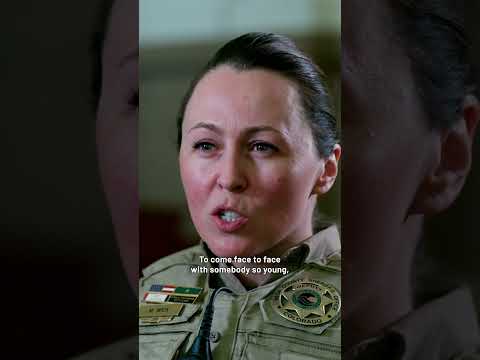
Women Behind Bars in HD - Season 3, Episode 1 - Melissa and Angela - Full Episode
Episode Description
One woman was convicted of killing two people and the other woman allegedly sexually violated and robbed a woman and then left her to die.
Read the full transcriptHide the full transcript
- NARRATOR: On this episode of "Women Behind Bars," one woman was convicted in the shooting deaths
- of an 87-year-old grandmother and her caretaker. This lady is sitting in her wheelchair.
- He's got a gun to her head and he kills her in front of me. And the question was, why?
- The house wasn't torn up. There was no breaking and entering. They had nothing to steal.
- NARRATOR: Then Angela Rocka tells her story. She allegedly robbed and sexually violated a 21-year-old woman and then
- left her to die in a closet. That's when I come in and I choke her and cover her face with the pillow.
- I don't know why I couldn't stop. As I'm trying to I sleep I begin to hear a female's voice
- come from Leslie's apartment repeating the words why, why, why, over and over again.
- NARRATOR: Two women, two brutal crimes. These are the stories of Melissa Harris and Angela Rocka.
- [THEME MUSIC] NARRATOR: On the morning of November 16, 1995, police responded to a horrifying scene at a mobile home
- after receiving a call from a concerned neighbor. They discovered the body of Mrs. Durfee lying on the floor.
- She had been shot twice to the back of the head. Mrs. Bailey was in a chair. And she had been shot once in the back of the head.
- NARRATOR: Detectives suspected that stealing a car from one of the victims could be a motive.
- They could have taken the car and they would have been well out of the area before they would ever have been caught.
- These two ladies died for no reason at all. NARRATOR: A few days later, 28-year-old Melissa Harris
- and her 25-year-old boyfriend Earl Linebaugh were arrested when they tried to enter
- Canada in the victim's car. He had escape charge and was really into the white supremacists movement.
- He was all about that. I think Earl Linebaugh killed Mrs. Bailey and Mr. Durfee.
- He then told or forced Melissa Harris to fire a second round into Mr. Durfee while she was already dead on the floor.
- I did not shoot anybody in that mobile home. I was not armed. I had no gun. And I would not have hurt either one of those women.
- NARRATOR: Was Melissa Harris a willing participant in a brutal double homicide or was she held hostage
- by an abusive boyfriend? Tyler, Texas back then was a very small town. We didn't have much going on, maybe a movie theater.
- I have one sister that I grew up with. She's seven years older than me. She was almost like a mother figure in a lot of ways.
- Melissa was a sweet little girl. I called her the princess because it was like she could do no wrong.
- She always had mom and dad's attention. And she was their little angel. We lived out on Tennessee Street.
- We bought a house out there. And that's where Melissa was born. She had a very outgoing personality.
- NARRATOR: But according to Melissa's sister Kim, the churchgoing family hid a dark secret.
- To say we came from a dysfunctional family is putting it mildly. My grandfather abused me from the time I was 2.
- And Melissa has claimed that he abused her too. Sexual abuse is something that she was raised seeing.
- I was sexually abused by my grandfather. And that's a very painful memory. I've never talked about it.
- Melissa never told the police about the abuse. But then again, she never told the family about the abuse.
- We weren't raised really to go to the police a lot. NARRATOR: Despite her problems at home,
- Melissa came into her own and excelled at school. I was freshman class officer. I also got in debate in the ninth grade.
- I loved debate. I felt powerful and motivated. But then it kind of all fell apart later in high school.
- Melissa was around 15 I think when she fell and she hit her back on the porch. I ruptured a disk.
- And I was put on an open prescription of Tylenol four with codeine. We had a charge account at a drugstore.
- And the prescription was always there, so anytime I wanted this medication to make me
- feel better I went and got it. Coming from a heavyset family she was afraid of being fat.
- She started taking the Mini Thins that you get at the supermarket and she became addicted to those.
- I learned real quick that it made me feel better more than physically. It did more than take away that pain.
- That anything emotional I didn't want to deal with I had it for that too. NARRATOR: In 1987, Melissa met a man named Dean.
- Although she earned good grades, the young student quit school her senior year to follow her heart.
- He became more important than anything else, my schooling, my dreams. Getting married and having children became my dream.
- I tried to warn her that any man that would let her throw her school education away there
- was something wrong. But she needed to do what you needed to do. NARRATOR: Melissa went on to have three children with Dean,
- Debbie, Amanda, and Douglas. But her love of over-the-counter drugs led to experimenting with harder street drugs.
- With smoked pot almost on a daily basis. But later he enter introduced me to something called crank.
- And I honestly, I fell in love with this drug. It made me feel invincible, like I could do anything.
- NARRATOR: But the false sense of security faded away. And Melissa says she was left to deal
- with an unraveling marriage. They had rented this apartment. And I went up there and she had a bruise on her arm.
- Melissa started coming up with a black guy or a bruise on her arm. And when you asked about them she always had an excuse.
- I would tell people I fell down. I would tell people I ran into walls or doors. They saw the bruises and I think they knew better.
- But I'm not going to tell them I'm putting up with that kind of abuse. NARRATOR: Despite the alleged violence, the mother of three
- was determined to make the relationship work. I was very much in love with Dean Harris,
- but I also think I wanted an escape. I wanted my own family to be perfect. And so in my head and in my heart
- I thought I could do that. NARRATOR: Finally, after nearly a decade of marriage,
- 28-year-old Melissa left her husband and returned home. She found a job cleaning homes and started
- putting her life back together. When I left Dean I moved in with my parents and I had all three my kids.
- I was feeling powerful. I felt like I could finally stand on my own two feet. And that's where I met her Earl.
- He wasn't sir Galahad but no means. But he treated her with respect. His father was police chief of a very small town.
- It just seemed like he had it all together. When we first started dating he was the kind of man that opened car doors and brought your flowers.
- NARRATOR: But Earl Linebaugh had a complex and sinister past. Linebaugh was a bad man.
- He left home when he was 18, 19 years of age, moved to Alabama. Was arrested for kidnapping and armed robbery.
- Sentenced to prison. Ended up being put on probation. Melissa seems to be drawn to men who abuse
- her, who want to control her. Maybe she has an inner need to be controlled. NARRATOR: The new couple rented a house by a lake next door
- to her mother in Flint, Texas. But within a week, Melissa says her boyfriend's behavior changed for the worse.
- Earl became very possessive. He started saying you're mine, these kids are mine.
- You will not go next door, you have to stay here. Melissa, she couldn't go anywhere without him.
- If he went to work or he went to the store he would tie her up. I'm scared of Earl.
- I'm scared to leave Earl. I don't know what to do. He would hit me and slap me and shove me against the wall.
- I couldn't do anything. NARRATOR: Melissa claims her continued use of painkillers left her numb.
- Then the alleged brutality reached a point of no return in November, 1995. The man ties me up, he rapes me.
- I can't even tell you everything he did to me that night in that house. The very next day, Earl put my son on the banister
- of the staircase. And he puts a gun to his head and he says you leave Texas or I will kill him and I will kill you
- and I will kill your whole family. That's the reason I left Texas with Earl Linebaugh.
- NARRATOR: When "Women Behind Bars" continues-- Melissa sees Earl going back to the living
- room with some sort of pillow. I hear this gunshot. And I freeze. I'm like, oh, my god.
- What did he just do? NARRATOR: In November of 1995, 28-year-old Melissa Harris was living in Flint, Texas with her three children
- and her 25-year-old ex-convict boyfriend, Earl Linebaugh. Soon into the relationship, Melissa
- claims Earl started acting paranoid and threatened to kill her family if she left him.
- Earl was in trouble with probation. He wanted to isolate us. So he tells me he's got this group of survivalists
- that he knows in New Mexico. So this is where we have to go. Earl felt like he had been wronged by society.
- And I think he was looking for acceptance from someone. One of the ways that he thought he could find that
- was in this white supremacist group. NARRATOR: Melissa contends her drug use and fear of Earl
- caused her to follow him. We were smoking marijuana and I was doing a lot of pills at the time.
- I'm scared to leave Earl. I don't know what to do. So what do I do? I take too much medication.
- NARRATOR: Contrary to Melissa's story, detectives believe she was in fact, a willing partner.
- According to police reports, the couple then stole a credit card from Melissa's cousin.
- They rented a trailer, hitched it to Earl's car and drove to Earl's father's house.
- Earl stole several guns from his dad's residence. His dad reports it right away to law enforcement.
- And he takes those guns with him. The first time I realized how heavily armed he is,
- is when he opens up the trunk of the car and there's just like all these guns. They go to school and take the kids out of the schools
- that they're in and then they disappear. NARRATOR: Earl, Melissa, and her three children
- headed west out of Texas. They go to Taos, New Mexico. They join the white supremacist gang.
- They actually stop and pawn a gun while they're in route. NARRATOR: The couple then turned south and tried
- to crossed the Mexican border. They're turned back by the Mexican authorities namely because Earl is not the father of the three children.
- And at some point after that the car breaks down. NARRATOR: Melissa left her kids with Earl and rented a truck.
- Melissa claimed throughout the whole thing that she was afraid of Earl, that Earl had
- threatened her and her kids. Despite all of her assertions, she was determined to stay with.
- I was not going to leave my kids behind and just take off to a police station when they were with him
- and he's armed. No, I wasn't going to do that. The couple drove halfway across the country
- to Melissa sister's house in Orlando, Florida. As Melissa tells it, she then wrote
- a letter giving her sister custody of the three children. My main focus is I want out of that house
- before he harms the kids, before he harms my sister. And if I have to leave with Earl to do that, so be it.
- He takes a book bag and he puts clothes in it and guns. They get up onto the interstate and they start to hitchhike.
- While she's hitchhiking a state police stop to pick her up. And I know if I say anything he's going to kill this man.
- If it kills us both, Earl's not going to care. People don't understand this man was crazy.
- He's got his hand on the gun the entire time we are in that car. NARRATOR: But Detective Proctor doesn't buy Melissa's story.
- She's with a law enforcement officer. If she'd had a problem with Earl Linebaugh,
- that would have been the opportune time for her to have brought it to his attention.
- It was a real missed chance if you believe her story of how afraid she was of Earl.
- NARRATOR: Melissa claims that when the state trooper dropped the couple of on the side of the highway
- he did not ask them for any identification. They made their way north on foot into Pasco county Florida.
- After not too long we're walking on the railroad tracks. We walked and we walked.
- And they came across this remote area called Crystal Springs. It was basically a few mobile homes on a dusty road.
- I got to the point where I couldn't walk any further. He takes us off the railroad tracks
- into this residential area. Earl immediately starts saying we have to steal a car.
- So at that point Earl says we're going into someone's home. He's going to tie them up and by the time
- they get loose we'll be gone. NARRATOR: Melissa and Earl stopped at a secluded mobile home on Wise Road.
- Inside were 84-year-old Maudeline Bailey and her 57-year-old caretaker Alice Durfee.
- They went up to the door, asked to use the phone. Said that their car had broken down.
- I pick up the phone and I dial a number. Earl's right behind me the whole time. I hang up the phone and we leave.
- When they leave the residence, she describes walking down to an area with a lake.
- Her and Earl sit there and they talk about what they're going to do. Earl says we're going back.
- This is the house. NARRATOR: Earl and Melissa returned to the Bailey's mobile home.
- Melissa claims Earl was the only one with a gun. I knocked on this door. And when Alice opened it he just
- strong armed his way through. He had her lay face down on the ground. He starts screaming at me, Melissa, go
- see what you can find. I run to the back of the house. He's screaming the whole time.
- The two women are in the living room. Melissa goes to a back room and she sees Earl going back to the living
- room with some sort of pillow. The woman on the floor says you don't have to kill us.
- I'm in this kitchen and I hear this gunshot. And I freeze. I'm like oh, my god. What did he just do?
- And then Melissa comes back out of the kitchen. She goes to the living room. This lady is sitting in her wheelchair.
- He's got a gun to her head and he kills her in front of me. Earl's explanation of why both women were shot
- was no witnesses, no crime. He did not have to kill these women. NARRATOR: The couple stole cash, credit
- cards, and Mrs. Durfee's car. Then Melissa Harris and Earl Linebaugh disappeared.
- The next day, police arrived at the mobile home after a neighbor called 911. They discovered the body of Mrs. Durfee lying on the floor.
- She had been shot twice to the back of the head. Mrs. Bailey was sitting in the chair
- and she had been shot once in the back of the head. And the question was why? Who?
- The house wasn't torn up. There was no breaking and entering. They had nothing to steal, no money, no jewelry.
- The police had no suspects. Neither lady deserved to die. Linebaugh and Harris stole their lives.
- While detectives scoured the scene for leads, Melissa and Earl were on the run. They drove to Georgia stopping only to sleep at a motel.
- It is here, Melissa says, that Earl gave her a weapon. He gives me a gun. I didn't think it was loaded.
- There's no way he would have gave me an operational weapon. I wrapped this gun up in tissue paper and I put it in my pants.
- He tells me that we're linked forever and that I better have his back. NARRATOR: Coming up on "Women Behind Bars"--
- They found actually in her vagina a semiautomatic pistol. NARRATOR: And later-- She had scratches over her body.
- She had a bandana tied around her neck. And I said Leslie, are you OK? And she says, Will, I've been raped.
- NARRATOR: In November of 1995, an execution style murder took the lives of two elderly women
- in Crystal Springs, Florida. A few days later, 28-year-old Melissa Harris and 25-year-old
- Earl Linebaugh were on the run. They drove west to North Dakota, using the victim's credit
- card to fund their escape. From there we know that they made it to the border of Canada
- where they were stopped by the Canadian officials and asked their purpose for coming into Canada.
- NARRATOR: The border guards asked to search the car. They checked the trunk of the vehicle
- and they don't find anything. They checked the passenger side and they find a 22 pistol in the front floor board
- underneath a pair of shoes. Linebaugh immediately declares ownership of that weapon.
- He says that he had it for protection. NARRATOR: Melissa was frisked and placed in a separate interview room.
- Even though she was in police custody, she still did not ask for help or alert officials in any way.
- After everything he had done to me, all I'm hearing is bullets travel through walls.
- I'm going to get you. I'm going to get your family. And that's all I can hear and that's all I can see.
- There's a $500 fine for bringing an unregistered gun into Canada. And when she is told that she pays the fine
- on Miss Durfee's credit card. NARRATOR: The authorities contacted Florida police
- and were referred to detective Proctor. He and his partner got on the next plane
- to Canada to interview Melissa. Eventually she tells us that she's Melissa. Of course, she also tells us that she
- doesn't want to talk right. She evokes her Fifth Amendment rights and chooses not to give a statement
- at that point in time. The whole time I'm incarcerated I still have this gun that Earl gave me wrapped in tissue paper.
- She was still basically dressed in the same clothing that she was detained in. When they start to transport her from this facility to a larger
- facility they do a strip search. And they found in her vaginal area, actually in her vagina, a semi automatic pistol.
- The gun was wrapped in tissue paper. There's no way it could have been inside me or anything
- like that. It was just in the panties up against, up against me. NARRATOR: Melissa Harris and Earl Linebaugh
- were taken back to Florida and charged with two counts of first degree murder. Melissa maintained that she never fired a gun
- and offered to testify against Earl in exchange for a reduced sentence. She was trying to get a deal from the office of the State
- Attorney, in turn, we requested that she take a polygraph test. And there's two target questions.
- Did you shoot one of the ladies inside the residence? And have you been totally honest with law enforcement
- about your involvement in the case? She failed both of those questions. As a result, the office of the State Attorney
- was not willing to make any deals with her. NARRATOR: Melissa and Earl were tried separately.
- Facing the death penalty, Melissa entered a plea of not guilty. They were very stone faced during the trial.
- Neither one of them testified in there own defence, so it was hard to say how they would have reacted
- as witnesses on the stand. NARRATOR: According to Melissa, it was her attorneys who
- prevented her from testifying. I was told Earl's not on trial. So I couldn't tell anybody on the stand
- what Earl Linebaugh did. My lawyers never cared. I had no defense. Before he's even met my sister, before he's
- heard a word out of her mouth he says to me, and I quote him, "If I save your sister from the chair
- I've done my job." NARRATOR: During the trial, a ballistics expert testified that the gun found in the car in Canada
- matched the bullet used to kill Mrs. Bailey and was also used to shoot Mrs. Durfee.
- The second bullet found in Ms. Durfee, however, remained a mystery. There were no real markings on one of the bullets that
- was found inside Mrs. Durfee. The same ballistics expert testified that it could have
- come from Linebaugh's gun, but it was just as likely that it could have come from the gun
- that Melissa had when she was arrested in Canada. It was our theory that Mr. Linebaugh, after having shot
- Mrs. Durfee and Mrs. Bailey turned to Miss Harris and told her now it's your turn.
- It's called a marriage. Earl didn't think that she would testify against him if she actually put a bullet into the back
- of Ms. Durfee's head. NARRATOR: The prosecution presented strong evidence. That pillow used to muffle gunshots and gruesome crime
- scene photos. But Melissa was shocked by what she felt were personal attacks. The prosecution, he said all kinds
- of things, horrific things. And that I went in this home knowing that Earl was going to kill these people.
- I may not be perfect, but I would not have participated in a murder. NARRATOR: Melissa was transferred
- to a maximum security prison in southern Florida. She still maintains her innocence.
- I didn't use a weapon. I didn't kill anyone. I could have died too. And sometimes I think that may have been best.
- Because we wouldn't me doing this now. My family wouldn't be suffering. NARRATOR: Melissa's mother raised Melissa's children,
- some of whom now have children of their own, but have never met their grandmother.
- It's been four or five years since I've seen my mom. I miss her a lot. NARRATOR: Myra Duato also suffered as a result
- of her mother's death. She has also dealt with the guilt that she never told her father what really happened.
- I said mother died of cancer in her sleep. I never told daddy that I lied to him.
- I never ever told him the truth, because it was too much for me, and I knew it would be too much for him.
- To the victim's family, I would just say I'm sorry. I wish I could have done something
- to stop what happened. I'm just sorry that my fear put me in a state of inaction
- rather than some kind of action. I should have let kill me before I ever knocked on that door.
- NARRATOR: Next up on "Women Behind Bars," a woman is tortured and robbed for drug money.
- There was absolutely no sense of humanity. This woman needed to be killed so she
- could not talk at a later date. NARRATOR: For more information about "Women Behind Bars,"
- go to WEtv.com. On May 29, 2000, police responded to a 911 call at an apartment complex in a Houston suburb.
- A 21-year-old pre-med student named Leslie had been robbed and severely beaten. She had scratches over her body.
- She said she had been raped. The victim stated that they took turns assaulting her.
- One had a bandana around her throat and was strangling her. Another one was blindfolding her.
- She'd been hit in the head with an iron. Then they tied the victim up and placed her in a closet
- and left her for dead. NARRATOR: Leslie was taken to a nearby hospital where she described her attackers.
- Police arrested Leslie's neighbors Angela Rocka, a 30-year-old habitual drug user,
- and a 21-year-old Harold Umanzor. I believe it was planned by both Angela and Harold.
- They knew what they were going to do. Once they had complete control of this victim
- they did what they wanted. Angela was the one driving the violence and the rage.
- What doesn't make sense is why she had to do what she had to do. I own up to my part of the robbery.
- And I own up to my part of the assault. But she was never sexually assaulted by me or Harold.
- NARRATOR: Was Angela Rocka a participant in a drug induced robbery and torture? Or was she the mastermind of a brutal assault and premeditated
- act of sexual violence? Angela's birth mother, according to the defense, was a drug addict.
- As a toddler, her mother would administer drugs to Angela so that when she would cry it would soothe
- her and have her stop crying. I'm certain that her ingestion of drugs both us a prenatal and as a young child had
- a significant influence on her. NARRATOR: Angela was given up for adoption to a couple in the suburbs who gave the little girl
- a second chance. They prefer to remain anonymous. Even though they adopted me at an early age,
- I think of them as my mom and dad. My brothers are my brothers. I was raised around them.
- That's all I know. Any sports that was in season I would play. And they're real supportive.
- They come every game, every practice. She had an outgoing personality, but I don't know as I would describe
- her as a real happy person. NARRATOR: But from an early age, Angela felt that she didn't fit in.
- My parents never made me feel out of place, just my brothers, because they were perfect
- little angels and I wasn't. For the first 10 years of my life, I was out of place, completely.
- NARRATOR: As Angela grew, the isolation she felt began to manifest in disturbing ways.
- I've always had a real bad temper. When I was a kid my brothers would hit me or whatever,
- and next thing I know I'm chasing them the hallway with a baseball bat. NARRATOR: By the time she was 12,
- Angela claimed she had seen several therapists for treatment of her violent tendencies.
- One psychiatrist decided to keep me in their hospital. I stayed a couple weeks. Next thing I know, hey, I am bipolar
- and I'm taking medications. NARRATOR: Almost immediately, the young teen began to abuse her medication.
- The pills would sit in the kitchen window sill. And I'm supposed to go take them at a certain time.
- I would take them at a certain time. I would just take more than I was supposed to.
- I felt like they were supposed to make me happy all the time. And they weren't, so I'd do more.
- And it became addicting. NARRATOR: It wasn't long before Angela's self-medicating lead
- to experimenting with a variety of street drugs. I started smoking pot with my friends.
- I was aware of being abandoned. My mom left me, never came back to get me. Why? What I do?
- And it stuck with me. Maybe I was escaping reality. I would mix my alcohol and my pills, smoke pot.
- And then if there wasn't any pot left I would get some cocaine, crack. Drug use seemed to be consistent
- throughout her entire life. This truly was a young lady that had significant psychological issues.
- When I was high, I was happy. I had no problems. I didn't have to think about anything.
- NARRATOR: Despite her difficulties with drugs, at age 17 Angela married and had a baby girl.
- The young mom says it was the best time in her life. It was sheer blissfulness. I love being a mom.
- I've always wanted to be a mom, always wanted to be settled down. NARRATOR: But the marriage didn't work out.
- Angela focused on staying sober and had a son with another man. I had already quit drugs.
- I was cleaning up real good. My structure is good, my foundation is good. Everything's like fairy tale.
- She appeared to me to be a good mother. She enjoyed being with the children, doing things with them.
- I remember reading to them and playing games with them. NARRATOR: Regrettably, the relationship with her son's
- father was also short lived, as Angela struggled to curtail her on again off again drug habit.
- A parent's not supposed to go looking for drugs while their child is at a babysitter.
- My kids went to their dads and I went off on my own living with guys, boyfriends, friends.
- NARRATOR: Estranged from her children and her parents, Angela finally sought help at a drug treatment center in 2000.
- Using drugs took control of her life. In my opinion, she had to hit rock bottom before she realized that.
- NARRATOR: But upon her release, Angela moved in with a man she met in rehab and went right back to her old ways.
- We got out at the same day, went to his apartment, partied. He was real into coke and crack cocaine.
- It was no good for me at all. But I didn't have anywhere to live so I stayed there.
- That area is basically a suburb of Houston where people, ironically, go to escape crime and the dangers
- of the inner city. It's considered a safe part of town. I didn't have a job so I didn't do anything
- but go to the pool, lounge around. And that's how I met the people I met. NARRATOR: At the time, Harold Umanzor
- was 21 years old and living with relatives a few doors down from Angela. I can't necessarily say I was actually in love with Angela,
- but I was very, very attracted to her. We'd go to his brother's apartment, hang out there, watch TV, get high.
- NARRATOR: In the same apartment complex lived a 21-year-old bartender named Leslie.
- At the time of the offense she was a pre-med student. She was intelligent, she was full of life.
- She was actually a remarkable young woman. Leslie was right across from me in my apartment.
- We spoke on occasion and talked for a little while. She said if I ever need to use her phone,
- she knew I didn't have a phone, that I could use her phone. NARRATOR: William Munoz is a Houston police officer
- who lived next door to Leslie. I was still in uniform the first time I met Leslie.
- She was moving in. She always had a smile on her face. I remember the last thing her mother
- told me was make sure you take care of my daughter. NARRATOR: Broke, desperate, and in danger of being kicked out
- of her boyfriend's apartment, Angela says she began a four day drug binge. The first two nights I was getting high with my boyfriend.
- Snorting coke, smoking crack. Then the third night I was hanging out with Harold.
- He had like 20 hits of acid. We split it. We just sat around coming up with this plot
- that we're going to get some money. It was really kind of a spur of the moment thing.
- NARRATOR: The prosecution believes Angela had an additional motive for the crime.
- Angela was crashing at someone else's apartment. And we believed that she was jealous of Leslie.
- Angela stated that she was jealous of the victim because the victim had a life, had a job, had family.
- Angela came to Leslie's door, knocking and asking to use the phone. Leslie says sure and invites her in.
- And then Leslie hears the door open again. At that point, Umanzor walks in with a gun in his hand.
- And he says surprise, surprise. And that's when the crime begins. NARRATOR: When "Women Behind Bars" continues--
- Angela grabbed an iron and bashed Leslie over the head several times. And they left her for dead.
- NARRATOR: In May of 2000, 30-year-old Angela Rocka had recently left a drug rehab center.
- She quickly relapsed with her friend Harold Umanzor and went on a four day drug binge.
- Hungry and broke, the two devised a desperate scheme to rob her 21-year-old neighbor, Leslie.
- We came up with this plan to go see Leslie and take her money from her and her credit cards
- so we could be OK. NARRATOR: Once inside, Angela claims that Harold tried to subdue Leslie.
- He was trying to contain her, keep her still. But she fought back. At that point, they turned up the radio to drown
- out Leslie's cries for help. I thought to myself, if I can just hit her on the back of the neck hard enough
- it will make her pass out. But that wasn't what happened. NARRATOR: Both Harold and Angela blame each other for bringing
- Leslie into the bedroom. I threw her on the bed, but I just couldn't get her to-- you know what
- I'm saying, to just stay still. I ended up trying to tie her up so she wouldn't move.
- They tied a bandana around her neck to choke her. They tied bandanas around her wrist to tie her to the bed.
- NARRATOR: But Angela denies that Leslie was bound in any way. She wasn't tied up.
- There was no need. You know, there was the both of us. NARRATOR: Angela says she then left the bedroom to search
- the apartment for money. When she returned moments later, she began her own furious attack.
- That's when I come in and choke her and covered her face with the pillow. I don't know why I couldn't stop.
- It seemed like she really had a lot of anger inside of her. It seemed like she was really taking that out on Leslie.
- I think maybe I was a little envious. Her bills were paid monthly. She always had something to eat.
- You know, she had a job, she had a good family. It was just all bottled up. NARRATOR: According to the prosecution,
- both Angela and Harold then blindfolded and allegedly raped Leslie. They apparently were inserting various objects
- in her genitalia. She realized from the difference of the hands and such that they were taking turns assaulting her.
- It was all about causing pain and submission and overpowering a young woman NARRATOR: But Angela denies the attack ever turned sexual.
- I never sexually assaulted my victim. Leslie was never sexually assaulted in that house.
- NARRATOR: The torture continued with Leslie slipping in and out of consciousness.
- It definitely got to the point to where we had reached the point of no return. At some point towards the end, Angela takes an iron
- and hits her a couple times upside the head. There was absolutely no sense of humanity.
- This woman needed to be killed so she could not talk at a later date. In addition, they stomp on her neck, fracturing vertebrae.
- I believe she did kick on her neck a couple times. Leslie had urinated on her shelf
- and had also defecated on herself and apparently was quite the mess. The only thing we could come up with
- was just to put her in the closet. I really don't even know what I wanted her in that closet.
- I don't know. It was my idea. So she's left in that closet with her own blood, her own urine, fecal matter.
- I just thought she was gone. I thought she had passed away. NARRATOR: As Leslie lay dying, Harold fled the scene.
- Angela stole some jewels and cash and met up with Harold at a fast food restaurant.
- The two then went home. When she finally came to she was able to sort of crawl up to the door
- and open the closet door where she just fell out. NARRATOR: Leslie's neighbor, Officer
- William Munoz had just come home after working the night shift. The wall for her bedroom and my bedroom were adjacent.
- And as I'm trying to go to sleep I begin to hear a banging noise and then a female's voice come from Leslie's
- apartment repeating the words why, why, why over and over again. NARRATOR: Officer Munoz crawled through Leslie's bedroom window
- and found her lying on the floor. He then called 911. She had scratches over her body.
- She had a bandana tied around her neck. And I said, Leslie, are you OK? And she says, Will, I've been raped.
- NARRATOR: Leslie was rushed to nearby Northwest Medical Center where she was interviewed by detectives.
- She told us what had happened and told us that she had recognized Angela. She'd also seen Angela around the apartment
- with the male suspect. She is seen by sexual assault nurse that does a full blown examination.
- NARRATOR: According to newspaper reports, the nurse called the attack one of the worst sexual assaults
- she had ever seen. Three days after the crime, Angela was arrested on an outstanding traffic warrant
- and questioned by police. She gave us a statement admitting that she'd gone into the victim's apartment.
- But she's trying to put all the blame on the male suspect, Harold. She wouldn't admit to anything at that time.
- Angela was adamant that a sexual assault did not take place. She was adamant that there was no gun used.
- It's not uncommon for a criminal to not admit everything they did. But perhaps it's even more difficult for a woman
- to admit to brutally raping another woman. NARRATOR: When Harold was arrested the next day
- he also claimed there was no sexual assault. I've been denying that since day one.
- I'm sorry, but it never happened. The state's case was all centered around Leslie.
- And Leslie was very clear that she was sexually assaulted and she was left for dead.
- That's what the state presented, the truth. The nurse was one of the first witnesses who took the stand
- and testified that this was one of the worst sexual assault cases that she had ever seen.
- NARRATOR: But the defense refuted the allegations. The only physical evidence on Leslie
- was the swelling in the genital area. And that could certainly be attributed to long term exposure to the urine and feces
- that she was discovered in. In essence, diaper rash, not necessarily a sexual assault.
- No hairs were found. No saliva, nothing sexually to link either Harold or Angela
- to a sexual assault on Leslie. When Leslie took the stand that was definitely the most
- emotional part of the trial. She said Angela's stuck one finger into my vagina and another finger into my anus.
- Then she said now [BLEEP], you're going to get what you deserve. And she pinched.
- And Leslie thought she was going to rip at that moment. NARRATOR: Angela testified in her own defense.
- She admitted assaulting Leslie, but denied raping and beating her with an iron. But once on the witness stand, unfortunately Angela
- didn't come across very well. It just made me out to be one of Charles Manson's followers,
- when I was really just a drug user and off my medication. Ultimately, there's going to be 12 citizens of Harris County
- who determined who they believed, whether it was Leslie or Angela. When they handed me the sentence I was shocked.
- I felt like someone just took my life. NARRATOR: But the final tragic footnote to Leslie's story
- came five years after Angela's conviction. I received a call from Leslie's sister
- who regrettably told me that Leslie decided to take her own life. I knew that she had not survived in the sense
- of putting that horrible, horrible crime behind her. Angela Rocka was still in the forefront
- of her life and her mind. They took away her lively spirit, all of all her dreams.
- If you don't have any of that left as a person, you probably don't feel like living anymore.
- NARRATOR: Angela Rocka will be eligible for parole in 2031. I am still, after a decade, real remorseful.
- I still carry a lot of guilt. With Leslie, I just wanted to talk to her, let her know
- it wasn't anything personal. I kind of wish she would have stayed around so I could have told her that.
- [MUSIC PLAYING]
Brief Summary
Melissa Harris and Angela Rocka commit brutal crimes, including a double homicide and a violent assault, revealing their troubled pasts and complex motivations.
Key points
- Brutal Crimes Unveiled. Two women, two brutal crimes: the shocking stories of Melissa Harris and Angela Rocka.
- The Dark Secrets of Melissa's Past. Melissa's family history reveals a painful legacy of abuse and dysfunction.
- A Relationship Turned Deadly. Melissa's relationship with Earl Linebaugh spirals into violence and control.
- Caught in a Web of Lies. Melissa's conflicting stories raise questions about her involvement in the murders.
- The Execution Style Murders. In November 1995, two elderly women were murdered in a shocking crime.
- Melissa's Innocence. Melissa maintains her innocence despite being transferred to a maximum security prison.
Episode highlights
- Brutal Crimes UnveiledTwo women, two brutal crimes: the shocking stories of Melissa Harris and Angela Rocka.“These are the stories of Melissa Harris and Angela Rocka.”0:58Sep 23, 2014
- The Dark Secrets of Melissa's PastMelissa's family history reveals a painful legacy of abuse and dysfunction.“To say we came from a dysfunctional family is putting it mildly.”3:41Sep 23, 2014
- A Relationship Turned DeadlyMelissa's relationship with Earl Linebaugh spirals into violence and control.“Earl became very possessive.”8:28Sep 23, 2014
- Caught in a Web of LiesMelissa's conflicting stories raise questions about her involvement in the murders.“Detectives believe she was in fact, a willing partner.”11:01Sep 23, 2014
- The Execution Style MurdersIn November 1995, two elderly women were murdered in a shocking crime.“An execution style murder took the lives of two elderly women.”18:11Sep 23, 2014
- Melissa's InnocenceMelissa maintains her innocence despite being transferred to a maximum security prison.“I didn't use a weapon. I didn't kill anyone.”23:56Sep 23, 2014
- Angela's Descent into CrimeAngela Rocka's life spirals as she relapses into drug use and violence.“Hungry and broke, the two devised a desperate scheme to rob her neighbor.”33:03Sep 23, 2014
- The Brutal AssaultLeslie is brutally attacked by Angela and Harold, leading to a horrific crime scene.“Angela grabbed an iron and bashed Leslie over the head several times.”34:24Sep 23, 2014
Tension
85/ 100High tension