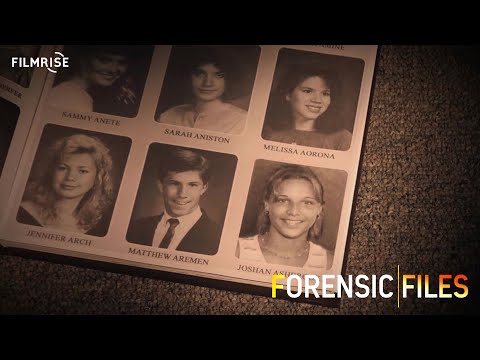
The Murder of Mandy Stavik | Murdered at First Sight
Episode Description
19-year-old Mandy Stavik and her faithful dog Kyra depart for a jog in rural Washington. When Kyra returns home alone, it is not long before investigators discover Mandy's body floating in a local river.
Murdered At First Sight is a true crime documentary series that tells the first-hand stories of the most complex and hard-to-solve homicide cases: murders committed by strangers.
Read the full transcriptHide the full transcript
- [CAMERA CLICKS] MOLLY: I probably took that picture of Mandy and our younger brother Lee.
- This has got to be up in Palmer, Alaska, in the wintertime, in the snow. We loved to play in the snow and ride horses.
- It was neat. That wintertime in Alaska, we'd tie a sled to my horse. We'd ride around the yard, taking turns pulling
- each other on the sled. It was a lot of fun. My sister loved animals, and she loved cats and horses.
- It was our one thing that we really connected with was with horses. And cats. Horses and cats were our thing.
- Mandy was a very confident and happy kid. She had lots of friends, and she was very active.
- DOUG: Mandy's personality, I would say vivacious. She was a hard worker at everything she did.
- When she committed to something, she really committed to it, and-- and succeeded at so much of what she did too.
- MOLLY: The day after Thanksgiving, on November 24th, 1989, Mandy left with Kyra, our German shepherd,
- for her run down to the end of the road and back, down to the river. Mandy never came home.
- KEN: She would have fought off attackers, so we believe that it would have to been through force, like a weapon of some type,
- to get her into the vehicle to kidnap her. Mandy's dog was very protective, but if the dog is overcome by force or weapon,
- was forced away from her, I think the dog would have not been able to defend her.
- MOLLY: My mom was calling everybody. She called all of her friends, and they didn't know where she was.
- Mandy's not someone who would just take off. We knew there had to be foul play. DAVE: We did have leads, but they never really materialized
- into any real prime suspects. BRYANNA: Typically, the victim and the offender will know each other.
- There's a relationship. But when that doesn't exist, police have almost nothing to go off of.
- DAVE: And it was an investigation that just went on for-- well, for 28 years. MOLLY: I mean, she was so close.
- How can she disappear that close to home? We were all just broken. I mean, this shouldn't have happened.
- It's a picture of Mandy and I and my older sister, Mary Alice, who had just graduated.
- That was a happy day. Mary Alice is seven years older than I am, which means she's 10 years older than Mandy.
- Mandy was born in Anchorage, Alaska on April 16th, 1971. Back then, we were just kind of your normal family.
- Mom was home and Dad worked. In 1974, my parents divorced, and my mom moved out and took with her Mandy
- and left me and Mary, Alice and Brent with our father, Glenn. In 1983, My family moved to Washington from Alaska.
- DOUG: Acme is a safe place to raise a family. It's a rural community. A lot of people live on farms down in the Acme Valley.
- Probably populated by what you might call hippies, a little bit back to the Earth.
- MOLLY: In 1983, Bandy joined Mount Baker High School. DOUG: Mount Baker high school in the '80s definitely
- had big hair. It was a close-knit school. Everyone wanted to go to the football games,
- everyone wanted to go to the dances, and it was quite a community. I was Mandy Stavik's band director.
- In 1983, Mandy joined band, and she played saxophone. She was really vivacious, really paying attention.
- She very quickly made a lot of friends and kept those friends throughout high school.
- MOLLY: Mandy was amazing. She was very active in high school. She did just about every sport she could think of.
- And my mom would kind of joke with her, and she's like, you can't do softball and basketball.
- She's like, oh, watch me. She was popular. She was bubbly. She was happy, very friendly.
- She would make people feel comfortable. People kind of gravitated to her. In 1989, Mandy graduated from Mount Baker High School,
- and then, in the fall, she went to Central Washington University. DOUG: Mandy was ready to take on the world.
- She just had everything going for her, and she knew where she wanted to go, and she was ready to pursue it.
- MOLLY: Mandy and her roommate came home from Central to spend the Thanksgiving holiday
- with the family. I remember hearing her talk with my mom about, you know, school and how much fun she's having and, you know,
- her plans. But right now, she was more focused on who she was going to get together with and reconnect
- with after Thanksgiving. The day after Thanksgiving, on November 24th, Mandy had stayed at the house, and
- she hung out with her friend. In the morning, we all ate leftovers, had pumpkin pie,
- and her and her roommate were going to go for a walk first, and then, after their walk, Mandy
- was going to go for a run. And they were going to get ready for, you know, a movie or whatever.
- Mandy left with Kyra, our German shepherd, down to the end of the road and back, down to the river
- Probably four to five miles total. It's kind of a straight shot to the river and back.
- It was an easy, flat run, and she did it all the time. I do remember my mom calling me and
- telling me that Mandy was missing, and I was just like, what? She goes, yeah, Mandy, she went for a run and didn't come home.
- And Kyra the dog just returned, but she was not herself. I want to say that she might even have
- been limping a little bit. My mom called the police immediately. [PHONE RINGING]
- [SIREN WAILING] KEVIN: Being a police officer means to me, serving the community and just making the community safer for myself
- and my family to live in. I started out as an explorer with the Bellingham Police,
- and I was hired by the sheriff's office in January of '89. I also attended Mount Baker High School,
- just like Mandy did. Once Mandy was reported missing, search and rescue was called out.
- KEN: I was 17. We all hung out with Mandy. We all knew Mandy. I was attending the same school that she did,
- Mount Baker High School, and our dads helped, I recall. Schoolmates helped. Because it was not a normal thing
- that happened in that area, for a girl to go missing. KEVIN: Mandy started at her house, which is behind me,
- and then ran in this direction. A lot of the times, her mom would ride her bicycle with Mandy.
- She just didn't happen to be riding that day. DAVE: And they told me right away that this young woman
- was missing. They were really very fearful that something had happened to her. Mandy was seen by a number of people
- between 2:30 and 3 o'clock, and she was coming back to her house. A friend of hers had seen her running
- and had pulled into a house and was waiting for her to run by, and she never did.
- KEN: We know that her brother Lee saw her at a residence just down the road from her house.
- We believe that she was abducted between the last time she was saw by her brother Lee,
- and between her house. DAVE: Mandy's dog had come home alone, and the dog was covered with silt on its hind quarters
- and looked like it had gone through a traumatic event. KEVIN: The neighbors and communities got together.
- There was 15 or 20 people that searched the roadway, the railroad tracks, the area within the home, and the route
- that Mandy normally ran. The resources to look for Mandy were citizens, family, friends, horses, helicopters, and
- they had a boat in the river. DAVE: We had a human tracker that went out that night,
- and he was trained to look at dirt alongside the road, and he found traces of a car stopped and
- a person got in on the passenger side, and alongside the vehicle was a ditch, and it was filled with water and silt.
- The family dog was cowering and wouldn't come with the tracker to go down. So we felt that she had been taken at that location.
- We thought the dog had been kicked into the ditch, and that's why the dog had silt on it.
- MOLLY: As a family, we didn't have any information other than you know, that she's missing and they're looking,
- but they-- you know, they did keep us up to date, obviously, but-- - I seem to kind of wave between total denial
- and hysteria, and-- and I haven't been able to sleep, and I just-- I mean, you know, you remember all the things
- you read in the paper, the Ted Bundy and the Green River killings and all of these terrible things.
- And all you can think of is, it doesn't happen to you. It doesn't happen here on Strand Road.
- But it did. MOLLY: We kept hoping. You want to hope for the best. And, of course, that didn't work out well.
- [SIREN WAILS] KEVIN: Mandy's body was found on November 27th of 1989 in the South Fork River.
- DAVE: The officers had been searching the river, walking all up and down the banks,
- and they had a patrol boat that had gone down the river, and the patrol boat spotted her body.
- KEVIN: Mandy's body was found right here. She was facing down river, outstretched, face down.
- She had tennis shoes and socks, and a watch on, and that was it. DAVE: We could tell by looking at the body
- that she had not been carried very far down the river. So we felt that she had been deposited there
- and had looked as though she had drowned, and it would have been very close to where we found her.
- KEVIN: One of the hardest parts of the job is notifying family members that their loved
- one has passed or died. MOLLY: I was at home with my mom, kind of waiting, and the police arrived and let us
- know that they found her body. I was shattered. I was just absolutely floored and shattered.
- I was mad that this was happening. I remember running out into the field behind our house
- and just screaming, just guttural, as loud as I can and as long as I could. Just-- just anger, like at everything.
- At God. Why? You know, how could He let something like this happen to us? DOUG: On Monday, after school, we had another staff meeting,
- and we kind of knew it might be bad news. And we went to the meeting, and it was announced by our principal that Mandy's body
- had been found. It was devastating to find out she had died. Such a vibrant young lady seemingly for no reason,
- had died. It was a very somber moment. There were people crying, just total shock for everybody.
- KEN: When Mandy's body was removed from the crime scene, she was taken to the Whatcom County Medical Examiner's
- Office, where she was examined thoroughly by the medical examiner. KEVIN: They found scratches on her legs, which
- indicated she had run through the brush in an attempt to get away. DAVE: We believe she was trying to escape
- and was running through blackberry bushes. We also discovered a hematoma, which is bleeding under the scalp, and
- it was on the top and right side of her skull. That was examined very carefully.
- KEVIN: This large bruise indicated she was struck or hit, and they found water in her lungs, which indicated that she had drowned.
- DAVE: And it appeared that she was just allowed to flow with the stream, and then was caught up with the branches
- where we found her body. Our medical examiner also determined that Mandy had been sexually assaulted.
- MOLLY: It made me feel sad that she had to endure that. Angry that it happened. She was probably terrified and running for her life.
- KEN: The crime scene where Mandy's body was found was important to preserve evidence
- in the form of footprints in the sand, to do canvas of the area for clothing or objects
- or anything to that effect. At that time in 1989, DNA was a new testing program that the FBI was doing, mostly.
- DAVE: The FBI worked with us in the laboratory and the sheriff's office and came up initially
- with a couple of suspects. And I got search warrants for them, and we cleared them through DNA analysis,
- and we eliminated them from the investigation. We checked all the sex offenders,
- and the officers are going door to door and checking on people and looking for anyone that could possibly be a suspect.
- This went on for a long time. We had a number of people that they were looking at initially.
- BRYANNA: There was a lot of suspicion by police that this murder was committed by the Green River Killer, who was later
- identified as Gary Ridgway. The Green River Killer would prey on women running in rural areas,
- on trails outside of Seattle. He would attack them, rape, and murder them. It's exactly what happened in this case.
- The exact same pattern with the exact same time frame. There was a lot that would link this case to this very
- infamous serial killer. This very plausible lead that the Green River Killer had
- actually just moved a little bit and had actually been responsible for the murder in this case didn't end up panning out,
- because the DNA found in Mandy's body and DNA found in the other victims' bodies of the Green River Killer
- were not the same. KEN: I believe the case was held back by lack of evidence. You have biological evidence in the form of semen.
- However, we have no way to test that or compare that against people at that time.
- So it was very important to preserve that evidence for future testing. DOUG: After finding out that Mandy had died,
- we were all devastated. You know, from 7th graders to 12th graders in this little tight-knit community.
- DAVE: The whole community was really impacted by this murder, and to think that a beautiful young girl who was so
- filled with promise could be abducted, raped, and then killed was just shocking.
- MOLLY: Mandy's death destroyed my mom. Absolutely. Losing a child is just unimaginable.
- And part of her was killed, too. My mom, who is 88 now, she's starting to have signs of dementia.
- As far as memories of Mandy, her forgetting that is, in my opinion, maybe a good thing,
- because memories of Mandy are painful, and I don't want her to be in pain. Mandy's funeral took place at the high school auditorium.
- It was a packed house. There were so many people there. It was just crazy. DOUG: Mandy had been on that stage many times.
- I had our jazz band, of which Mandy had been a member. The jazz band played a song at this memorial service,
- and we played "Here's That Rainy Day". I remember the song real clearly. It just seemed appropriate.
- KEN: The investigation turned to, who haven't we talked to in this area? They continued talking to classmates, old boyfriends,
- people that lived in the area, people that committed violent crimes, and nothing was coming to the forefront of who
- did this to Mandy Stavik. BRYANNA: But investigators never let it go. In fact, many detectives had pictures of Mandy
- on their desks, because they didn't want to forget this victim, and remembering we
- have to keep working this. And they did. In fact, investigators in this case kept writing to the FBI, asking, were there any updates?
- Did they rerun the DNA and find any hits? But, unfortunately, none of those ever panned out.
- KEVIN: As time progressed, it felt like this case would go unresolved. Mandy's family was kept appraised
- of the status of the case, as well as letting them know that we had not given up
- and that it was still assigned to somebody. MOLLY: As time went on, people started losing interest
- and it wasn't quite such a big story, and I didn't think they would ever find him.
- And in some ways, I kind of put it away. KEVIN: I was assigned as a primary investigator
- to Mandy Stavik in 2007. I feel a case that happened 20 years ago versus just happening are equally important,
- and I had the opportunity, because of my seniority, to pick which cold case I wanted to work on,
- and I purposely chose the Mandy Stavi case, not only because I went to Mount Baker, but because it was in my community
- and I felt that I had something to give. DAVE: By this time, we had a huge mass of reports,
- 7,000 pages of reports. Kevin Bowhay took all of the reports, sat down with me, and he organized those.
- KEVIN: I had it spread out over my living room, and reorganized it regarding persons of interest.
- There were still 20 to 30 people that needed to be contacted, as well as one person
- needed to be followed up on. I visited Mandy's family on several occasions, as well as making phone calls to let
- them know that I was still assigned, and that I was not going to give up. MOLLY: Every couple of years or so they
- would touch base with us and say, hey, you know, we haven't forgotten. We're still looking, you know.
- KEVIN: The only evidence that we were able to recover from the scene was DNA evidence found on her body, which
- we were able to preserve. So we started out doing DNA sweeps of individuals that lived in this area
- or were registered sex offenders. In 2010, myself and an FBI agent traveled to Cambodia to interview
- a suspect in this case. His DNA was collected. However, it did not match that that was left on Mandy's body.
- KEN: In 2012, I asked the lead detective, Kevin Bowhay, if I could review the case.
- My belief was that it could be a local person. As far as the DNA not coming back into the system,
- either the person hasn't been caught for another crime or the person hasn't been booked.
- In 2013, a schoolmate of mine came to me and said she had some information to tell me of some suspicious happenings
- to her that may be in aligned with what happened to Mandy Stavik. DAVE: It was during the summer, a number
- of women were at a water park in Whatcom County. One of the women said, you know,
- one person I thought could have been involved in this was Timothy Bass, and she described
- an incident she had with Bass where he had tried to grope her. The other woman said she had a similar experience.
- He had come to her house, wanted a glass of water, then refused to leave unless he had sex with her,
- and so she said she finally had to throw him out and was really concerned. So they said, you know, we should
- go to the sheriff's office and tell them that he is someone that should be looked at.
- KEVIN: Both of the women that came forward described him as being odd, antisocial,
- and sexually aggressive. DAVE: We looked at Tim Bass and found that his family lived on the same road
- that Mandy always ran on. She would run by his house every day. They realized right after this murder,
- he had moved out of the area to another city in Whatcom County, and had not been involved in the search for her.
- KEVIN: Detective Ken Gates knew Tim. He was friends with Tim's brother. So Ken Gates and I went out to Tim Bass's house.
- KEN: During that contact, it was very odd to me. He claimed he didn't remember who
- Mandy Stavik was, even though it was a huge case for the community. It was odd to me that he would make that statement.
- DAVE: We knew from other people that he had watched her play basketball. She was a star basketball player in high school.
- So the fact that he said he didn't know her was really suspect. KEVIN: He kind of looked up at the ceiling
- and repeated Mandy's name a couple of times, saying, Mandy, Mandy. Kind of like pretending to search
- for who she might be, and then made the comment, oh, yeah, she's the gal that they found in the river, right?
- KEN: We asked Tim ass at that time, in October of 2013, for his DNA sample. He refused.
- He did mention that he watched crime shows and saw innocent people go to jail. We left his house knowing that that was his frame of mind.
- BRYANNA: Now, that could be a sign that he is guilty, but it could also be a sign that this is someone who wants
- their civil rights respected. KEVIN: So the next step was to see if we could get a DNA sample from his place of employment.
- KEN: We went to his work and asked management, and they did not give us permission to do that.
- They advised to seek a warrant. KEVIN: At this stage of the investigation, we did not have enough evidence to put Tim with Mandy,
- therefore a judge would not have issued a warrant. So that was not an option. From 2013 to 2017, we kept an eye on Bass.
- We even went out and followed Tim during his delivery route, waiting for him to discard an item which
- would have had DNA on it. Unfortunately, he never discarded an item, and he wore a rubber gloves.
- MOLLY: The impact of Mandy's murder affected our whole family. It made me more guarded, more skeptical of people.
- It just made me less trusting. I worried about my daughter and wanting her to be careful.
- I know that they were still working on it and they didn't have a lot to go on, but it just-- it was frustrating.
- KEVIN: In August of 2017, we had followed Tim on his route, and his supervisor made the statement,
- well, I know what you want. You want Tim's DNA. And she said that she could get his DNA.
- She told me that she had a cup which he had drank from, as well as a Coke can that she had
- collected out of the garbage, which he threw away. So I collected the can and the cup
- to have it shipped down to the state crime lab. In December of 2017, I got back to the office,
- and my coworker had stated that he had gotten an email from the state crime lab wanting to know
- what my phone number was. I called the state crime lab, and she said, Kevin, just wanted to let you know that the DNA
- matched that of Tim Bass's. KEN: And Kevin Bowhay contacted me and said, Ken, we got a match.
- KEVIN: It was like winning the lottery. I was in shock and disbelief, but in the same sense,
- I was relieved and-- and ecstatic. DAVE: I was extremely happy when I got that call.
- We had worked for 28 years in this case, and we did everything we could possibly
- think of to-- to solve it. KEN: Now the next steps were to, OK, what has he done in the last 28 years?
- [SIREN WAILING] We developed a strategy to arrest Tim Bass. We did not want to have an incident at his house,
- because he had children. He had his wife. So it was decided that we would take him down at his place of work.
- KEVIN: We drove out to Tim's place of employment. It was about 8 o'clock in the morning.
- He was walking from the warehouse to his truck. We stepped in front of him. I asked him, do you remember me?
- And he said, yes. He looked at us and said, well, what's going on? What's this about?
- And I said, well, I believe you know what this is about. And he was arrested. MOLLY: It was in the afternoon.
- I was in the living room when I got the phone call, and he said, we found Mandy's murderer.
- And the ironic thing was it was my mom's birthday. We were notified on my mom's birthday.
- Her 81st birthday, December 12th, 2017. It's like, man, what a birthday present.
- DOUG: I was in the band room at Mount Baker High School. I checked my email, and I saw that they had arrested
- someone in Mandy's case. First thing I see as I scroll up is Mandy's picture, and I just jumped away from the computer,
- because I was not expecting that. It brought so many feelings back about the time when she had disappeared
- and throughout all those years when nothing was happening. And then all of a sudden, someone was arrested.
- And it was a hopeful moment, but it was shocking. It was shocking to me. KEN: Tim Bass was brought into the station, where
- detectives interviewed him. - And he denied everything. KEVIN: We asked him if he ever dated Mandy.
- He said no, that he had never dated her, he never had any sexual relationship with her, that he just watched her basketball games.
- KEN: When Tim Bass was notified that his DNA was a match to the semen, it was almost like he was trying
- to think of another story. KEN: He engaged in conversation. Again, at first saying he didn't know much
- about the case, didn't know Mandy at all, but ultimately ended up saying that he had some type
- of relationship with her. KEN: Tim was asked about dating her, what they did on dates.
- Did they come to her house? Did-- did she come to his house? Locking him into a story to try to take him back to 1989
- to see where he was at the time. MOLLY: There's no way that she would even give him the time of day.
- Maybe in his-- you know, his dreams. There's no way. It was just laughable that he would say that.
- KEVIN: We knew this was a lie. When we pressed him on, well, do you know why Mandy was going to school?
- KEVIN: He had no idea why, which proved that they had no relationship. Otherwise, they would have talked
- about whether she was enjoying college, whether she wasn't. He had no idea of any part of her life.
- DAVE: I knew by the evidence we had, we had probable cause, and I felt we had enough evidence to convict him.
- And so it didn't matter to me at that point what he did say. KEVIN: Once we were done talking with him,
- Tim was booked on charged with murder as well as rape and kidnapping. KEN: After Tim Bass was arrested,
- we discovered that he didn't have much of a criminal history. He was pretty squeaky clean as far as criminal activity.
- DAVE: I was going to retire at the end of 2018, but I'd worked on the case for, at that point, 29 years,
- and I really wanted to see it concluded. So I came back and tried it in May of 2019.
- It was an extremely important case, so I was very, very happy. In fact, I did it as a volunteer.
- MOLLY: When Mandy's murder trial began., I did go to most of it, but there was a lot that I
- just could not sit through. I didn't want to see autopsy photos. They showed everything.
- It was horrible. I don't think my mom did either. I think when that happened, we just said,
- no, we can't do this. DAVE: The focus, of course, was DNA, but we built up a lot of attended facts.
- We showed where he was living. We could show the access he had to Mandy. We could show that some of the stories that he told officers
- were not true. We could show by the timeline that he moved to a different city when we
- were right in the middle of the investigation, and we felt that he was trying to get
- out of sight, out of mind. We could show the other involvement he had with women.
- So we had a variety of things that circumstantially pointed to him. And then, of course, we had the DNA, which was irrefutable.
- His brother also provided some information. He showed that Tim was wanting him to lie and give him an alibi, which
- his brother refused to do. MOLLY: The first time that I saw Tim at the trial, my feelings were anger, disgust
- that he got to spend the last 28 years free after doing what he did. I was mad. I was angry.
- DAVE: I met with Mandy's family on a number of occasions. We really tried to keep real close contact with them.
- They're extremely nice people, and we really wanted them to understand what we were doing.
- MOLLY: He maintained his innocence. When we were sitting in court listening to Tim Bass lie,
- blatantly lie, it was-- it was infuriating. We knew he was lying. KEVIN: I was a little concerned that he may get away with it,
- but in my heart of hearts, I knew that the jury would be able to put everything together and
- come up with a guilty plea. KEN: On May 24th, 2019, Tim Bass was sentenced to 27 years in prison.
- DAVE: The judge gave him the maximum, and we hoped that that's enough, that he would never, ever get out and see the light of
- day again. KEN: After the trial, we met with the family. They were delighted, overwhelmed,
- emotional about the verdict and the sentencing of Tim Bass. MOLLY: Seeing Tim being sentenced was quite a relief.
- We were very appreciative to all of the juries. We said thank you to every single one of them.
- I will never be able to forgive Tim Bass for what he did to my sister. Never. I hope the guy rots in jail.
- DOUG: I was in the same room that I used to teach Mandy in when I found out the verdict.
- I cried. I just burst into tears. KEN: This case made it more personal because I
- went to school with her. Mandy was a smart person, always nice to me, always nice to people.
- The last memory I have of Mandy is walking down the aisle during graduation. MOLLY: What happened to Mandy broke my mom's heart,
- and I've seen her cry on several occasions. And me too. We've cried together, you know, in response to that.
- It's difficult. DOUG: Over the years, the murder of Mandy meant less to the kids because they
- were so young when Mandy died. The one place that we would get discussion going, in the band
- room at Mount Baker, there's a plaque with Mandy's picture, and kids periodically would ask, what's this all about?
- So we'd tell the story then. MOLLY: Our biggest connection was our horses. We would ride.
- We would ride together, and that was really cool. That was fun. Yeah, she was a great rider.
- She was definitely an All-American girl. KEVIN: I really question whether justice is ever
- served when somebody's killed or murdered, but I'm glad that Mandy's story is still alive
- and that her memory is-- is still in everyone's heart and on their minds. MOLLY: If I could say one last thing to Mandy,
- it was just to let her know that I love her. You don't always say it. You know, it's kind of an assumed thing,
- but it'd be nice to be able to tell her that I loved her. [THEME MUSIC]
Brief Summary
Mandy Stavik went missing in 1989; her case remained unsolved until Tim Bass was arrested in 2017 after DNA evidence linked him to her murder.
Key points
- Mandy's Disappearance. Mandy went for a run and never returned, sparking immediate concern.
- The Community's Response. The local community rallied together to search for Mandy after she went missing.
- Tragic Discovery. Mandy's body was found in the South Fork River, leading to devastating news for her family.
- Investigation Challenges. The investigation faced numerous challenges, including lack of evidence and leads.
- DNA Evidence. Despite DNA evidence found on Mandy's body, the investigation struggled to find a match.
- DNA Match Found. In December 2017, Kevin learns that the DNA matched Tim Bass's, leading to a breakthrough in the case.
Episode highlights
- Mandy's DisappearanceMandy went for a run and never returned, sparking immediate concern.“Mandy never came home.”1:49Sep 28, 2025
- The Community's ResponseThe local community rallied together to search for Mandy after she went missing.“There was 15 or 20 people that searched the roadway.”11:03Sep 28, 2025
- Tragic DiscoveryMandy's body was found in the South Fork River, leading to devastating news for her family.“I was shattered.”14:37Sep 28, 2025
- Investigation ChallengesThe investigation faced numerous challenges, including lack of evidence and leads.“We had a number of people that they were looking at initially.”18:11Sep 28, 2025
- DNA EvidenceDespite DNA evidence found on Mandy's body, the investigation struggled to find a match.“We started out doing DNA sweeps of individuals.”24:52Sep 28, 2025
- DNA Match FoundIn December 2017, Kevin learns that the DNA matched Tim Bass's, leading to a breakthrough in the case.“It was like winning the lottery.”31:18Sep 28, 2025
- Arrest on Mom's BirthdayMolly receives the news of Mandy's murderer being found on her mother's birthday, a bittersweet moment.“What a birthday present.”33:20Sep 28, 2025
- Tim Bass's DenialDuring the interrogation, Tim Bass denies knowing Mandy, despite DNA evidence linking him to the crime.“We knew this was a lie.”36:45Sep 28, 2025
Tension
85/ 100High tension