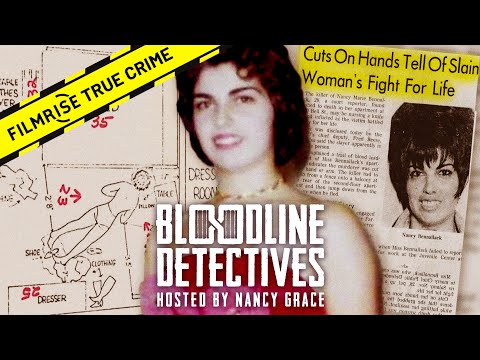
The Heartbreaking Murder of Christina Castiglione | Bloodline Detectives with Nancy Grace
Episode Description
Redford Michigan, 1982, the body of 19-year-old Christina Castiglione is discovered in a remote area. Four decades later, a groundbreaking DNA science technique links the crime to a man with a record for sexual deviancy and attempted abduction.
Now in its fourth season, Bloodline Detectives is the leading true crime series that explores how police departments harness genetic genealogy to solve crimes that were once considered "unsolvable," bringing long-awaited answers to victims' families.
=============== Like, comment and subscribe if you’re ready for more true crime. Your favorite shows like World’s Most Evil Killers, Meet Marry Murder, Forensic Files, Unsolved Mysteries, Murdered At First Sight and Bloodline Detectives are all available to stream 24/7 for free via the FilmRise Streaming Network. You can access The FilmRise Streaming Network through most free App Platforms and Smart TV portals such as Amazon Fire TV, The Roku Channel, Android, iOS and many more.
Read the full transcriptHide the full transcript
- [MUSIC PLAYING] NANCY GRACE: Oak Grove State Forest, Michigan, 1983, a hunter in a remote area discovers the body of teen girl
- Christina Castiglione. MATT YOUNG: He was traveling along five miles searching for somebody who he felt
- he could control and abduct with the littlest resistance possible. And he came across Christina, and she
- was a victim of opportunity. NANCY GRACE: A homicide investigation launches immediately, and detectives
- hunt for a depraved killer. Serial killers were looked at in this case because the theory at that time was that maybe it was somebody
- that was just passing through the area, maybe it was a serial killer that murdered other people.
- We really didn't know. NANCY GRACE: Eventually, the case goes cold. Now almost 40 years later, can the power
- of a new forensic science reveal Christina Castiglioni's killer? This is the story of a 40-year-old search
- for the vicious killer of a beautiful teen girl. It's the story of how police did all
- they could when the crime was committed and how a new generation of detectives and remarkable science each play a role.
- I'm Nancy Grace. This is "Bloodline Detectives." [MUSIC PLAYING] NANCY GRACE: 1983, Redford, Michigan, one
- of Detroit's Western suburbs. Christina Castiglione living at home with her parents,
- she's 19 with a boyfriend and a great job at an office. We're pretty much an Italian family.
- I was more quiet. She was more outgoing. We've always been close. I was more of like a doll person playing with the dolls,
- had my barbies, loved my barbies. She was more into sports. In the summer, she'd take basketball clinics.
- We have a parks and rec where they do a lot of stuff for children. She would coach kids all the time.
- NANCY GRACE: March 19, 1983, Christina Castiglione tells her friend she's planning to go to a party,
- but she never arrives. Her last known movements were walking along Five Mile Road in Redford Township near Telegraph
- Road and the Lola Park area. This was about 7:30, 8 o'clock at night. She had been walking along the roadway after exiting a vehicle
- that she was in with her boyfriend and some of her boyfriend's friends. She decided to walk because she didn't
- like her boyfriend's friends. And as she walked along the roadway, her boyfriend had actually passed her in the vehicle
- and decided that he was going to get out of the vehicle and wait for her at a nearby liquor store
- to arrive where he was, but she never showed up. NANCY GRACE: March 29, 10 days after Christina Castiglione's
- disappearance her body is found. It's in the Oak Grove State Game area 50 miles Northwest of Christina's home.
- MATT YOUNG: She was found by an area resident that was out walking in the state game area.
- He had been searching for evidence of wildlife activity, deer, or whatnot and had come across your body.
- He had alluded to the fact that he was out hunting or engaging in some sort of outdoor recreation in that area,
- but he didn't have any sort of weapons or guns, fishing poles, anything like that that would have
- led investigators to believe that he truly was there to hunt or fish. They found a female body deceased lying
- partially covered in the snow. She had been stripped from the stomach down. Her pants and her underwear and her shoes
- had been thrown to the side and were off of her. She was still wearing a shirt. And she had been strangled with her own sock
- tied around her neck. Aside from the sock being tied around her neck, there were abrasions to her face and superficial injuries,
- but it was apparent that the sock was likely the murder weapon for strangulation purposes.
- Soil was taken from the scene to not only compare to what was on the bottom of her feet to try to determine if she
- had been walking in that area or if she might have been walking someplace else. As well as if we did find a suspect and a suspect
- had any type of dirt on them, we could also hopefully do some comparisons with that.
- Everybody received their assignment as to what they were going to do. Certain detectives were going to collect evidence
- from the scene, others were responsible for photographs, and then a detective was also sent up
- into an airplane to take overall aerial photographs of the crime scene. So at the scene, there was Jack Daniel's bottle collected.
- There was undergarments collected. There was a soil sample taken from underneath her body,
- a brassiere. The guys that processed the scene just did a phenomenal job. The blood was put into vials.
- The clothing and the other matter was put into paper bags where it could dry. There was stick that was taken.
- The idea at that time was we don't know what's in play here. So let's collect as much as we can and go from there.
- The victim was identified at the scene due to the fact that the Redford Township Police Department when they sent out
- their flyer that Christina was missing, the Sheriff's Department as well as local police departments in the area
- had received a copy of that flyer. So it was based upon the official description
- from the flyer and then the body. After the scene was processed, all the evidence was picked up,
- Christina was then placed into a transport bag and taken to McPherson Hospital. NANCY GRACE: Detectives must inform
- her family their beautiful teen girl is the victim of a savage murder. ANNA CASTIGLIONE: On March 29, when they came over,
- I just remember my mom and dad were in the living room. I was out in the dining room.
- And they had just told them that they had found Christine and that she wasn't alive.
- My mom was devastated, and my dad was. They brought a priest with them. And I was very upset because he swore at the priest
- and told him to get the F out of his house. There is no god or his daughter wouldn't be with him today.
- He was very-- my dad was very quiet the whole time, even when she was gone. He didn't work while she was gone.
- He just wouldn't get up and take a shower. He just sat on the couch for days waiting.
- It was very sad. No one ever expected that to happen. I don't think anybody ever does.
- NANCY GRACE: Detectives work closely with the coroner to determine the exact cause of death.
- Nature provides some help. It's still very cold in Michigan. The cool temperatures help to preserve evidence on Christina
- Castiglione's body. EDWIN MOORE: Finger and footprints were taken. Head hairs were pulled so that the follicles
- would come out with the hairs as well as pubic hairs. And a sexual assault kit was performed.
- There was semen that was found. And that evidence was sent to the State Police Crime Lab
- after the autopsy and as the investigation progressed. Christina's death was ruled as homicide by strangulation.
- We sent all of the evidence to the crime lab to be processed. MATT YOUNG: And they located the presence of semen
- in different places on her body. They were able to take that semen, sent it to the State Crime Lab for blood typing,
- and determined that the suspect was a type A blood. It's a brutal attack. Are there enough clues left at the crime scene for detectives
- to find Christina Castiglione's killer? We find out next on "Bloodline Detectives."
- [MUSIC PLAYING] NANCY GRACE: 1983, Redford, Michigan, the body of teen girl Christina Castiglione
- discovered by a hunter in a remote woodland. Christina, strangled and brutally sex assaulted.
- Now her family and friends prepare to give the beautiful teen a final farewell. Oftentimes when there's a homicide or a major crime,
- the suspect shows up at a funeral or some other family gathering to see what and who's there.
- So law enforcement we were there for that matter to see if there was anybody that didn't belong frankly
- that would have shown up at the funeral. We observed several cars that came and left the parking lot.
- We recorded license plate numbers and then tried to find the owners of those vehicles.
- The purpose of that was to get with the family a few days after the funeral service
- and run the names by the family to see if they knew the people that was driving through the parking lot.
- Nobody that stood out to them. There was a couple people whose names they didn't know,
- but they couldn't say at that time whether or not they might have been coworkers
- or something of Christina. NANCY GRACE: The very first suspect for police is the hunter who discovers Christina's body.
- He was the primary suspect from day one. He took a lie detector test, and the first one was inconclusive.
- So he was asked to take a second one. He had hired an attorney, and then refused to take the second one.
- Well, it definitely throws a red flag up in the air and makes you wonder a little bit more
- like what's the motivation for not taking the second polygraph or getting an attorney that quick.
- But it's also not completely uncommon either. So it really brought more suspicion to him.
- NANCY GRACE: Next, detectives consider Christina's boyfriend Chip. They know the pair have had a stormy relationship,
- and they've argued because of chip's drug use. EDWIN MOORE: On the day that Christina came up missing,
- the boyfriend was supposed to meet Christina and did not. The boyfriend the same way as a spouse or a family member
- are always looked at until we can verify that they've got a proper alibi and it's been verified.
- The type of blood for the person that found Christina as well as her boyfriend were all the same,
- and that was type A. It meant that the case, we needed more information. The boyfriend was looked at heavily.
- He took a polygraph. And all of the people that he was riding with were interviewed, and his story was verified.
- MICHAEL MURPHY: The boyfriend was ruled out. The individual that found her was still kind of on the radar,
- but not a huge focus. So the theory at that time was that maybe it was somebody that
- was just passing through the area, maybe it was a serial killer that had murdered other people.
- NANCY GRACE: Then police looked at similar cases like that of Kimberly Louiselle.
- She's also a Michigan teen found murdered almost exactly one year earlier. Kimberly Louiselle was 16 years old.
- Her death case was handled by the Michigan State Police. That happened in March of 1982.
- She was missing for more than 10 days. Christina was last seen on Five Mile Road West of Telegraph.
- Kimberly Louiselle was last seen, as I recall, Eight Mile and Merriman Road, which is within a short distance of where Christina was.
- Both cases were investigated with the agencies cooperating with each other and sometimes teaming up
- to go do interviews and follow up, the reason being is because both of them disappeared from the same basic area
- and ended up into Livingston County. Charles Abraham was a probationary worker for the state of Michigan.
- During the funeral for Kimberly Louiselle, Charles Abraham drove through the parking
- lot of the funeral home on more than one occasion. He was interviewed. His story was not the best.
- And he ended up being arrested at a later point in time for sexual assault. And he did not
- have any ties to either Louiselle or Castiglione. Police keep eliminating suspects.
- So detectives try a different approach. They call in experts to analyze what they do know and try
- to create the killer's profile. During our initial investigation, we contacted the Michigan State Police who
- had a behavioral crime unit. We provided them with all the details from the case,
- including evidence found and the bodies. They came up with a psychological profile
- for a possible suspect. They said that the person would be between the ages of 25
- and 35, as I recall, a white male, that they felt that he would have taken the victim by force with some type
- of a weapon, possibly a gun. They also included that he was a sexual deviant. NANCY GRACE: The criminal profile that is created
- fails to provide any strong leads. I believe the case went somewhat cold in the mid
- '80s, probably about '86 or so when the tips started kind of drying up. They weren't coming in as hot and heavy.
- Most of the leads that could be pursued from the initial onset of the investigation
- had been looked into. Everyone had been interviewed. People had been re-interviewed.
- So there was really nothing new coming in about that time. In 2001, we did take the DNA from the rape kit in 1983,
- and it was determined to be of suitable quality to enter it into CODIS. And we were very hopeful.
- We put it into CODIS, and then got the report back. And there was no hits. There was no suspect.
- There must have been at least 50 different serial killers and sexual assault suspects that were
- evaluated as potential suspects for this case. Samuel Little was a prolific serial killer
- that operated in multiple states in the United States, primarily killing prostitutes and then
- discarding their bodies. He was ultimately ruled out not only by DNA through CODIS,
- but just wasn't operating in this area in Livingston County or in Michigan at the time.
- So he wasn't a viable suspect. Around the same time that the suspect's DNA went into CODIS,
- we decided to seek out the original suspect on the case, the person who had found her body.
- And he was living in Rhode Island at the time. So we coordinated with the NCIS service.
- And they went over to Rhode Island with a search warrant and got his DNA so that we could send
- it in for direct comparison. Unfortunately, the results at that time came back as negative, ultimately ruled him out.
- The Cold Case Team was established in 2009. And really, it was too late to take a look at these cases
- to go back over with a fresh set of eyes. Investigators are able to look at that
- and verify that yes, in fact, every stone has been overturned, every rock has been looked under,
- every interview has been done. And when you have a fresh set of eyes, you may find a discrepancy.
- Oftentimes when you're too close to an investigation, you have it in your head that this was done
- or maybe you read a person a particular way or you know what they said. But on a second or third interview,
- oftentimes, that might change a little bit. It's SOP-- standard operating procedure--
- that when cold cases are reviewed, the victim's family is kept informed. The Cold Case Team investigating Christina castiglioni's murder,
- however, struggles to make contact with Christina's sister, Anna. I don't trust too many people these days.
- And I always had in the back of my mind all these years, what if it was a person that
- did this and nobody knew about it and is still alive today harming other people?
- So I think the detective called me a few times. I never called them back. Then I got a note on Facebook from the detective
- telling me who he is, and I still didn't call him back. I'm like, somebody got my name.
- It could be the person that killed Christine. And finally, he-- and I think I still have it on my phone.
- I actually do. He sent me another note on Facebook. So I called him. And I told him I said, "Sorry, but I
- thought you were some psycho guy or something out there." And that's when he told me that Livingston County was
- starting the cold case team and that they were doing Christine's. So this was like, OK, there's something new.
- Can we do this? Can this determined cold case team revive the investigation into Christina Castiglione's case?
- That's next on "Bloodline Detectives." [MUSIC PLAYING] NANCY GRACE: Livingston County, Michigan 2009,
- a cold case team reopens the 1983 murder of teen girl Christina Castiglione, the 19-year-old found
- strangled and brutally sex assaulted in a remote forest. In 2009, then Sheriff Bezotte, who
- was one of the original detectives on this case, decided to form a cold case unit here in Livingston
- County Sheriff's Office. And it was comprised of three investigators with background
- in law enforcement that could have been federal, local state, and their volunteers.
- And their only job was to come in and evaluate Livingston County's cold cases and be that fresh set of eyes
- to look at the case and see if there was anything new that could be done. EDWIN MOORE: My role was kind of a liaison officer
- until Sergeant Young came along as to where I would try to communicate with the detective
- Lieutenant at that time to any search warrants, supplies, trips that had to be made.
- Like, some of the interviews might be in another county that would be 100 miles away,
- that all had to be coordinated. And then I started trying to digitize some of the old cases.
- This particular case, it was just very sad that she was so young when she passed away.
- I felt that it was good for closure for Anna because unfortunately, their parents had passed away,
- and there was no closure for them. I had been in touch with Anna several times since being on the cold case team.
- And I was really hopeful that we were going to get someplace. NANCY GRACE: Police hope developments
- in investigative DNA technology can help them identify Christina Castiglione's killer.
- MATT YOUNG: It really took the advancements of technology and DNA and forensic science so this case could be periodically
- reopened over the years. So after looking at a few different companies, the main standout was Othram.
- They were kind of the all-in-one genetic genealogy company. They were reputable.
- There was a lot of people who recommended them that I reached out to. And we ultimately decided that they
- were going to be the company we were going to use. We sat down, and we started looking at what we had
- that could go to the Othram. So we pulled out all of the evidence that we still had in the property room for this case,
- repackaged it, and got it ready to go in case we were able to pursue this type of technology.
- We sent them a DNA extract that was created by the State Crime Lab of the sexual assault
- kit that had male DNA on it. What's unique about Othram is that we have seen an evolution in DNA technology
- in how it's applied to law enforcement. But the scientists here at Othram have taken extreme measures to ensure
- the way that it's applied is the best way to handle the evidence. And that includes being able to tap into evidence
- that nobody else can. NANCY GRACE: Othram must now analyze the DNA sample to see if it's viable enough
- to even be tested. ANDY SINGER: But we're very fortunate. Many of these investigators as they were collecting evidence
- and saving these cases from 50, 60 years ago, they took those steps. Clothing was recovered, a discarded Jack Daniel's bottle,
- a sock, a soil sample was recovered. Essentially, they were looking to preserve as much evidence
- and identify as much evidence that ultimately could help drive their investigation.
- They took the time to protect and preserve the evidence. And we at this point, become partners with law enforcement.
- Our job is to handle the evidence in the best way that-- they took the time 50 years ago.
- We want to make sure we're not racing through any of these cases today. We're doing what's best for the case
- just as they've been doing throughout the course of these investigations. The extract that was collected from the vaginal swab done
- during the autopsy of Christina was sent to Othram for us to try to identify the male contributor in that sample.
- What we did is we immediately started with forensic-grade genome sequencing process, which here
- means that the first thing we do is we figure out all the properties of that extract, what type
- of contamination was there, what was the ratio in this mixture, how many non-human versus human contributors there were.
- All of those things allowed us to compare that extract to the thousands of extracts, the thousands of samples we've
- already used here at Othram to successfully provide investigative leads back for and figure out
- the quickest way to get there. We call this process suitability analysis. It includes the standard QC that you would see anywhere.
- And then it comes with a suitability assessment that tells us based on our experience and having processed more
- of these crime scenes than anyone else on Earth with this kind of method, do we think that we're
- ready to work on this case? Because any time we do take on evidence, the evidence is destroyed in the process of testing.
- DNA testing is a destructive process. And we don't want to consume the evidence.
- We don't even want to consume budgets if we can't bring value. And so our suitability analysis allows us to essentially
- guarantee that we'll be able to build a profile or we generally won't consume the evidence at all.
- And we don't want to then take anyone's money. We'll wait until we've got the process
- in place to make sure they can also have a great outcome. And so once we knew that we've done something very similar
- before and that we were certain that we could provide one of these profiles, we contacted law enforcement
- and told them that it has passed feasibility analysis. And we now need funding in order to move
- forward to the sequencing. February 2021, Sergeant Young presented the idea that there's a an outfit out there
- Season of Justice that is willing to write grants for DNA genealogy. When you have viable DNA and that's the only thing left,
- they will help you get the money to have that tested. So frankly, it was a no brainer.
- I commend Sergeant Young for coming up with that resource. NANCY GRACE: At this point, Othram's given the green light
- to test the DNA sample believed to be from Christina Castiglione's killer. We told them, we're ready to proceed.
- And so we built a DNA profile, did the investigative work the genetic genealogy necessary to find nearest relatives,
- and built a report of investigative leads that we turned back to the Michigan State Police.
- And so looking at the pieces of DNA that you share with someone uninterrupted or mostly uninterrupted segments of DNA
- allow you to infer how closely or not closely related you are to someone. And the unit of measure to describe that relationship
- is called centimorgans. And so if the number is very small, you know, maybe 10 or 20
- centimorgans, then you really don't share much similarity at all. If you have shared centimorgan value of like 1,800,
- then you may be a half sibling or an uncle or an aunt. And if it's somewhere in between,
- you might be a first cousin or a second cousin. So this value essentially assigns some kind
- of numerical assessment to the amount of DNA markers that are shared between two folks
- and can be loosely used to infer the relatedness or how far back your common ancestor might be.
- These centimorgan measurements combined with lots of matches in the genealogical search form essentially a scaffold
- that allow you then to place your unknown person on a tree at the right spot. The Michigan State Police being the coordinator in this group
- then reached out to the local agency, further passed on to them the leads, and this allowed the investigators
- to use those leads in conjunction with the other leads that they had already generated,
- their own further investigations and interviews, and lo and behold, they came to an answer.
- MATT YOUNG: It seems like it took forever to get the result back. I remember checking my email nonstop
- and checking my voicemails nonstop waiting for Othram to call me to tell me they had a name.
- And it wasn't until July 22, 2022, that I got a call from. And they said, "Hey. We've got an investigative lead for you."
- They said that the DNA we had sent them had matched a person in a familial database that shared about 1,700 centimorgans
- of DNA, which they believed meant that this was a living uncle of the suspect. We started breaking it down because there
- was more than one name on it. And we started looking at each person that was on there,
- could they have fit within this case, could they have been a potential suspect. And we got to one name Charles David Shaw.
- And as soon as we checked his criminal history and found a prior abduction attempt in Livingston County,
- he was our main focus. NANCY GRACE: So, who is the new prime suspect named Charles Shaw?
- And where was he at the time of Christina Castiglione's murder? The detectives learned a lot about Charles David Shaw
- as the investigation unfolded. They did learn that he was a sexual deviant. He was married.
- He did have a son. The wife has some interesting accounts about her time with him being married.
- NANCY GRACE: Charles Shaw, better known as Chuck, was once married to a woman named Lori Lawrence.
- And now his ex-wife cooperates with detectives and tells them about Charles Shaw's disturbing and violent
- character. I met him in a factory job. And I was drawn to him. He was drawn to me.
- I've always been drawn to the people that are going to be a little different. And he loved John Lennon.
- That's about the only person I know Chuck ever loved besides me and my son. And it was a tumultuous relationship.
- When he drank, he was violent. He was aggressive. And that would be when he'd get really smashing drunk,
- which did happen a few times. And the red flags were there, but I refused to see that kind of thing
- and carried on with the relationship. And I had a hard time breaking up with him.
- I think I broke up with him 40 times. NANCY GRACE: Lori Lawrence recalls the day
- her ex-husband has a serious encounter with local law enforcement. There was an incident in 1981 in the McDonald's parking lot
- in Fowlerville, which is in Livingston County where he had attempted to abduct a young woman at the time
- by bringing her with mace. LORI LAWRENCE: I don't know what day it was, but Chuck had walked in the door,
- and he immediately went to the bathroom. And I just didn't ask any questions. I thought he had to go pretty bad.
- But he was in there for quite a while. But like five minutes after he was in there,
- I hear a knock on the door, and it is the police. I let them in. They just asked for him.
- And I said, "Sure, he's in the bathroom." So they waited another five minutes and told him to come out.
- And he finally came out. And they just walked him out the door. And he took one quick look at me, my husband did,
- and I noticed he didn't have a mustache. He always had a mustache. But I think he'd done something earlier that day.
- I think there was big reason why he shaved his mustache. Anyway, they walked him out.
- And I asked, "What are you taking him away for? And they said, "For a possible abduction."
- He was ultimately convicted of a lesser charge of aggravated assault and spent two
- weeks in the Livingston County Jail and a few years on probation. I would have expected to see him spend a little bit
- more time than two weeks. NANCY GRACE: Can Charles Shaw be put behind bars for life
- in the kidnap and murder of teen girl Christina Castiglione. That answer next on "Bloodline Detectives."
- [MUSIC PLAYING] NANCY GRACE: May 2022, almost 40 years since the murder of teenager Cristina Castiglione
- in Redford Michigan. After all this time, finally, a breakthrough. Othram Labs, which specializes in investigative genetic
- genealogy IDs a prime suspect from a DNA sample left at the murder scene. His name?
- Charles David Shaw. His ex-wife Laurie Lawrence tells police incriminating evidence about her ex, Shaw.
- The nightmare began after they left and I looked in the bottom drawer and decided to snoop.
- I found ropes and chains and horrible, the worst kind of pornography journals that talked
- about what he was going to do to these girls that he worked with. And they were very sexual and torturous and grotesque.
- And there was a gun in the drawer. And there's things that I think I just blacked out.
- But I know the gist of it was when he was arrested and then after he was released, and I
- was asking all these questions, I'm sure he told me something to the effect of it's not real
- or it's just fantasy. I wasn't going to do any of that stuff. And it was horrible.
- I had nightmares for years about all this stuff and wondering, always wondering, could he have killed somebody?
- With all the paperwork and the journal that he wrote in sure pointed to the idea that he could have done all this.
- So for 40 years, yeah, I always wondered. MATT YOUNG: It seemed like the shoe fit like this was the guy.
- She described how he was struggled with mental health health problems and had been in mental health facilities
- at a young age. She described everything that we would have expected to see in the offender based on the behavioral science analysis
- that was previously conducted. And he was the only name out of that group of names
- that had a criminal history and had these sort of circumstances going on in his life.
- His criminal career started probably in about 1973 when he was arrested in the Metro Detroit area
- a few different times, once for stealing women's shoes from a local Kmart. He wanted to undergo a sex change in the '80s.
- He was arrested for breaking into a house on one occasion. And then ultimately in 1981, he was arrested here
- in Livingston County for trying to abduct another younger female. I honestly don't know whether Charles David Shaw premeditated
- specifically for Christina. But based upon what we know now and what his involvement was
- in 1981, I think, it was premeditated in that he had that forethought of wanting to do something bad.
- I got a phone call, and they said they wanted to come over which was nothing new.
- He gave me a few other detectives that I didn't know and said that their commander
- was coming with them, too. The one detective takes out a picture, and he puts it in front of me.
- And he says, "Do you know this person?" And I said, "No." You took the picture, put it back in his folder,
- he goes, "That's who murdered your sister." So my first thing was I didn't want to cry in front of him,
- and I tried not to. The first thing I asked him was, "Where is he now?" NANCY GRACE: Anna Castiglione plays
- her long wait to confront her sister's killer might finally be over. Sadly, she does not get that opportunity.
- The passage of time in a case like this one can take its toll on relatives and investigators,
- and that's what happens here when police learn Charles Shaw died barely six months after Christina
- Castiglione's murder. During our investigation, we found out that he was dead. He died in Wayne County.
- So we obtained a copy of the death certificate. And as I recall, the wording was something
- to the effect of "Autoerotica sexual fixation." I think justice was done when he died in the fashion
- that he did because he was turned to a higher authority. And hopefully, he's burning in hell.
- I found out he had passed away when his brother had called me and said that Chuck had died, fell down the stairs,
- and broke his neck. I thought it was true at the time. What happened was when I got the death certificate that I needed
- for Social Security purposes, I had seen that he had died differently than what I was told.
- And then I knew right away what that was all about it wouldn't be that everybody
- else would in the '80s. But I knew because chuck had told me he loved playing out in the woods,
- and he would do this sort of thing. And I was like shocked and feeling a little sad
- and not knowing what to think. But in the back of my mind, I think, I was actually happy he was dead.
- And that really triggered a lot of horrible emotions in me because we're not supposed to be happy that people are dead,
- but I didn't want his son to know him. I knew that he was a very sick man. MATT YOUNG: We initially looked at exhuming
- his body as a potential way to confirm the DNA. Then when we learned that he had a living brother,
- so we needed to confirm that the living brother wasn't the suspect. So we got his DNA voluntarily.
- We told him that it was involving a cold case back from the '80s. And then the conversation started
- about his deceased brother. And then we learned a little bit more about some of the issues
- that his deceased brother Charles David Shaw had had in his life early in the '80s.
- So we contacted Lori on this one. And we didn't want to intrude too much into her family's life
- through this process, if we didn't have to. So we wanted buy in from the family.
- We knew Lori was very much on board with participating, but we wanted buy in from their son.
- So we allowed her to approach him and basically give a case synopsis as to why we were there
- and what we wanted. And he ultimately was very agreeable to participate. And we had drove upstate Michigan, met with him,
- and then obtained his DNA sample. Charles Shaw may be dead, but detectives now have two DNA samples, one from Shaw's brother,
- the other from his son. Will that DNA prove once and for all Charles Shaw brutally murdered teen girl Christina Castiglione in 1983.
- That's next on "Bloodline Detectives." [MUSIC PLAYING] NANCY GRACE: Livingston County Michigan
- 2023, "Bloodline Detectives." are convinced Charles Davis Shaw murdered 19-year-old Christina
- Castiglione in 1983. Shaw is now dead. So police must rely on DNA from his brother
- and from his son and groundbreaking science to positively tie him to the murder.
- So the kin snip testing, in this case, came from the DNA of his son. They sent his DNA to Othram.
- And we were able to confirm the father-son relationship. He didn't get justice for what he
- did to Christina in this case, but I do believe that the world knows his name. They know what he's done.
- They know their story. They know how their life was ended. And so for their family, there's not justice,
- but there's answers. Detectives suspect Charles Shaw may be responsible for other sex attacks.
- They enter his DNA sample into CODIS, the national DNA database. And very quickly, CODIS produces a match.
- MICHAEL MURPHY: Kimberly Louiselle was another body that was dumped here in Livingston County that happened
- to be a state police case. But now that there was legitimate DNA from Charles David Shaw, that information was shared
- with the Michigan State Police. And they were able to solve that homicide as well.
- Very similar set of circumstances in that there was no connection between on the suspect
- and the victim. So another case frankly that probably would have been unsolved had we not
- gotten the forensic genealogy back on the Christina case. I was just happy that people had closure.
- I talked with the detectives, and I know that people wanted closure. I know there was people out there waiting
- and just sorry that they just never could see Chuck go to trial. I'd love to wrap my arms around them
- and tell them how sorry I am and to live in this community and not know. I'm just sorry they've had to go through all the pain.
- And I just hope that they solve as many cases as they can to help as many families
- along that need closure. It's incredible. This case didn't only affect the Livingston County community.
- It impacted their family. They were in the area. And their willingness to understand
- the importance of resolving this case, it's unspeakable. It's amazing that they were able to do that.
- Every case is important to Othram. Every one of these cases, there's a family out there,
- there's a victim out there that's looking for an answer. They won't truly ever receive closure.
- In this case, they may not even necessarily receive justice. But there's a few things that we can do.
- We can we can help them answer the question that they've been asking for years. In closing a case like this, we can
- also put a community at ease. We know that this person is no longer a threat to the community.
- He's off the streets whether he's deceased in this case or in prison. But it's important to the family,
- the victim, the memory of the victim, as well as the community itself. I didn't think at this point that we
- would never know who it was. I think today that when my mom and dad passed they're with her now.
- So they are happy. My dad was sick with Alzheimer's and dementia. So I think at that point, he didn't even know who I was.
- I was just a nice girl that used to go see him. And probably two weeks before he passed away,
- he actually asked me, "How come your sister doesn't come see me?" I just told him--
- he just kind of looked at me. I said, "You know, she's doing all the basketball games with the kids during the summer."
- And he would be, OK, but still Very sad because I wish this would have never happened.
- The incredible efforts of police going all the way back to 1983 along with cold case investigators
- and groundbreaking science solves Christina Castiglione's murder. Those efforts finally delivered the truth to a loving sister
- after 40 long years. I'm Nancy Grace. Thanks for being with us here on "Bloodline Detectives."
- [MUSIC PLAYING]
Brief Summary
The 1983 murder of Christina Castiglione is solved through DNA evidence, identifying Charles David Shaw as the killer, who died shortly after the crime.
Key points
- The Discovery of Christina Castiglione. In 1983, a hunter finds the body of 19-year-old Christina Castiglione in a remote area.
- The Impact on Christina's Family. Detectives inform Christina's family of her murder, leading to devastating reactions.
- Cold Case Team Reopens Investigation. In 2009, a cold case team reopens the investigation into Christina's murder, seeking new leads.
- DNA Testing Breakthrough. Othram Labs identifies a prime suspect from DNA left at the murder scene.
- Ex-Wife's Disturbing Discovery. Laurie Lawrence uncovers shocking evidence about her ex-husband's dark side.
- Closure After 40 Years. The efforts of police and science finally solve Christina Castiglione's murder.
Episode highlights
- The Discovery of Christina CastiglioneIn 1983, a hunter finds the body of 19-year-old Christina Castiglione in a remote area.“A homicide investigation launches immediately, and detectives hunt for a depraved killer.”0:37Aug 20, 2024
- The Impact on Christina's FamilyDetectives inform Christina's family of her murder, leading to devastating reactions.“My mom was devastated, and my dad was... very quiet the whole time.”6:28Aug 20, 2024
- Cold Case Team Reopens InvestigationIn 2009, a cold case team reopens the investigation into Christina's murder, seeking new leads.“Can this determined cold case team revive the investigation into Christina Castiglione's case?”17:26Aug 20, 2024
- DNA Testing BreakthroughOthram Labs identifies a prime suspect from DNA left at the murder scene.“His name? Charles David Shaw.”30:05Aug 20, 2024
- Ex-Wife's Disturbing DiscoveryLaurie Lawrence uncovers shocking evidence about her ex-husband's dark side.“I found ropes and chains and horrible, the worst kind of pornography journals.”30:21Aug 20, 2024
- Closure After 40 YearsThe efforts of police and science finally solve Christina Castiglione's murder.“Those efforts finally delivered the truth to a loving sister after 40 long years.”40:48Aug 20, 2024