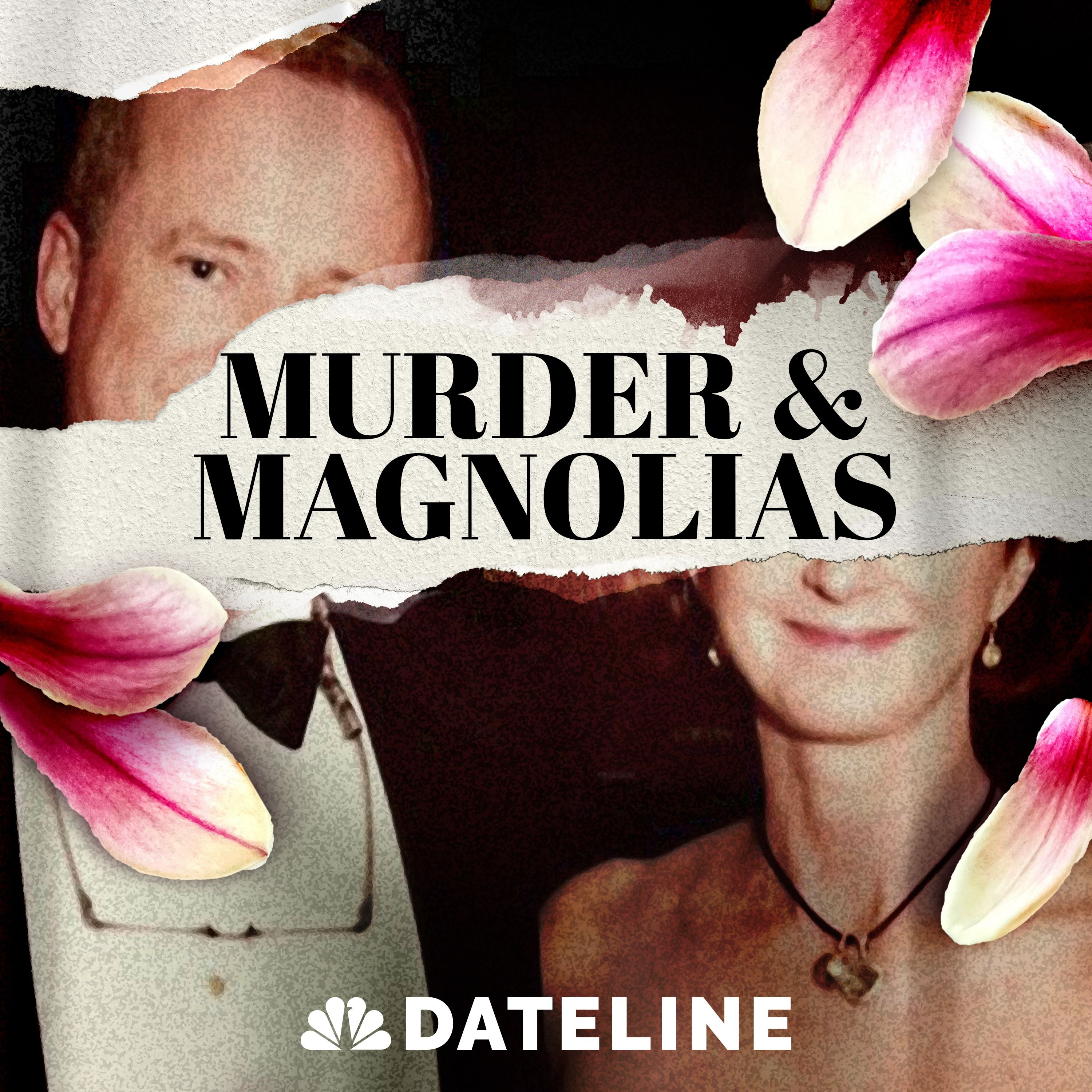
Talking Dateline: Murder & Magnolias
Episode Description
Blayne Alexander sits down with Keith Morrison to discuss his original series, “Murder & Magnolias.” In 2017, a bitter divorce between prominent Charleston, South Carolina, couple Chris and Nancy Latham spiraled into a murder-for-hire investigation that stunned the community. Blayne and Keith break down the key moments in the case, including the unlikely person who helped authorities crack it, and the “hit packet” that brought the plot into focus. Plus, Dateline producer Carol Gable joins the conversation to discuss where Nancy Latham is today and what it took to report the story. Keith also talks about what -- if any -- his aspirations were before getting into journalism, and the team reflects on some of their most dangerous moments in the field. Plus, they answer viewer and listener questions.
Have a question for Talking Dateline? DM us @DatelineNBC or leave a voicemail at (212) 413-5252. Your question could be featured in an upcoming episode.
Listen to the series on Apple: https://apple.co/40tIdpy
Listen on Spotify: https://open.spotify.com/show/4VpCDcpZxWVTEuJrZCKMoj
Hosted by Simplecast, an AdsWizz company. See pcm.adswizz.com for information about our collection and use of personal data for advertising.
Read the full transcriptHide the full transcript
- Hi, everyone. I'm Blaine Alexander, and today we are talking Dateline. Today, I'm here with Keith Morrison to talk about his original podcast series, Murder and Magnolias. Keith, my friend, it's so good to talk to you.
- It's so delighted to see you. Now, if you have not listened to it yet, you need to go do so. We dropped the full series in the Dateline feed as a bonus while Dateline has been taking a break for these past few weeks for the Winter Olympics. So go there, listen, and then come right back here.
- And later, we will be joined by Dateline producer Carol Gable to share what it was like behind the scenes reporting on this story as it unfolded.
- And then, as always, we're going to take some of your questions. OK, let's talk Dateline.
- Keith, so this story was fascinating for a number of reasons. Can you just give us a quick primer, just kind of run down what the story was about?
- It's about a very successful couple in Charleston, South Carolina, a banker and his wife.
- They're society people. They have parties all the time. they seemed to have the perfect life. It wasn't perfect. It was a bitter divorce.
- And then we discovered that the husband was seeing a woman who happened to know somebody who
- kind of spent some time in the underworld, had spent some time in prison, and secretly arranged
- to have this man kill the wife, Nancy Latham. But the plan went awry. The person who was actually
- had volunteered to be the trigger man was arrested in the traffic stop. And it turned out he was
- trying to figure out a way not to do the killing. He was a drug addict, and he gave the whole story
- away. So they were able to, in the end, protect Nancy, get the proof to arrest the husband and
- the girlfriend, and they went to prison. It was a rich story in its details, and the characters
- were fascinating. And it was a rare situation where we were able to conduct interviews with
- everybody outside and inside prison. Nancy, of course, who turned out to be a very funny woman.
- In fact, she later on made a, I don't know if you could say made a living, but she became a stand-up comedian for a while after this was all over.
- But Chris Latham spoke to us. Wendy spoke to us. You know, Charleston has given us a number of really remarkable tales, and this is one of them.
- Let's start with those fascinating characters. I have to say you give a great primer, but there is so much to this story that it's almost impossible to kind of summarize it all.
- Right. You get lost in the weeds as soon as you start to describe it. You do. But one thing that you can't really describe, even with the rundown that you just gave, I think just the southern feel of these folks, of these characters, and the fact that it took place in South Carolina somehow just takes the story to another level for me.
- Yeah, it did for me, too. And I don't live there. I'm not from there. I grew up in Canada, far away from that culture. But I love it.
- and the producer I've worked with for many years on a number of stories in Charleston,
- Carol Gable, would call me and say, you won't believe the latest. And she had some new nugget about this story over a period of time while we were watching developments
- before we actually were able to complete doing it. So let's talk about the couple at the center of the Lathams.
- So you mentioned you grew up far away from South Carolina. I'm right next door. I'm in Georgia.
- I'm not originally from here, but certainly lived in the South long enough to, you know, know it.
- Sure. When you talk about those two, they are kind of like this quintessential just Southern charm success story.
- Right. He's a money man. He's got the brains and she is just a charmer and knows society.
- And you put those two together and you have magic dynamite. Yeah. He was on the board of the Spoleto Festival, which was the big, big thing in Charleston every year.
- And you don't get a role like that unless you're a pillar of society. And she was the hostess who could charm everybody.
- So they were great together. Do you find that when there are these people who are pillars of society and, you know, murder plot notwithstanding, we'll get to that in a second.
- But just when it comes to those folks who are high in society and then divorce happening, there's usually some sort of added drama that's infused.
- There usually is. The thing about people is we're all made of the same stuff. We all have feet of clay. We all lie. We all lie probably a lot more than we think we do. And we try to protect the lives we're living while living the life we fantasize about living on the side.
- people have been doing that since time began this was a case for whatever reason chris latham
- was so drawn to this wendy person fascinating character in her own right that he was prepared to engage in these terrible acts against nazi of course well let's talk about
- the thing that kind of sets this whole at least the storytelling investigation in motion which is
- this traffic stop that takes place. Which, this happens in so many of our stories, doesn't it?
- There's one little thing that happens. Without that thing, what might have changed?
- What might have been different? It might have been all different. The murder may have occurred.
- So Aaron Wilkinson was a drug addict. Aaron Wilkinson was with his wife and his dog driving through Charleston.
- He had promised to do this deadly errand for his friend Sam. But he was trying to kill time as opposed to killing the person he was supposed to kill, Nancy Latham.
- So that by the time he had a deadline to do it, he just was trying to wait out the deadline.
- And it was the middle of the night and he was driving down America Street, which was another fascinating thing to me that he was at the end of America Street where there is a tremendous amount of poverty and there are drug addicts and there are people sleeping on the street.
- At the other end of America Street some of the wealthiest families in Charleston live you know mansions by the sea Sure Aaron was at the wrong end of the street He went through a light He saw a police siren behind him He had to stop And then the cop discovered that he was you know maybe not
- all there. And the conversation continued. And Aaron said, you got to listen to me. You got to
- listen to me. I got a story to tell you. And so that was the opportunity that Aaron took
- to tell the police that there was a murder plot, which he had been asked to be a participant in.
- and didn't want to be. He had to tell the story. It took a while to persuade the cop that he should
- be believed. But eventually he was. There are several things there. One, just this very small
- thing, right? Like you said, in every Dateline story, there's what it is that kind of helps
- investigators solve the crime. But in this case, it stopped the crime from happening,
- which I thought was just so fascinating. And then it was just the most unassuming
- character who really was the hero in this whole situation. He was, and to the point where Nancy Latham went and thanked him at the end.
- And the two of them had a very nice moment together. Yeah. One of the things that was a theme through this, certainly when in dealing with Aaron, was how do we know that he is to be believed, right?
- How do we know police can believe him? Will he be believed there? He was, right.
- He was precisely the sort of person who should not be believed in most cases. Yeah.
- And the cop recognized he should take him in, listen to his story, see if it went anywhere.
- Mm hmm. I love the juxtaposition, though, as you talk about the two ends of the street, that it was somebody like Aaron who brought down somebody like Chris Latham.
- Right. Exactly. Yeah. Part of the little metaphor there. Yeah. Yeah. Let's talk about this hit packet in all your years of datelining. Have you ever heard of a hit packet?
- you know people who set out to become tough guy criminals often aren't the brightest bulbs the
- hit packet had everything that you would want to know if you're going to have to kill somebody and
- they managed to write it down on a piece of paper and then put it in a bedside table where somebody
- could easily find it well the crazy thing it had it not only had everything you needed to know if
- you needed to kill somebody but it had a lot of things to know if you were trying to investigate
- the plot to kill somebody i mean absolutely and writing there was wild yeah it was it was the key
- to the whole thing. And then, of course, you talk through this hit packet with the investigators.
- Take me back to that moment. I mean, when you were going through, was that the actual hit packet
- you were looking at, by the way? Yes. I think that wasn't exactly the same room,
- but it was the same hotel and a very similar room. There was some small difference that I
- can't quite recall at the moment. Sure. But yeah, the detective in there was sort of reliving it,
- and you could feel he was reliving it. It was one of those fly on the wall moments when you think,
- okay, I'm kind of witnessing what he was feeling as he did this. It was very cool.
- Absolutely. So Keith, let's talk about Nancy because poor Nancy was, of course, the subject of this hit packet. I can't imagine being at home in the bathtub,
- trying to just kind of get your mind right, get yourself together. And suddenly there is a knock
- at your door and there are two officers who say, hey, someone's trying to kill you.
- These are things that happen to other people. They never happened to them. And yet here they
- are happening to this woman who is just very charming and i enjoyed every conversation i had
- with her she was spicy nancy was spicy very spicy yeah exactly right yeah she was so one before we
- even get to the the plot against her i certainly loved how when you asked her point blank hey are
- you having an affair were you having an affair no i was not are you offering that was her way of
- she's just you know she's bright and comes right back at you when you're kind of like
- hitting a ball like that across the net with each other right like an interview is always
- kind of like a tennis match or an airball match sure when something like that comes at you how
- do you respond you're obviously very uh skilled in interviewing but no that's a skill um i have
- to say that's the first time it happened but wait a minute no it's actually the second time but it's
- You know somebody has just given you a home run, so you're going to use that piece.
- And they know you're going to use that bit. But it also disarmed me because here she had been presented with the possibility that she had done some bad things,
- that she was the cause of the breakup of this marriage, which was the allegation that her husband made.
- And she had a number of ways to respond to that. She could say, no, no, no, and jump up and down and deny, deny, deny,
- as most people tend to do when they're accused of such a thing. Or she could simply, as you say, bat it back into my court with something flirtatious and fun.
- And it worked far better. Yes, yes, absolutely. It definitely did. I think that gave us a look early on into just kind of her personality and who she was.
- It explains why after a traumatic event like that, she would choose to rebuild her life by making a living as a stand-up comic for a couple of years.
- I think Nancy's way of dealing with traumas is to make light of them. It's just another way to cope with stress and difficulty.
- That's the way a lot of us deal with tough things, right? Yeah. When we come back, we will be joined by Dateline producer Carol Gable for a behind-the-scenes look at how this entire story came together.
- Well, Keith, you have invoked her name a number of times. I would like to bring in the fantastic producer of this episode, the one and only Carol Gable.
- We've got to stop meeting like this. Always through boxes, right? That's right. Little square boxes.
- Well, Carol, it's so lovely to have you join us. Well, thank you so much. And this brings back a lot of memories because this story took months and months and months to do to get everyone comfortable with talking to us.
- And one thing about Nancy and Keith is absolutely right The way she deals with horror is that she makes fun of it She doesn feel it any less And one thing to remember is that in that hit packet the photograph that Aaron was
- given included their children. Yes. Like the two daughters were okay if they were collateral
- damage. That didn't matter. And that was made clear enough that I think any chance that Nancy
- or the daughters would have of getting past this was probably eliminated at that point.
- Well, and to move ahead, I talked to Nancy last week about a wholly different story. I was going
- to her hometown for a hearing, but she told me that, you know, she has two daughters and one of
- them has never dealt with her father since then. The other daughter has gotten married,
- had a wedding that she invited the dad to. Wow. So it's kind of been an interesting
- ending, although it's probably not an ending. It's probably just where they are right now.
- Did the dad come to the wedding? No, yeah. Yeah, sure. He came. Yeah. Face to face. They all had to kind of coexist in that wedding. Wow. Yeah. Well,
- the person that wasn't there was Nancy. So there's been, you know, fallout for years after that.
- Carol, let me ask you this, because I am fascinated by the fact that you all spoke to
- every major player in this story. It's something that we don't often see in Dateline, but especially
- in a story like this, when you had to get into prisons, when you were talking to folks who,
- you know, had been involved in different ways, can you just kind of talk about the process of
- getting comfortable? How did it go from, hey, I'm Carol with Dateline to getting these folks to
- trust you and actually open up? Yeah, it's a superpower of some sort, I'll tell you. And
- don't ever get too close because the same thing will happen to you. No, I invoke Keith's name. That's what I do. I skate by on his reputation. You know, I think I've
- always believed that if you're in big trouble, almost the best thing you can do is let people
- know your point of view. And I think that's one thing that I talked about with everyone in the
- story is, you know, this didn't happen out of thin air. People at home may not agree with you,
- but if they don't hear what you were thinking, then we don't know. And we can't have a clear
- picture of the whole story if we don't. So Carol and I spent quite a bit of time with these
- folks, even the ones in prison. And, you know, they're all people and they all once you meet a
- person in prison, they have already kind of been torn down to a level that they've never been in
- before. And they have to recognize their basic qualities, pro and con as human beings. And they're
- a little more realistic. And so it's actually very nice to meet people in a situation like that. Nice
- is the wrong word, but it's illuminating to meet them in a situation like that because,
- while they are defending themselves and probably not telling you the truth about what they did or
- didn't do, you see them without the layers of protection that they would normally have
- that we all try to put up. I'm curious, behind the scenes, just very quickly, what does it take to convince a correctional facility to allow such? Is it just different
- state laws? How were you able to do that? Well, in South Carolina, once someone is convicted
- and is put into the custody of the South Carolina Department of Corrections, you can't touch them.
- You can't interview. But there's this little sliver of time between conviction and when they're transported to the South Carolina Department of Corrections.
- So that was my job to discuss the local with the local detention facility. You want to be on good terms with the sheriff in every county in the country.
- Yes, you totally do. And they were very gracious and very nice. And they allowed us essentially in an unused part of the prison to set up the equipment so we could do these interviews. But in South Carolina, that's the only way you can do it.
- And I will say just as a little add on about the jail where we conducted the interviews, the sheriff, I think, was justly proud of the facility and we were able to find some good places to do it.
- But I was struck by the way it was set up. And a lot of jails are this way. I wake up at night sometimes thinking about the relative lack of thickness in those little mattresses.
- They put on concrete beds. They're this thick. Exactly. And the giant rooms where everybody has to share everything.
- it. If you don't want to go to prison, the best thing to do in advance is inoculate yourself by
- knowing what they're like. Sure. Yeah. I'm curious, when you talk about murder for hire plots,
- you've done several, right? This is certainly not the first. Secrets in a small town comes to mind.
- But do you find as you kind of talk to these people or just kind of cover these types of
- stories, is there some sort of like psychological difference perhaps that people have when it comes
- to actually committing a murder themselves versus hiring someone? Do they feel removed?
- Is it kind of like psyching themselves out that maybe I'm not a killer, I just am someone with a lot of money?
- You know, it's a very good question. I don't know how I'd answer it, except that there is a pecking order in society
- and the people at the top of the pecking order rather like other people to do the hard work for them.
- But, you know, it's a good question. It's a good question. But, you know, it's so always shocking that the people who instigate murder for higher plots always seem to think that's cheaper than just getting a divorce.
- It just always odd math to me that they would do that And of course if you don get away with a crime you on Dateline Very true Yeah Yeah Carol you mentioned the fact that you just
- talked to Nancy last week. She lives in Florida. She has reinvented herself as an IT department head
- in a school. She doesn't do open mic stand up much anymore, but she sounds really good.
- That's wonderful. I'm curious. I mean, all three of these people involved have, you know, they were sentenced to prison. They're now out of prison and among society again. How does she feel about that? Does she have any pause about the fact that these folks are now out?
- I think she was so glad, A, that she lived to tell about it and B, that both Wendy and Chris were held accountable.
- But there's not a fear. I just wonder, it would be hard were I in that situation.
- It seems that it would be difficult after going through everything she's gone through to even though situations change, just to not be kind of looking over your shoulder or just feeling a way that these people who tried to carry out this elaborate plot to end your life are now back out on the street.
- Well, they are and they are. Yeah. And it's one of the reasons it's interesting to continue to follow the people involved in these stories, because for them, the story is never really over.
- It just enters a new kind of phase. So I'm sure she's probably thinks about it once in a while.
- We'll go to some viewer questions in a moment, but I'm curious for both of you all to weigh in on this.
- At the end of the episode, one of the questions that's left is who hatched this plan? Was it Chris? Was it Wendy? Whose idea was it in the first place?
- Investigators never quite figured it out. I'm wondering if you if either of you have your own thoughts.
- I'll go first. Sure. There's nothing in Chris Latham's background that we're aware of that would make you go to, as you say, door number two as opposed to a divorce.
- What do you think, Keith? I don't want to surmise too much because we have no idea what happened or who said what to whom.
- But it was certainly a reasonable idea that Chris might have said, man, I could kill that woman.
- And Wendy said, I know exactly who could do that for us. And ironically, Sam Yenawine died in jail under some sort of mysterious circumstances.
- As people sometimes do. As they do. Well, this was a fascinating story with unbelievable characters.
- And again, a testament to you both that you made them feel so comfortable that they would share their various parts of the story with you and with the world.
- So it was fascinating. Well, Carol threatened them. Give it up or else. All five, four of me did that.
- Yes. And after the break, we will answer some of your viewer and listener questions.
- Okay, so we have a lot of social questions. These are from some of our folks who came to Dateline Live in Nashville or asked questions.
- So if you didn't hear your question, then you might hear it right now. Let's get this one from Jessica from Nashville.
- She says, huge Dateline fan here. Whenever a mystery is solved after 10 plus years of working on it, are you ever sad to close that chapter?
- And the second part, do you stay in close touch with those families? We already know that answer, but do you ever feel sad about closing a chapter?
- I don't feel sad, but I do stay in touch with everybody. Sure. It's hard to let them go.
- and then you wind up going and doing them again because you find out something new because you
- can't let them go. Absolutely. Here's another one from someone in Nashville. Okay, Keith,
- I'll pitch this one to you. What was your job aspiration or your occupation before landing
- with Dateline? Well, I was in the business for, I've been, this year it's 60 years in the television
- or radio business, which is hard to believe. So I've been doing that for a long, long time. But
- What was my aspiration? I was one of those people without an aspiration. I didn't know what the heck I wanted to do.
- I got a job at a radio station. There we are. Keith, well, congratulations on that milestone.
- What are we doing to celebrate? That's the question I want to know. Nothing. Absolutely nothing.
- I shouldn't have even told you. Well, too late. Something will happen. Yeah, it's true.
- Okay, this question is from Jessica C. in Nashville. I love you guys, she says. what is the scariest moment that you've ever experienced while either interviewing or researching?
- Carol, do you have a scary moment? Oh, wow. Scary moment. Well, I did have a woman who all I really wanted to do is talk to her.
- And she came flying out of her front door with a shotgun. Now, I felt like I was okay because she didn't point it at me.
- She was only running with it. And then by the time she got to my rental car, we had agreed we might talk first.
- Yeah, that was it. Well, that's quite a moment. It was. That's a good moment. Also, kudos to you for being able to literally disarm somebody in that moment.
- That's impressive. Yeah. Well, I was hiding behind the door of my rental car. The things we will do to bring a story together.
- How about that? Okay. Keith, do you have one you want to share? Oh, no. I mean, look, I've interviewed lots of people.
- Some of them, I would get scared by somebody who was, you know, intellectually daunting and who you ask the wrong question, you're going to get battered about.
- That would scare me a little bit. And there have been situations like Tiananmen Square and certain wars I went to.
- But that's not a deadline, that's for sure. But it's life. It's part of your 60-year span as a journalist.
- Okay. Last one, I'll ask you this one to you, Keith. This one is from Instagram from at DannyDay1985, who asks, how do you keep your calm when interviewing criminals?
- I remember Keith with Lori Vallow, and he was amazing. I don't think I could do it.
- Well, criminals are people like you and me, and usually they're trying to put on a good impression.
- They want people to think that they're innocent, or if they did do a bad thing, that it was just one time and they really don't do other bad things ever.
- So, you know, they're trying to be Mr. Nice Guy. I have found interviewing criminals is you find a more friendly reception than you do with a great many politicians, for example.
- Amen. Very interesting. Well, Carol and Keith, this has been a fascinating discussion.
- I have appreciated you both. Carol, I know you have to get back to court. So we'll let you go.
- Keith, you've got to do, you've got to tend to fend. I got to tell you, we need to start planning a party because six years is not nothing.
- Oh, stop it now. I shouldn't have said a party. We'll be a party. Listen, you've let the cat out of the bag, so prepare.
- Exactly. Well, that's it for Talking Dateline this week. Thank you all so much for listening.
- You can stream Dateline anytime on Peacock or on our Dateline 24-7 channel. And, drumroll please, we are back.
- This Friday, we're back with an all-new Dateline episode, and it's actually my new episode.
- So please join me here in Georgia, my state, for a case involving the mysterious death of a husband.
- It was ruled a suicide, but his family believes there may be more to the story. And after you watch the episode, of course, you can leave us your questions, DM us your audio or video questions on social media at Dateline NBC, or you can use the good old landline.
- Leave us a voicemail at 212-413-5252 for a chance to be featured right here. And of course, we'll see you Friday at 9, 8 central on an all new Dateline on NBC.
- you
Brief Summary
Keith Morrison discusses the murder plot against Nancy Latham and the unexpected events that led to her rescue.
Key points
- Murder and Magnolias Podcast. A deep dive into a chilling murder plot involving a Charleston couple.
- Unexpected Hero. A drug addict's traffic stop leads to the prevention of a murder.
- The Hit Packet. A bizarre document reveals chilling details about the murder plot.
- Nancy's Resilience. After surviving a murder plot, Nancy finds humor in her trauma.
- The Unsolved Mystery. Questions remain about who truly orchestrated the murder plot.
- Scary Moment with a Shotgun. A woman surprised the interviewer by running out with a shotgun, but they managed to talk.
Episode highlights
- Murder and Magnolias PodcastA deep dive into a chilling murder plot involving a Charleston couple.“It's about a very successful couple in Charleston, South Carolina.”0:48Feb 25, 2026
- Unexpected HeroA drug addict's traffic stop leads to the prevention of a murder.“He was the hero in this whole situation.”6:48Feb 25, 2026
- The Hit PacketA bizarre document reveals chilling details about the murder plot.“It had everything you needed to know if you needed to kill somebody.”7:50Feb 25, 2026
- Nancy's ResilienceAfter surviving a murder plot, Nancy finds humor in her trauma.“Nancy's way of dealing with traumas is to make light of them.”10:46Feb 25, 2026
- The Unsolved MysteryQuestions remain about who truly orchestrated the murder plot.“Investigators never quite figured it out.”19:37Feb 25, 2026
- Scary Moment with a ShotgunA woman surprised the interviewer by running out with a shotgun, but they managed to talk.“Well, I did have a woman who all I really wanted to do is talk to her.”22:37Feb 25, 2026
- Interviewing CriminalsKeith shares insights on how criminals often try to present themselves as innocent.“Well, criminals are people like you and me, and usually they're trying to put on a good impression.”24:03Feb 25, 2026
- Mysterious Death CaseA new Dateline episode explores a husband's death ruled a suicide, but family suspects foul play.“It was ruled a suicide, but his family believes there may be more to the story.”25:14Feb 25, 2026