Talking Dateline: Conversations at CrimeCon Part 2
Episode Description
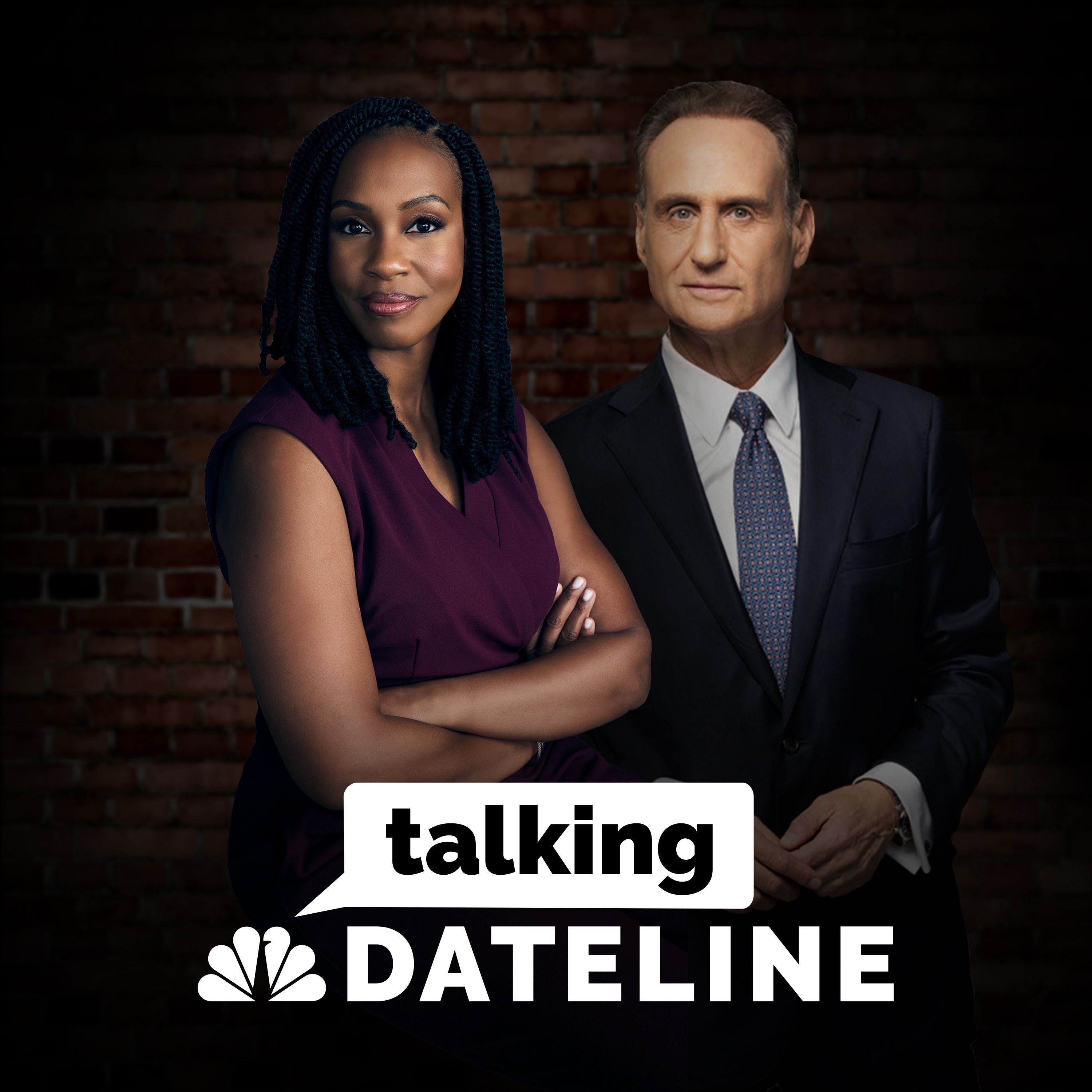
In part two of this special edition of Talking Dateline, NBC News’ Ellison Barber, host of the Netflix podcast “Allegedly," sits down with Josh Mankiewicz at Caesars Palace in Las Vegas, for CrimeCon 2026. Josh tells Ellison what it’s like interviewing families who have gone through the unimaginable and how some have turned their pain into purpose. He also talks about a common thread of stalking in some of his recent episodes, and how the legal system could help protect victims before it’s too late. Plus, he takes questions from the audience.
Have a question for Talking Dateline? Send us a DM @DatelineNBC or leave a voicemail at (212) 413-5252. Your question could be featured in an upcoming episode.
Links to Dateline episodes mentioned in this session:
“Haunting” about the murders of Tom Hunter and Shirlee Sherman: https://swap.fm/l/dl_haunting
“Complicated” about the murders of Tori Vienneau and her 10-month-old baby, Dean: https://swap.fm/l/dl_complicated
Josh catches up with Tori’s mother, Danya Heroz, on “After the Verdict, available to Dateline Premium subscribers: https://dateline.supportingcast.fm/listen/dateline-nbc-premium/after-the-verdict-complicated
“Breaking Point” about the murder of FedEx mom, Morgan Fox: https://swap.fm/l/dl_breakingpoint
“The Phantom” about the murder of Kristil Krug: https://swap.fm/l/dl_thephantom
Kristil’s cousin, former prosecutor Rebecca Ivanoff, talks about stalking, coercive control, and the fight for safety: https://www.nbcnews.com/dateline/video/former-prosecutor-rebecca-ivanoff-on-stalking-coercive-control-and-the-fight-for-safety-248448581562
Hosted by Simplecast, an AdsWizz company. See pcm.adswizz.com for information about our collection and use of personal data for advertising.
Read the full transcriptHide the full transcript
- Hi, everybody. Lester Holt here. We've got a special talking dateline for you this week.
- It's part two of a conversation Josh Mankiewicz had at this year's CrimeCon with Ellison Barber,
- his NBC News colleague and host of the Netflix video podcast, Allegedly. The conversation was
- taped in front of a live audience at Caesars Palace in Las Vegas, and the audience had some
- questions of their own for Josh, which we'll play later. But first, Ellison, who is a lifelong
- Dateline fan herself, asks Josh what it's like talking to families who have suffered the
- unimaginable. Hi, guys. I'm so happy to be here at CrimeCon. I'm so honored to be here with you.
- How has your CrimeCon been? It's been wonderful. I've seen a lot of familiar faces. I gather this
- is, if it's not the biggest crime con, it's certainly pretty close. It's a lot of people.
- I cannot find my way around Caesars. No one else can either. But I bring you greetings from
- everybody at Dateline, particularly what's-his-name. Let's talk Dateline. One of your old episodes I
- recently watched. I think it's called Haunted. And it's they're investigating a pair of double
- murders that took place in Nebraska years apart. And police are starting to realize they think
- that they're dealing with a serial killer. And one of the things in that that I thought a lot
- about after was there's a moment one of the victims was an 11 year old. I think his name
- was Tom Hunter. And there was a moment when you're doing interviews with some of the families
- and you say something about how grief presents itself in different ways. And for me, I think about that a lot when I'm covering stories
- because it's hard to know how anybody will react in a traumatic situation. But I also think of recent cases where there have been instances
- where people have felt like their family has come under a microscope unfairly. There was a case recently involving a dentist where he and his wife were murdered
- and there was a situation where the brother-in-law, and I've spoken to him, where he talked about
- people speculating when he was doing media interviews of thinking that he was behaving
- in a way, and he had nothing to do with this, and how painful it was for him and his family.
- And I was curious, when you think about that concept of sort of grief presenting itself
- in different ways, what have you learned in that regard, and how does it impact the way you cover
- stories? One of the things I never say in Dateline, and that I try not to use if we get interviews,
- on this is the idea that settling one of these cases, figuring out who it was, maybe locking
- somebody up represents something called closure because that doesn't exist. And it's a nice idea, but it is not reality.
- And I hate it when people talk about, well, now the family can have some closure.
- Like, they're not, that's not going to happen. Your life is split in half. the part before and the part after.
- And, you know, I think that sort of the ripple effect of murder is something that isn't as well understood,
- something I certainly didn't understand until I started covering this, which was about 20 years ago at Dateline.
- and the extent to which things that happen, these losses that families suffer, end up affecting people who maybe didn't even know the person who was killed.
- Kids who grow up and then have families of their own and then they have a kid in junior high
- who says, can I go to this sleep away? And the answer is, absolutely not, you cannot.
- And they say, well, everybody else is going, yeah, well, you're not. And they can't even really,
- parents sometimes can't really explain why that is. And it's because it mirrors too directly
- the situation that their own family member went through. So, I mean, I think that, you know,
- the idea that distance and time sort of mitigates what people feel, again, it's like closure.
- It's a nice idea. It's not always real life. And some of these stories that you've done and the families that you have gotten to meet,
- Nicole Schmidt is here, Gabby Petito's mom. You and I have both been able to meet her.
- And she's such an amazing person. And for me, when I think about that story and all the news coverage that came around it,
- I find hope because I think that it is the lesson that comes from it is that there is a chance that everybody can do something that can have a big impact.
- How has that been for you, seeing families go through the unimaginable, being put in positions they never asked for, having their lives irreparably changed,
- and then choosing to use it to do something? Sometimes, you know, what we see on Dateline shatters people.
- And it's ended marriages. And it has reduced people to a puddle. and sometimes it transforms people.
- I did a story right at the beginning of sort of our focus on true crime in San Diego
- about a woman named Tori Veneau. She and her almost infant son, he was killed and she was killed by the baby's father
- who did not want to pay child support but I think mostly did not want to embarrass his family I thought that was sort of the motivation He locked up now Tori mom sort of fell apart after that losing her daughter and her grandson
- and then picked herself up, and a couple of years later was like Victim Advocate of the Year in California.
- And now when I encounter families who are having a difficult time, which is not uncommon,
- I send them to Tori's mom, Dana Eros, and she's been able to help people. Tracy Matheson, whose daughter Molly was murdered.
- There's a thing called Project Beloved, which I urge you to all take a look at. It's a similar kind of thing,
- which was spawned by the loss of someone. It's like the Smart family in California,
- who even though a man was convicted of killing Kristen, their daughter, like they haven't stopped for a second. Like they want her body. Like they know,
- they know she's dead. They want her remains and they're still putting pressure on law enforcement
- to find it. And I, I, I, I think they will at some point because they're relentless. So, I mean,
- you see both sides of this. You mentioned Kristen Smart. There's been a lot of activity in terms of
- searches related to Kristen Smart of late. What do you make of that? Look, I mean, I think a lot of it is due to a couple of things.
- The Smart family, as I just said, won't give up. They have remained very focused on getting a result in that, even after their daughter's murderer was convicted.
- I think it's also a tribute to the sheriff there who when he was elected which was some years ago
- made a pledge during the campaign that this was like the big unsolved case in that jurisdiction
- and he wanted to make it a priority and he said that he would and then he did so that's part of it
- the other part of it which was this great sort of X factor was that, as a lot of you probably know,
- a podcast played a huge role in that case. And in some ways, that's sort of what I want to give law enforcement
- and the sheriff's office sort of the most credit for because frequently when someone unorthodox walks through the door,
- whether it's a private citizen or private eye or a podcaster or a journalist, and says, you know, I have information on your case.
- I think I know some things that you might want to know. Frequently, lawmakers are not terribly interested in talking to those people,
- or they say, like, great, fill out this form, which I might never read. But in this case, the podcaster, a guy named Chris Lambert,
- who has a podcast called Your Own Backyard, that was really sort of instrumental in getting that case over the finish line.
- And so a huge amount of credit is due, not just to him for the sort of way he presented it, but also to the Smart Family and law enforcement, which listened and was willing to take information from what was at the time a nontraditional source.
- And I think you'll probably be seeing more of that as the years pass. When we come back, Ellison and Josh discuss a theme running through several of his recent episodes, stalking, and what more the legal system can do to protect victims.
- Two of your episodes that really stood out to me for talking season 34, Crystal Krug and Megan Fox.
- for people who maybe haven't seen those episodes, and I think probably most people have,
- but give us an overview of those, and then I want to ask you kind of more broadly
- about some of the systemic issues I think it brings up. Okay, Christelle Krug was a mom and an engineer
- and a wife in the Denver area, killed by her stalker, who she thought was her high school boyfriend,
- but who turned out to be her husband. and his motivation apparently is that she was going to leave him
- and he thought that if he could make her afraid of this phantom stalker that he had created
- that she would come back to him. And then when he realized that that wasn't going to work
- and that in fact he was going to be found out and then he would be on the losing side of what was going to be a lopsided divorce
- then he felt that he had no choice but to kill her. That story is interesting because police in Broomfield, Colorado,
- which is just outside Denver, had written search warrants for the phone and internet companies that this phantom stalker was using to contact Chris Steele.
- So they'd written warrants for phone and internet and text companies trying to figure out where this guy was and where these texts were coming from.
- And that information was not made available until the day that Christiel was murdered in her garage.
- Then the police department went back to those companies and said, now we have not just a stalker, but a killer on the loose, and we need that information right away.
- and it arrived within hours, making it clear that that information could have been provided
- before she died. And if that information had been provided, she almost certainly would have you know thrown her husband out of the house changed the locks taken a she certainly wouldn have allowed him to stand behind her in the garage which is where he was when he murdered her So that made Christelle family through their grief
- her cousin Becky, who was a domestic violence prosecutor, began lobbying the Oregon state legislature, where she lived,
- to pass a law called Christelle's Law. And they did pass it, and it's now on the books in Oregon, and it requires that in stalking cases, there is a very short clock on companies that receive law enforcement search warrants to respond with that information.
- And that is a wonderful development, and I look forward to it expanding to all 50 states.
- And the fact that we played any role in that at all is wonderful, but that was Christelle's family at work.
- The Morgan Fox episode was outside the Canton, Ohio area. She was being stalked by someone at work.
- All these people worked at FedEx in a packaging facility, and he murdered his coworker, who he was clearly obsessed with,
- and she merely saw him as a friend. So one of those is sort of workplace stalking,
- and the other one is sort of a more traditional form of stalking. I ended up doing a lot of work on stalking because of those two cases.
- And I didn't know this before we started down the Christelle Krug story road, which is that stalking is not even a felony in about half the states in the United States.
- It's about where domestic violence was about 30 to 40 years ago, which is that frequently the response from the criminal justice system is, you better stop doing that.
- But when you think about the cases that you have covered, when you look at statistics today,
- the CDC says one in five women in the United States have experienced, and this is as of 2024,
- have experienced some sort of stalking incident in their lifetime. It amounts to like 22.8 million women in this country alone.
- And that's just the ones that are reported. Correct. A lot of people, when you talk to people who have experienced this, will say they feel like, if I go report, nothing will be done. And then maybe the person who's doing it is going to get mad. Maybe the situation will get worse.
- And as we know from domestic violence, much more attention and much more severe penalties are required than just essentially saying, you stop doing this, don't make me come back here.
- But stalking requires a concerted, deliberate effort and series of efforts to do something.
- And so much of it now has moved from parking across the street from somebody's house to online.
- And the laws need to reflect that. And they need to reflect how closely stalking is frequently followed by other crimes, many of which are significantly more violent, dangerous, and frightening.
- And so, like, we're kind of at the infancy of things evolving with that. But that is the thread that unquestionably connects both of those cases.
- And unfortunately, I guarantee you, we're going to be doing more. You talk about it being kind of in its infancy, at least legally speaking.
- But I look back and I think 1990 in California, you had one of the first anti-stalking laws passed.
- It was considered landmark legislation. It came after a series of high-profile murders that had come from a stalking situation and or attempted murders.
- And essentially what that law did at the time, in essence, was it said, OK, there are some behaviors that maybe individually will not amount to a crime.
- But if there is a pattern, that's something that could be criminally prosecuted.
- and the idea behind that law was saying the pattern maybe changes things. When you think about the legislation that was passed in the 90s
- that is looked at and often framed as these landmark moments, legally speaking, do you think they've done enough to change the course of what's happening?
- Clearly not. And as I said, a lot of the laws that are on the book sort of don't reflect cyberstalking at all.
- That's all changed with social media and the fact that everybody has a phone in their hand now.
- that that i mean that that's a whole other aspect of this but no i mean i remember when i uh
- when i was a local news reporter in los angeles um an actress named rebecca schaefer had been
- murdered by this guy who who got her address from the dmv and came to her door and killed her
- and one of the laws that that was changed as well as you can't get that kind of information but like
- that's that's a that was a great start but it didn't go much beyond that so i mean you know
- For example, on the search warrant thing, phone, internet, and text companies will tell you,
- we get thousands of requests from law enforcement all the time. And we do not have the personnel to answer all of those search warrants.
- And we generally rely on law enforcement to tell us which ones are urgent and which ones are not.
- And of course, the other thing is that law enforcement has figured out that if you say it's urgent,
- you're going to get the results back quicker. So it's not always as urgent as maybe they make it sound.
- So the idea of Christel's Law, which would be great if it were expanded nationally,
- is that in stalking cases, it requires a much more immediate response by the tech companies than has previously existed.
- Again, you're working a 30-year cold case homicide. It might not matter as much if you get the phone records back today as opposed to getting them tomorrow.
- But it does matter in a stalking case. When we come back, Josh answers some questions from the audience, including one about his good friend, Keith Morrison.
- We have mic stands If people want to start lining up to ask any sort of question Who has a question Oh we have over here Go ahead Could you tell Keith how much we miss him here at CrimeCon
- You mean here at CrimeCon? Yes, I will tell him. We miss him a lot. Yes, I'll tell him.
- He's definitely going to be on plenty of stories in the next few months, but I will tell him that he needs to come to CrimeCon.
- A quick question for you. I have a friend whose daughter was murdered and could use some direction from an advocate to advocate for his own daughter's case.
- How would I get in touch with, or he get in touch with Tori's mom? Tori Van O's mom?
- Yeah. Dana Eroz is her name. H-E-R-R-O-Z. Yeah, Dana read like 50 books about how to survive, about recovering from grief.
- but none of them were about dealing with violent loss. They were all about what if a family member of yours dies from illness or a car accident or something.
- And so she contributed to one. There's a book on Amazon called The Murder Survivor's Handbook.
- I'm sure you can find it elsewhere, but it is on Amazon. And that's been useful for a lot of people.
- Okay, great. Thanks. Can I go over here? Yeah. Oh, hello. Hey, Josh. I'm Keith Sharon, the host of the Murder on Music podcast.
- Oh, yes. You and I worked on a similar case in Southern California about the death of Kathy Torres.
- And I thought it might be good for you to illustrate the lengths of advocacy that her mother, Mary Bennett, went to.
- Yeah, I mean, that's a perfect example is what Mary Torres went through. She was pretty sure, I think, she knew what had happened.
- I mean, she wasn't just advocating that law enforcement get to work or work harder.
- She was like, no, no, this is who it is. Let's focus on that. And got a job at the police department.
- Right. So they had to stare at her every day at the desk next to the chief of police.
- Right, yeah. And then literally came inside the building, which is just an amazing thing.
- Good to see you. Nice to see you. Thank you. Yeah, go ahead. Hello, I'm Stacey with womeninhorror.com.
- And I have a question that I think the answer is yes, but I have to ask Josh. Have you seen the Bill Hader impersonation of you?
- There's an impersonation of me? Yeah, I saw it. So the day that it happened, we heard sort of through like back channels that like, you know, you guys should watch Kimmel tonight.
- right? And we, I guess Kimmel's staff must have, must have called, or somebody at ABC did,
- at ABC Entertainment. So I was told you have to watch, but I didn't know why. So then I saw it
- the night it aired. And I was like, it was incredible. Also, I would have told you that
- you couldn't imitate Dennis, but his imitation of Dennis was so great. So, so yeah, now people
- have sent that to me like a thousand times because every time it reruns, people think it's the first
- time right they say you've seen this like I have yeah so so yeah it's amazing yes I've seen it I've
- seen a lot of times um I've never met Bill Hader um and you know there's this kind of like sort of
- uh unspoken rule in Los Angeles which is where I live and I think where he lives that you know
- you don't sort of go bother people like that like if they're you know you see him in a restaurant or
- something like that. But if I do, I do ever see him, I'm going to have to like interrupt his dinner.
- Oh, you've got to. I'm going to be like, I can't not thank him for that. Thank you.
- Thank you. Yeah, just really quick. I was just wondering, I know you do some cases where there's like law
- changes because of something that happened to somebody. But do you ever go back many years
- later as investigative reporters and follow up to see like what what did change because i'm thinking
- a particular case that from my neighborhood that was covered that nothing did change and i don't
- know like i would like to see like many 10 maybe 10 15 years later go back and like okay we've done
- what was missed here we've done that we've done that on podcasts and if you're a premium subscriber
- on podcast. You can listen to a thing called After the Verdict, which is updates on stories that we've done.
- Not just what people are doing, but exactly things like that, like what came of this issue
- that we brought up in a story. Okay, thank you very much. Thank you. This feels like a good place to talk about
- Ellison's podcast, video podcast, which is on Netflix, which which is something you should all be checking out
- I have already watched it and found it kind of hypnotic so yeah that's another already like appointment viewing
- in my house and it's called Allegedly and so I'm sort of looking forward to seeing where that goes
- and I'm also looking forward to finding the right case where I can I know I really want a crossover episode
- Yeah, I want that too. I've asked repeatedly. Yes. So now that I have you saying it in front of people that you'll do it, everybody help me remember this.
- We're going to find the case, but I'm going to be on there with her. Thank you, guys.
- Well, that's it for Talking Dateline for this week. But get ready for my new podcast series, Before and After, with Lester Holt, that drops later this month.
- Starting on September 14th, I'll be talking to Jeremy Renner, Colin Kaepernick, Gabby Giffords, and more about the moments that changed their lives forever.
- and their resilience in the face of the unimaginable. For early access, subscribe to Dateline Premium.
- Thanks everybody for listening. And remember, if you have any questions about our stories or about anything else,
- you can write to us on social media at at Dateline NBC. You can also leave us a voicemail at 212-413-5252
- for a chance to be featured right here on Talking Dateline. You can also watch the video version of Talking Dateline, well not this one, but most episodes, on Peacock or YouTube.
- Or you can subscribe to the NBC News app.
Brief Summary
Josh Mankiewicz discusses crime reporting, grief, and advocacy at CrimeCon, focusing on stalking legislation and family impact.
Key points
- The Ripple Effect of Murder. Josh Mankiewicz discusses how murder impacts families and communities far beyond the immediate victims.
- The Role of Podcasts in Solving Cases. Josh Mankiewicz highlights how a podcast played a crucial role in advancing a cold case.
- Christelle's Law. A new law in Oregon aims to expedite responses to stalking cases, inspired by a tragic murder.
Episode highlights
- The Ripple Effect of MurderJosh Mankiewicz discusses how murder impacts families and communities far beyond the immediate victims.“Your life is split in half: before and after.”3:15Sep 2, 2026
- The Role of Podcasts in Solving CasesJosh Mankiewicz highlights how a podcast played a crucial role in advancing a cold case.“A podcast played a huge role in that case.”8:16Sep 2, 2026
- Christelle's LawA new law in Oregon aims to expedite responses to stalking cases, inspired by a tragic murder.“Christelle's Law requires a short clock on companies to respond to search warrants.”12:21Sep 2, 2026