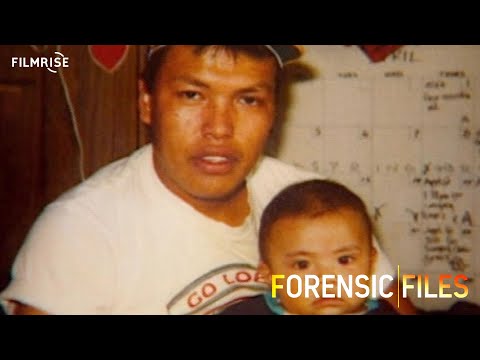
Forensic Files | With Every Breath | FULL EPISODE | HD | True Crime Procedure Investigation Drama
Episode Description
Season 4 Episode 12 | Young Navajos in the Southwest were dying at an alarming rate. The tribe's medicine men provided investigators with a critical clue...which would lead halfway around the world to a most unlikely killer.
Read the full transcriptHide the full transcript
- [Music] In 1993, on an Indian reservation in the southwestern United States, young Navajo
- Indians were dying at an alarming rate. More than 20 people would die from the mysterious disease, one that health
- officials had never seen before. But the Navajo Medicine men provided a critical piece of information which led
- investigators around the world to a most unlikely killer. [Music] [Music] Covering 25,000 square miles of high
- desert in four states, Utah, Colorado, New Mexico, and Arizona, is a Navajo Indian reservation in an area known as
- the Four Corners. It's the largest Navajo community in America with some 1,200 members of the
- tribe living throughout the desert hills. The scenery brings thousands of tourists
- each year, a vital source of revenue for the Navajo who have inhabited the area for centuries. But poverty is endemic
- and was a fact of life for people like 19-year-old Merrill Bahi. But Mel Bahi had something that set him apart. Merl
- was a very phenomenal person. But where he stood out was his running ability. And uh I think if you talk to anybody
- that saw him run, you know, they would tell you that it was a gift that he had uh in running. and he loved to run.
- >> Merryill Bahi was so fast he won a full scholarship to the Santa Fe Indian School, a boarding school that was miles
- away from his home both physically and culturally. >> He didn't really know how to put a sheet on a bl,
- you know, it was like he threw the blanket on and that was it. Said, "No, Mo, you um you put this down first." So
- I I had to show him how to to make up a bed. >> Bahi slowly adjusted to his new life. He
- did well in school, but the transition to life in the city was difficult until he met Florina Woody.
- >> Something magical happened. He met another Navajo girl at a PBLO school and they fell in love so intensely that um
- the track coach decided to make Florina the manager of the track team to hand out the towels so that uh Merryill would
- keep his mind on his running. >> Not long afterwards, they had a son Maurice and planned to get married. But
- shortly after the baby was born, Florina woke up one morning with what she thought was the flu.
- >> She was all cold. She kept, you know, having these chills and it was it was something like you're
- getting a cold or getting sick from a a common cold. >> Her lungs were a white out, meaning they
- were just solid. They should usually be dark from from the air, and they obviously had something in there, fluid
- in there. >> Doctors raced to find out what was wrong. They administered oxygen to help
- Fina breathe, but she went into shock. I saw um one of the nurses coming out of her room all disturbed and she was
- crying and and I knew there that something was happening. >> None of the standard procedures worked
- and Florina's heart stopped beating. The pressure on her lungs was simply too much for her body to bear. The cause of
- death, acute respiratory failure. Florina Woody died on Mother's Day. She was just 21 years old.
- >> When they told us that she was gone, then they allowed us to go into her room. I just couldn't believe that my my
- baby is gone. I didn't want to leave her. I just want to hang out there right there.
- Doctors had no idea what had caused Florina's sudden death, and they feared that whatever killed Florina Woody might
- be contagious. Florina's death was a particularly cruel blow to Meil Bahi. The mother of his
- infant son was dead. As Bahi prepared Flerina's funeral, he too started to develop similar symptoms.
- Merryill Bahi was beside himself. He wasn't feeling well, but it didn't occur to him that uh that it
- could possibly be the same thing that affected Florina. >> Merryill's physical condition quickly
- deteriorated, and he was rushed to the Crown Point Hospital, the same hospital that treated Florina.
- After an initial consultation, Merrill did not want to be treated where Florina died. So his family drove him to the
- Indian Medical Center in Gallup, an hour away. Shortly before arrival, Merrill lost consciousness.
- As doctors rushed him into the emergency room, he died. The cause of death, acute
- respiratory failure. Merryill Bahi was only 19 years old. Ironically, Merryill died during
- Florina's funeral service, which was taking place directly across the street from the hospital. The funeral was going
- on and there we had a meeting with our medical investigator and Merryill's family were coming in for Flo's funeral
- and they were told there and everything just started happening here and there and and that's when I went to shock.
- Health authorities had no explanation for what killed the young couple. The only way they could determine the cause
- was to perform a complete autopsy. But autopsies are not permitted in the Navajo community.
- >> It's forbidden in among traditional Napos to have autopsies done and the Navajo tribal government can forbid that
- if they want to. And I don't think the government people really understood that that we have that sovereign power to do
- that even if it's a medical emergency. But with her daughter and future son-in-law dead, Beta Beay wanted
- answers. She took the unusual step of defying tradition and the tribal elders by giving doctors permission to perform
- the autopsies. The autopsy findings took on a new importance when Merrill and Florina's
- infant child, Maurice, also fell ill. He was rushed to the hospital and quarantined.
- >> What is it? Where did it come from or what is it? Is it going to is it going to be here or how? You know, I asked I
- had that I had those questions and I wanted to find out. As authorities awaited the autopsy
- results, the disease continued its deadly rampage. Within a week of Florina and Merrill's
- deaths, the number of dead had risen to six, and each day more people were being
- hospitalized with symptoms. New Mexico officials feared they had an epidemic on their hands and panic
- gripped the region. We were getting calls from concerned citizens and concerned physicians and concerned
- school administrators and concerned everybody. Uh and that always will happen when something as dramatic as
- this and as frightening as this is occurring and when you do really don't have any good answers.
- >> The autopsies on Meil Bahi and Florina Woody answered few questions. The mystery illness could not be identified
- and until it was more people were destined to die. >> Doctors in the Four Corners area are on
- alert to a deadly respiratory illness. >> May 1993, Navajo radio stations in the Four
- Corners Indian Reservation broadcast an alert. Young Navajo were dying at an alarming rate and new cases were being
- reported every day. So little was known that health officials were not able to tell listeners what precautions to take
- against the disease. >> It was frightening for people who came down with a fever and cough and headache
- at the time. As a physician, we're sending people home who we had to accept the possibility that they could drop
- dead within hours of leaving the hospital. >> The outbreak was now national news. And
- since it appeared that only Navajo were affected, it was dubbed the Navajo flu. >> There was pandemonium.
- It's impossible to keep a string of deaths like this a secret for very long. One possibility was bubanic plague. The
- dreaded black death that killed millions during the Middle Ages and still strikes
- more than a thousand people worldwide every year. Plague symptoms, particularly the high fever, muscle
- pain, and fluid buildup bore similarities to the four corners disease. bubanic plague still crops up
- in New Mexico from time to time and so the state is very well equipped to do that test and um much to the to the uh
- chagrin of the investigators um the test was negative. It it was shagrin because
- they still didn't know what had killed this young couple. Another possibility was pneumonic plague, a highly
- contagious disease. It attacks the lungs and kills quickly, which is what happened to the four corners victims.
- Since it could be treated with large doses of antibiotics, doctors actually hoped that this was what they'd find.
- But the autopsies turned up something different. The capillaries of the victims had collapsed, leaving the lungs
- wet like large sponges. This was not consistent with pneumonic plague and it did not resemble anything medical
- investigators had ever seen before >> and it was very puzzling and it was it was frustrating because you felt like
- how come we're not smart enough to figure this out? You know, this shouldn't be that hard. So, I haven't
- had I haven't had that many cases at one time that I didn't understand. >> Local health officials called in the
- Centers for Disease Control in Atlanta, Georgia. The CDC special pathogens team was sent in to look for possible causes.
- And they started their investigation in the trailer that Mel Bahi and Florina Woody once called home.
- >> We had no idea what this was. We didn't know whether it was contagious. We didn't know whether working with the
- tissues was going to be dangerous. We didn't know whether you could get this uh in the laboratory or from somebody
- outside in the field. >> The outbreak was considered a biosafety level four hazard, the most lethal
- designation. Dressed in specially designed suits to keep them free from any contagion, CDC
- specialists searched the trailer and the surrounding area. They wore something like that. You know the astronauts that
- they're they're sending off to outer space. You know how they dress? They were dressed like that when they came to
- our place. And that was even scarier. They There was fear. They they scared us. While the medical community turned to
- their scientific experts, the Navajo turned to their own specialists, the traditional healers or medicine men who
- were responsible for the health of the reservation. They said they were familiar with this disease and that it
- had struck before. They were saying that uh this outbreak had occurred in the century in uh 1933 and 1918 when uh it
- was preceded by 2 years of plentiful rains and heavy winter snows in the mountains.
- The tribal healer said the heavy rains had resulted in a dramatic increase in the number of mice on the reservation.
- And they suspected there was some connection between the large number of mice and these deaths, but they could
- not say what it was. There was an old Nashville saying that I learned as a child that uh if a mouse ever runs over
- your clothing, you should burn it. And uh nobody ever knew what that old saying meant. Records indicated that there were
- heavy rains in 1991 and 92, the two years preceding the current outbreak. But health officials could not find any
- link between the rain, the growing deer mice population, and the outbreak. Meanwhile, in what's known as the
- maximum containment section of the CDC labs, an area reserved for the study of the world's most dangerous germs and
- viruses, investigators performed an ELISA test or enzyme linked imunosorbent assay on the tissue samples from the
- victims. When a disease strikes, the body reacts by producing antibodies which are unique to that disease. The
- ELISA test can isolate those antibodies in order to compare them to the thousands of samples in the CDC files.
- Comparison after comparison was made and no matches were found until the investigation took an unexpected turn,
- one that would take medical detectives back in time and halfway around the world.
- [Music] Within six weeks of Florina Woody and Melbah's deaths, more than 12 other
- young people had also died of the same mysterious disease. Investigators got a break in the case when a tourist from
- Iceland after visiting the reservation developed symptoms of the disease. Investigators now realized the outbreak
- was probably environmental and was not confined to the Navajo. >> Unfortunately,
- somebody um sort of identified this as a Navajo disease, which it very obviously
- wasn't because we were seeing there there were other cases occurring in in non-Navajos, but but that that was
- particularly offensive, I think, to people. When CDC investigators compared the antibodies from the outbreak victims
- to those in their vast file of known diseases, they made a surprising discovery. The only sample that was in
- any way similar was one that was 40 years old. It was a sample taken from a soldier stationed in Korea in 1950.
- During the Korean War, more than 3,000 troops developed high fevers and kidney failure. About 400 died. Doctors called
- it Havirus because it was traced back to Korea's Honan River. That region was home to large numbers of striped field
- mice. Feces and urine from infected mice carried the virus. When it dried out, it
- became airborne and was then inhaled by the soldiers. From there, the virus attacked the kidneys. But investigators
- were uncertain whether this was the same as the four corners virus. There had never been a haunt virus reported in
- North America. And the four corners disease attacked the lungs, not the kidneys. I had no idea what Honda virus
- was and looked looked in, you know, my textbook which had a very short section on it. Uh, and of course it describes a
- disease that occurs in Asia which which sounded nothing like what we were dealing with.
- >> Was this the same disease? And if so, how did it travel from Korea to a North
- American Indian reservation? CDC investigators then remembered what they'd been told by the Navajo
- traditional healers. >> The medicine men had said it when a remarkably wet winter was followed by
- the masting of the the pinion trees. When when the pinion trees put out um an abundant supply of nuts, the rodent
- populations in the state began to to grow. And when that happened, young Navajo died.
- >> Investigators caught and tested deer mice from the Four Corners area. They found the mice were shedding a virus
- with the same DNA profile as the virus found in Florina Woody and Melbi. But the DNA profile of this virus was
- not identical to the Korean H virus. Although the DNA profiles were similar, the strain from the Navajo reservation
- was a new one unique to North America. >> What we found when we did the comparison
- was that this was a new honor. That is the sequence was far enough from any other known hanavirus that we were
- convinced that it was a new virus. It wasn't just a minor variant on one of the old viruses. CDC scientists and
- Navajo medicine men suspected the North American HANA virus had been around for centuries, but since the cases were so
- isolated, it had always been misdiagnosed. The Navajo made up a greater percentage
- of the victims only because they lived in more rural areas with large deer mice populations.
- In the two years before the outbreak, heavy spring rains created a bumper crop of pinion nuts, a rich source of food
- for the growing mice population. Authorities believe that Merryill Bahi and Florina Woody inhaled the dried
- urine and fecal matter from the infected deer mice when they were house cleaning
- or digging in their garden. In my heart, I think it's it was God's will that this is what was supposed to happen to
- both of them and they were meant for each other and they were meant to go together.
- >> Health officials recommend that masks and gloves be worn when cleaning rodent
- droppings and that people do everything possible to keep rodents out of their homes. They also point out that the four
- corners outbreak was identified through the wisdom of the Navajo medicine men and the scientists who were smart enough
- to listen. >> We were discovering an old disease that the traditional healers had discovered
- long ago. And that was the I think to me that was uh the most exciting thing about this whole investigation. The
- Navajo, using an entirely different approach, looking at the balance of nature, were able to identify factors
- that led them to the same conclusion that um when rodent populations um explode the way they did in in the
- Four Corners in the spring of 1993, young Navajo died. These two very different sets of people
- set out on very different paths and arrived in the same place. [Music] Why? [Music]
- Heat. Are you ready? [Music]
Brief Summary
In 1993, a mysterious illness killed young Navajo, leading to a CDC investigation that uncovered a new strain of hantavirus linked to deer mice.
Key points
- Tragic Loss. Florina Woody's sudden death at 21 leaves a community in shock.
- A Race Against Time. As the death toll rises, health officials scramble to find answers.
- The Mysterious Illness. In 1993, a mysterious disease struck young Navajos, leading to alarming death rates.
- A New Virus Emerges. Investigators discover a new strain of hantavirus linked to the outbreak.
Episode highlights
- Tragic LossFlorina Woody's sudden death at 21 leaves a community in shock.“Florina Woody died on Mother's Day. She was just 21 years old.”4:25Oct 16, 2025
- A Race Against TimeAs the death toll rises, health officials scramble to find answers.“The disease continued its deadly rampage.”7:59Oct 16, 2025
- The Mysterious IllnessIn 1993, a mysterious disease struck young Navajos, leading to alarming death rates.“Young Navajo were dying at an alarming rate.”9:13Oct 16, 2025
- A New Virus EmergesInvestigators discover a new strain of hantavirus linked to the outbreak.“This was a new hantavirus.”18:46Oct 16, 2025
Tension
75/ 100High tension