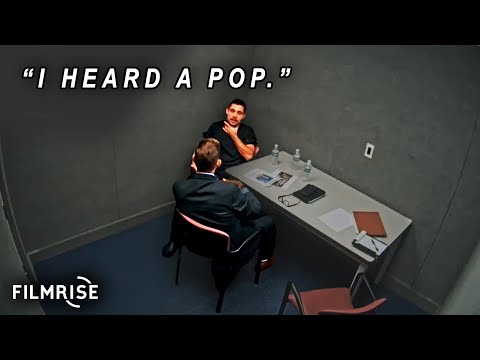
Forensic Files - Season 7, Episode 11 - A Clutch of Witnesses - Full Episode
Episode Description
Two eyewitnesses may hold the key to the death of a motorcycle gang member.
Forensic Files is the longest-running true crime series in television history. Evidence and interviews with experts help solve real crimes, disease outbreaks and accidents around the world.
Read the full transcriptHide the full transcript
- NARRATOR: Two eyewitnesses said they saw a man in a pickup truck deliberately run over another man-- not
- once, but twice. Police could not find the victim's body, or the pickup truck. And when police tried to talk to the two eyewitnesses,
- they had disappeared, too. All police could find were some blood stains in the snow.
- But would this be enough to prove murder? [theme music] On January 29, 2001, a member of a motorcycle gang in Duluth,
- Minnesota called police to report his roommate, 27-year-old Erik Schrieffer, missing.
- He said he hadn't seen Schrieffer for the last four days, and he was worried. -Usually that doesn't happen.
- People that report missing persons usually call in within the first six to eight hours in a panic.
- -Well great. I appreciate your assistance. Have a good day. NARRATOR: Officer Ryan Temple was assigned to the case.
- -Hi, this is Officer-- RYAN TEMPLE: I attempted to contact all the area hospitals,
- all the county jails in the area, the Duluth Detoxification Center. Also tried to contact the victim's family--
- his mother, his father. Also, his employer. NARRATOR: No one had heard from Erik Schrieffer.
- He worked as an apprentice for the Boilermakers Union 647. -Erik was very quiet and reserved.
- Very good performance on the job site. NARRATOR: But he hadn't been to work, either.
- Police found Schrieffer's three automobiles still in his driveway. His wallet and winter coat were inside his house.
- Police discovered that Schrieffer was last seen at a party in a motorcycle club house.
- Two motorcycle club members who were at that party, Charlie Johnson and Herbert Zingle, said that Schrieffer
- got into an altercation with Joseph Wehmanen, a member of a rival motorcycle club.
- -Who stuck you? [crashing and yelling] -Son of a bitch! [glass breaking] -What's up?
- Jesus! -What the fuck, man? Screw him. Take it outside. NARRATOR: The two were separated and escorted outside--
- -Get off me, man! -It's all right. Just calm down. NARRATOR: -- where The witnesses say Wehmanen easily won the fight.
- While Schrieffer was still on the ground, Wehmanen did the unthinkable. He got into his truck, started the engine,
- and intentionally ran over Schrieffer. Amazingly, he wasn't killed. Wehmanen then put his truck in reverse,
- and ran over him a second time. Fearing for their own safety, the witnesses ran back inside.
- When they looked out again, both the truck and Schrieffer were gone. -There was something more to this story
- than just a missing person. NARRATOR: The witness is admitted they were drinking heavily that night,
- and weren't sure of all the details. And the alleged fight took place almost a week earlier.
- And the inclement weather complicated the investigation. -There was a four day time lapse,
- and we had received approximately eight inches of slushy snow on-- in between time.
- It made it a very difficult crime scene. There was-- once we got there, there wasn't a whole lot to see, to start with.
- NARRATOR: When police looked into Joseph Wehmanen's background, they discovered he had
- never been in trouble with the law. He was an ex-Marine, who had served during the Gulf War,
- and was a member of the Thunderbird motorcycle gang, although not an active member.
- Investigators needed to find some forensic evidence to corroborate the witnesses' story.
- Police wanted to find some way to verify the claims of two eyewitnesses that Erik Schrieffer was run over twice
- by Joseph Wehmanen in his truck. -From the very beginning, we had to try and put the case
- together to understand exactly what had happened, and then attempt to try and locate where, possibly,
- the body had gone to after that period of time. So initially we were trying to put the puzzle together
- before we could find out where the body may have gone to. NARRATOR: Police set up a command post in the alley
- where the fight allegedly took place. Working in subzero temperatures, officers uncovered the top layer of new snow
- in order to search for blood. They were successful. They discovered a blood trail that led from the alley all
- the way to the end of a parking area, nearly 80 yards away. At the end of the trail, police found
- one very large pool of blood in the snow. -Due to the amount of blood that we found in that one spot,
- and the fact that there was no blood after that as we continued to excavate the snow past that point,
- we believe the body was loaded into the truck. NARRATOR: Medical examiner Dr. Donald
- Kundel was called to the scene. -A person, to produce that much blood in one localized area,
- had to still have their heart beating. They may have suffered serious injuries, but their heart had to still be beating in order
- to produce that much blood coming from a wound. NARRATOR: Once the heart stops beating,
- a body no longer bleeds. The blood evidence suggested that the victim was lodged
- under the truck, and was dragged 80 yards. The pool of blood at the end of the trail
- indicated the victim was still alive, and had been picked up from the snow. However, Doctor Kundel told police
- that without immediate medical attention, the victim would have died within four hours.
- To collect the blood evidence, police used a standard coffee filter to separate the blood from the snow.
- The filter trapped the red and white blood cells, and allowed plasma and melting snow to drip
- through, just as the filter traps coffee grounds, not allowing them to drip into the coffee.
- Without a body, police had another problem-- how to tell whether this was the blood of Erik Schrieffer.
- But police got a break. They learned that Schrieffer had undergone hand surgery a few years earlier, when he had accidentally shot himself.
- The hospital saved Schrieffer's tissue sample that had been sent to the pathology lab for analysis.
- The tissue was preserved in paraffin, which halts the degenerative process, preserving
- the tissue indefinitely. The blood DNA found in the snow was compared to the DNA from Schrieffer's tissue sample.
- It matched. Police canvassed area hospitals, health clinics, and doctors' offices.
- No one with the type of injuries Schrieffer would have sustained had been treated.
- Convinced that Erik Schrieffer could not have survived without treatment, the medical examiner
- signed a death certificate. -Yes, we do have a homicide, and one of the worst types
- for a detective to have-- a homicide without a body. NARRATOR: The next step was for police
- to speak with the driver of the truck, Joseph Wehmanen. But he was uncooperative.
- -He started to shut the door on me. At that point, I reached over and grabbed him
- by the shirt, informed him that he was under arrest for murder. NARRATOR: Police impounded Wehmanen's vehicle.
- But a forensic analysis found no evidence of an accident. They found no trace of blood, body fluids, or hair anywhere
- on the trunk, or underneath. -The crime lab is well-respected by law enforcement agencies in this state.
- They've got the best equipment, the most sophisticated gear. And if they couldn't find any evidence in the truck,
- then you started wondering, well how could that be? How could somebody drive a truck over somebody
- twice, and there's no hair, no blood, nothing? And that didn't seem right to me.
- NARRATOR: The lack of forensic evidence wasn't the only problem. Witnesses' credibility was another.
- During police questioning, both witnesses admitted they were inebriated at the time
- of the alleged accident. One said, quote, "I don't remember who was at the house, who came back.
- We were sitting there drinking. I know there was people in and out. Like I say, I'm drunk.
- I stay drunk as I can." And Joseph Wehmanen maintained his innocence. With two inebriated eyewitnesses,
- no forensic evidence in Wehmanen's truck, and no body to prove there had been a murder,
- prosecutors knew they didn't have enough evidence to go to trial. Investigators needed more evidence in the Erik Schrieffer
- case, and the search for his body intensified. Police decided to find out how their prime suspect, Joseph
- Wehmanen, spent his leisure time, and with whom? -I came across one of his friends
- and asked, when's the last time you spent time with Wehmanen? Where was that that he spent the time with him?
- And it'd come to be that within the week previous, he was ice fishing with this friend.
- NARRATOR: Police had a general description of the ice house that Wehmanen and his friend used,
- but they weren't sure where it was located on the vast Saint Louis River. Nevertheless, police were assigned to search the area.
- SCOTT CAMPBELL: He came across an ice house. We weren't quite sure whether it was the one
- that we were necessary looking for. But as he was looking into the ice house, he found a hole that was larger than your normal ice fishing
- hole, probably the size of one that a human could be slipped into. NARRATOR: An underwater dive team searched the frigid waters
- of the Saint Louis River for Schrieffer's body. Conditions were miserable. It was snowing with wind gusts up to 30 miles per hour.
- Divers could stay under the freezing water for only 30 to 45 minutes before suffering hypothermia.
- After days of searching, they found nothing. Then investigators got more bad news.
- Their case against Wehmanen was based almost entirely on the testimony of two eyewitnesses who claimed they
- saw a fight between Schrieffer and Wehmanen. But when police went to question them further,
- the two had vanished. SCOTT CAMPBELL: We have actually documented testimony from family members of the two witnesses
- that the Thunderbirds were approached by the Hells Angels, an in turn approached the two witnesses
- and asked them to leave the community. Downright threatened them. NARRATOR: With no body, no forensic evidence
- against Wehmanen, and now, no witnesses, the defense filed a motion to dismiss the case.
- The prosecution was in a difficult position. -All the while, too, we're looking for the body.
- And we're looking for some more physical evidence to tie Joe Wehmanen into this.
- We were convinced that he was the person responsible for the death, but he wasn't saying anything.
- The more police thought about Wehmanen's truck and the eyewitness testimony, the more they
- realized how unlikely it was that the undercarriage of his truck would be so clean, especially
- in the middle of winter. In the words of investigators, it was almost too clean.
- So nearly six months after the murder, they examined the truck once again. -We decided we would take the truck apart piece by piece
- until we were satisfied that there was no evidence to be found, or we actually found evidence.
- And that's what we did. -We had a belief all along that if the truck was used in transport of the body, there always
- has to be some type of forensic evidence that's left behind. Or in any kind of crime scene-- I strongly believe
- that there's always forensic evidence that's left behind in any crime scene. NARRATOR: They hoisted Wehmanen's truck
- up on a rack in the police garage, and bolt by bolt, they took the truck apart. -I think I used the analogy in one of my stories--
- it was like they were cutting their lawn with tweezers. They went over that vehicle inch by inch.
- NARRATOR: For over two days, police searched every inch of the vehicle. Finally, they found their first piece of evidence--
- a single strand of human hair that was attached to the front spring of the truck.
- And when they removed the top covering of the truck's cargo area, they found several small blood stains in the crevices.
- Police now suspected that Wehmanen power sprayed his truck after the murder, and the water pushed the victim's
- blood into the tiny crevices between the sheets of metal. But scientists still needed to find out
- who the blood and hair belonged to. When police found blood stains and a strand of hair
- in the undercarriage of Joseph Wehmanen's truck, they promptly informed Wehmanen's attorney
- that they would be sending the materials for forensic testing. -Once the state could tie the body to Mr. Wehmanen's truck,
- the case changed dramatically. And I talked to Joe, and I told him so. Ultimately it comes down to the old Kenny Rogers song.
- You've got to know when to hold 'em, and know when to fold 'em. And I felt it was-- when they found that blood in the truck,
- it was time to fold 'em. NARRATOR: Without even waiting for the results of the forensic testing, Wehmanen
- agreed to lead police to Schrieffer's body in return for a reduced charge of unintentional second degree
- murder. The prosecution agreed, and Wehmanen confessed. -It's my opinion that this forensic evidence
- was so powerful that Mr. Wehmanen knew what the outcome would be when we sent it to the lab,
- and just decided to plead guilty. NARRATOR: In Wehmanen's taped confession, his version differed from the eyewitnesses'.
- Wehmanen admitted running over Schrieffer in the alley, but said it was an accident.
- He also said he didn't realize Schrieffer was stuck under the truck until he reached the end of the parking lot.
- Wehmanen said he put Schrieffer in the back of his truck, and dumped him into the river the next day.
- He said the police had searched the correct spot in the Saint Louis River, but the body may have drifted.
- When the divers returned for a second search, they still couldn't find the body.
- A few weeks later, after the plea agreement was signed, Schrieffer's body surfaced by itself
- on the Wisconsin side of the river. The autopsy revealed that the cause of death
- was blunt force trauma to the head. In Wehmanen's mother's garage, police found a cinder block.
- Its size and shape were consistent with Schrieffer's head injury. Wehmanen didn't deny striking Schrieffer
- in the head with the block, but said he did it after Schrieffer was already dead.
- Prosecutors were skeptical. MARK RUBIN: He says he hit him with a block when he was wrapping up his body at his mother's garage,
- and hit him with a block of cement just out of frustration, expressing anger at Erik Schrieffer
- for having caused him to do this. Doesn't make a lot of sense. NARRATOR: Because of the plea agreement,
- Joseph Wehmanen was sentenced to 12 and 1/2 years in prison for Erik Schrieffer's death.
- He'll be eligible for parole after eight years. -12 years in prison for a murder where you drive your vehicle
- over a body one time, then back over it again, if the witnesses are to be believed--
- to me, that's not justice. -The family wanted us to make some type of negotiation,
- compromise on the amount of time, in return for recovery of the body. And I remember even telling Erik's mom and dad and brother
- that Joe Wehmanen is not going to get what he deserves for what he did to Erik. I made that very clear to them.
- And that's what I even told the court at sentencing. But we were willing to make a compromise in order
- to recover the body and put the case behind. NARRATOR: The other reason for the deal
- was the disappearance of the two eyewitnesses. They are still missing to this day.
- -I hope they are OK. I hope nothing has happened to them. And if we could find out who is responsible for their
- disappearance, for their being conveniently absent at a time when we needed them, for us having to reduce
- the charge for murder in the second degree intentional murder down to unintentional, we want to know.
- Then there'll be a little bit of finality to this case. NARRATOR: The case was solved by forensic evidence
- Wehmanen couldn't power wash away. Wehmanen knew that the blood found in the metal crevices
- and the single strand of hair were Schrieffer's, and that forensic testing would prove it.
- -I strongly believe that there's always forensic evidence that's left behind in any crime scene.
- It's just a matter of your human eye picking up and looking in certain places, and using the current technologies
- to locate that forensic evidence. -Forensic science was remarkable, because without the police department going
- that extra distance and finding that evidence in the truck, in the tailgate and the undercarriage,
- without the medical examiner finding that blood sample with the matching DNA at the end of that alley,
- we would have been out of luck. [theme music]
Brief Summary
Erik Schrieffer went missing after being run over by Joseph Wehmanen, leading to a complex investigation and eventual plea deal.
Key points
- Eyewitnesses Disappear. Two key witnesses vanish, complicating the investigation into Erik Schrieffer's disappearance.
- Confession and Plea Deal. Wehmanen confesses to running over Schrieffer, leading to a plea deal for reduced charges.
- Forensic Breakthrough. A single strand of hair and blood stains found in Wehmanen's truck lead to a confession.
Episode highlights
- Eyewitnesses DisappearTwo key witnesses vanish, complicating the investigation into Erik Schrieffer's disappearance.0:25Dec 10, 2021
- Confession and Plea DealWehmanen confesses to running over Schrieffer, leading to a plea deal for reduced charges.17:00Dec 10, 2021
- Forensic BreakthroughA single strand of hair and blood stains found in Wehmanen's truck lead to a confession.“Forensic science was remarkable.”21:44Dec 10, 2021
Tension
70/ 100High tension