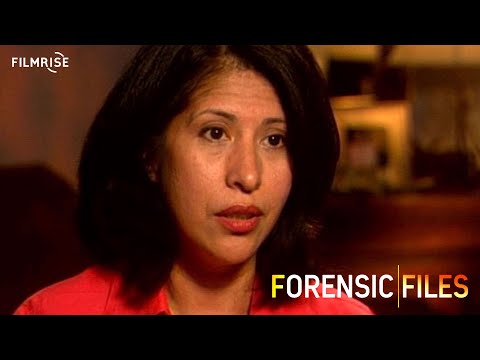
Forensic Files - Season 10, Episode 30 - Material Witness - Full Episode
Episode Description
A teenager went missing after an evening of horseback riding. Her body was found a month later, three miles from her home. The killer unknowingly left trace evidence behind - tiny but unmistakable clues which pointed to him and him alone.
Forensic Files is the longest-running true crime series in television history. Evidence and interviews with experts help solve real crimes, disease outbreaks and accidents around the world.
Read the full transcriptHide the full transcript
- NARRATOR: A teenage girl went missing after an evening of horseback riding. Some tiny bits of metal, wood, and some weathered green paint
- revealed the girl's path on the night she disappeared. And they also painted a portrait of the person she was with.
- [theme music] NARRATOR: Between school, sports, a part-time job, and homework, 16-year-old Tracy Parker
- didn't have a lot of spare time. Yet, she devoted every free minute she had to her first and only real love, riding.
- -We had actually been riding our entire lives. My dad actually brought the first pony
- we ever had home when, I think, I was four years old. So horses and animals very much a part of our lives.
- NARRATOR: Tracy's neighbors, Wayne and Sharon Frye, often allowed her to ride their horses.
- And in return, Tracy cleaned their stalls. But after one visit, Tracy disappeared
- and was never seen again. SHANNON PARKER: My mother knew that Tracy was going there to go riding.
- And she had anticipated her to be coming home. So obviously, that was where she started to make her calls,
- to the Frye residence to see if they had seen Tracy. NARRATOR: The Frye's told Tracy's parents
- they were out to dinner that night. And when they returned home, Tracy wasn't there.
- But they noticed that Tracy's favorite horse was sweating, an indication it had been ridden.
- And the riding equipment had been used and put away. -Everything seemed to be in order at their house.
- And then my mom continued to make calls from that point on. NARRATOR: Tracy's parents called police to report her missing.
- -When a teenager shows up not coming home, disappeared for less than 24 hours, without any other evidence indicating otherwise,
- the normal response is to treat it as a run away and begin the investigation in that manner.
- NARRATOR: Friends, neighbors, police and volunteers searched the entire area looking for any signs of her.
- But they found nothing. Five days later, searchers found Tracy's clothing in the woods,
- about two miles from her home. -The clothes were all crumbled and commingled with each other,
- and just thrown off of the road into the brush. SHANNON PARKER: The condition of the clothing was very bad.
- There was a lot of blood on the clothes when they were found. And the fact that it was pretty much all of her clothing
- just really made everyone's heart sink and-- and-- really, I think, left a very sickening feeling over the whole family.
- It was a-- a difficult day. NARRATOR: Nearby, searchers found a red towel and an orange blanket, both soaked with blood.
- Since this was before widespread use of DNA testing, serology identified the blood as type O.
- The same blood type as Tracy's. The Frye's home was Tracy's last known location,
- so police searched their home and stables and made a surprising discovery. DOUGLAS HUDSON: I discovered some blood spots
- inside the door to the basement, and I though this is very suspicious. NARRATOR: It was clear that this was blood spatter.
- DOUGLAS HUDSON: It wasn't a smear. It wasn't a drip. It had been thrown there through some type of force.
- NARRATOR: When questioned, the Frye's said the blood was the result of an accident.
- An explanation police found almost too convenient. DOUGLAS HUDSON: I talked to Wayne Frye about that
- and asked him if he'd injured himself or anything. He'd had an injury on his thumb.
- NARRATOR: The Frye's home was beginning to look like a crime scene, although Tracy's family still
- held out hope that she might be alive. -Please bring her home. That's all I want to say.
- NARRATOR: 16-year-old Tracy Parker had been riding horses at her next door neighbors home before she
- mysteriously disappeared. Her bloody clothes and a blanket were discovered just a few miles away.
- -Locating the clothes was really putting things into a perspective that we really
- didn't want to have to face. NARRATOR: The red towel found with Tracy's clothes was even more telling.
- Police discovered that the towel belonged to Tracy's next door neighbors, the Fryes.
- They had used it to cover the window in their garage. SHANNON PARKER: They just seemed very, kind of, unmotivated
- and a little bit like two burnouts. I just thought they were kind of odd people.
- They didn't seem particularly dangerous or there wasn't any reason to feel afraid of them, I guess.
- -The Frye residence became very high on my list as a potential crime scene. NARRATOR: Also suspicious, investigators found blood
- on the basement door of the Frye's home. -And certainly at that point, suspected
- they had found the place where Tracy had last been. NARRATOR: But in a huge setback for investigators,
- an antibody test revealed that the blood was from one of the Frye's dogs. DOUGLAS HUDSON: He had two rather large dogs
- and one of them had injured the tip of it's tail. That it was possible that the blood that was on the wall
- had come from the tip of the dog's tail. NARRATOR: Nevertheless, police continued
- to focus on Wayne and Sharon Frye. They said they were out to dinner with friends on the night Tracy disappeared.
- But a check of their telephone records indicated someone used their home phone at 7:44 PM.
- Brian Lord, the Frye's handyman, called his girlfriend to say he was running a little late.
- IONE S. GEORGE: Brian Lord and his girlfriend had just had a baby. There was a family get together going on.
- It was their first real dinner party, and he was expected at home. NARRATOR: Tracy Parker made a telephone call from the house
- 15 minutes later to one of her friends. IONE S. GEORGE: We know that Tracy made a phone call to one
- of her girlfriends at about 8 o'clock. The friend was unavailable to talk and Tracy said, well, call me back.
- NARRATOR: During questioning, Brian Lord said he didn't see Tracy Parker that night.
- He claimed he left the Frye's home shortly after calling his girlfriend. SHANNON PARKER: My sister had actually said to me,
- you know that guy that works on the house up there where I ride the horse says you're really cute.
- She goes, anyhow, I don't hang out with him. He's given me a ride home before. That was nice.
- NARRATOR: In the forensics lab, scientists found some rare and unusual evidence on Tracy's bloody clothing.
- Tiny pieces of metal. JOHN A. BROWN: When we looked at the metal shavings, we could see that there were tool marks on them
- and that they had these characteristic little curled-up shapes of metal turnings, as opposed to some other process.
- NARRATOR: They appeared to be shavings from a metal lathe, a machine that grinds and cuts metal.
- Investigators used X-ray Fluorescence Spectroscopy, or XRF, to determine the chemical composition
- of the shavings. EDWARD SUZUKI: They were comprised primarily of aluminum, but they had a large number of other elements
- present. So these were aluminum alloys. NARRATOR: Metal isn't an item commonly found on clothing.
- -It would be extremely rare. Not everybody is wandering around with aluminum shavings
- on their clothing. NARRATOR: But investigators couldn't find similar aluminum shavings anywhere in the Frye's home, in their stables,
- or anywhere else on their property. As the investigation continued, a search team
- made the discovery everyone had been dreading. One month after she disappeared, Tracy Parker's partially
- clothed body was found in a field about three miles from her home. SHANNON PARKER: I felt like my childhood
- ended the day Tracy died. All of a sudden, I-- I had to be an adult and had adult problems and responsibilities,
- and things that went along with, you know, being part of something like this. So I feel that I lost my childhood in a sense.
- NARRATOR: The autopsy revealed the cause of death was blunt force trauma to the head.
- She had apparently been murdered around the time she disappeared. The autopsy also found evidence she
- had been sexually assaulted. Investigators found those same aluminum metal shavings
- on Tracy's body, along with chips of very old weathered green paint. -From that point, law enforcement
- began looking for a construction site, or really a woodworking shop to match up to
- where did all of these small wood shavings come from? Where did all the metal shavings come from?
- And so they went out really looking for any connection to a woodworking or a small base construction shop.
- NARRATOR: Investigators knew if they found the source of both the green paint and the aluminum shavings,
- they would find the killer of 16-year-old Tracy Parker. Records show that Tracy Parker used her neighbor's telephone
- to call a friend around 8:00 PM on the night she disappeared. Brian Lord, the handyman, used the same phone
- to call his girlfriend 15 minutes earlier, although he claimed he didn't see Tracy that night.
- Lord said he stopped by his brother's workshop on his way home. When police searched the shop, they found nothing suspicious.
- -Nothing jumped out at us right away. It appears that nothing really happened in the workshop.
- NARRATOR: Brian Lord allowed police to search his pickup truck, and examine the clothes he said
- he was wearing the night Tracy disappeared. Investigators found no forensic evidence.
- But neighbors told police they saw Lord washing his truck with a hose that night.
- -We had witnesses that had him cleaning his pickup truck, which was very unusual for him to do that.
- TRAVIS BAKER: He was washing a truck without a shirt on in 57 degree weather. That sort of behavior was hard to explain.
- NARRATOR: Naturally, investigators found this suspicious. So they decided to take a much closer look
- inside his brother's workshop. The floor looked remarkably clean and appeared to have been covered with some type of oil.
- To find out what was beneath it, analysts sprayed the floor with a reagent called leucomalachite green
- that reacts with the protein in human blood. Just seconds after it was applied, large areas illuminated.
- FEL ABILLE: Which told us that there was quite a bit of blood that was not seen with the human eye.
- I was overwhelmed. NARRATOR: When Brian Lord's attorney saw the blood stain, he suggested the blood was from Brian's dog
- when she was in heat. -I said, well then, we better look for this dog. And he goes, what do you mean?
- Because there's got to be one heck of a dead dog here somewhere. I mean, look how big that spot is.
- NARRATOR: Serology tests showed that the blood was human, and was the same blood type as Tracy Parker's.
- DOUGLAS HUDSON: The crime lab examination of the blood revealed that it was type O with a particular enzyme, which
- limited it to approximately 4% of the population. Turned out that Tracy Parker's blood
- was identical in type and that enzyme. NARRATOR: Next, analysts collected everything
- they could find in the workshop. Paint chips, metal shavings, wood chips, debris, dust, dirt,
- all were sent to the forensic lab. EDWARD SUZUKI: In the history of our crime laboratory,
- which has been in existence since the 1970s, this is by far the largest case, as far
- as the volume of trace evidence, that has been received. NARRATOR: Among the thousands of pieces of trace
- evidence investigators identified wood chips and paint fragments. But the wood chips were so small it was impossible to tell
- whether they matched those found on Tracy's body. The white paint chips were difficult to identify,
- but the green ones were easier. Colored paint has variables like color pigments, binding agents,
- synthetic and organic base materials that can be unique. JOHN A. BROWN: Never in my life have I see green paint that
- would have matched this green paint. It was badly weathered and very old, and it showed in the examination I did.
- And I've never seen a paint like this before or since. NARRATOR: The green paint chips were subjected
- to microscopic infrared elemental analysis. The results were astounding. The green paint chips found on Tracy's body
- were identical to the paint of an old piece of fence found in Brian Lord's workshop.
- EDWARD SUZUKI: They were similar in their color, texture, layer structure, degree of the weathering, chemical
- composition, composition of minor elements, and so forth. NARRATOR: Police checked Brian Lord's work records
- and learned that Lord had dismantled this old green fence just a few weeks before Tracy's disappearance,
- and carted those pieces away from the work site in his truck. -To me, the green paint chip was the smoking gun
- as-- in relationship to Brian Keith Lord. NARRATOR: Finally, investigators tested metal fragments
- in Lord's workshop with X-ray Fluorescence Spectroscopy, or XRF. They were identical in composition, size, and shape
- to those found on Tracy's body, on her clothing, and on the orange blanket. And a single strand of human hair on the orange blanket
- was microscopically similar to Brian Lord's hair. TIMOTHY A. DRURY: I think Brian Keith Lord was an angry person,
- and I don't know why. A vicious, angry person. NARRATOR: Police found no evidence that Wayne and Sharon
- Frye had anything to do with Tracy Parker's murder. Brian Lord was arrested. He insisted he was innocent.
- But a background check revealed a violent past. One that literally went unpunished.
- Forensic evidence linked a 25-year-old handyman, Brian Lord, to Tracy Parker's murder.
- When police checked Lord's background, they found something horrifying. Lord had been convicted of murder once before.
- -As a child, when he was only, I believe it was 13, walked over to a house of one of his friends
- and shot his friend's mother in the back while she was hanging up clothes on the line.
- There was no motivation. He killed her. NARRATOR: For that crime, Lord served only six months
- in a juvenile detention facility and was released. -When we learned that Brian Lord had killed before,
- I think our family felt very cheated. We felt like the system just didn't do its job.
- Why would somebody spend so little time for such a heinous crime? NARRATOR: Prosecutors believe Brian Lord had
- his eye on Tracy Parker for quite some time. He frequently worked at the Frye's homes as a handyman
- while Tracy was there caring for the horses. On the night of the murder, the Frye's were out to dinner,
- so Lord and Tracy were alone. Phone records show that Lord called his girlfriend
- at 7:44 to say he was running late. -OK. I'll see you then. NARRATOR: That phone call ended just 8 minutes
- before Tracy called her friend from the same phone. -We believe very much that they met together
- at least in the kitchen area when those phone calls were made. Tracy was not seen after that time.
- NARRATOR: Prosecutors think Lord may have offered Tracy a ride home. Along the way, he stopped at his brother's workshop.
- His brother was out of town that day. Lord somehow enticed Tracy inside the workshop.
- -Yeah, I like it. I like it a lot. -Well, come here. Right back in here. NARRATOR: There, he may have propositioned her
- and she refused. -Stop it. NARRATOR: The evidence suggests Lord struck her on the head with a blunt object and sexually assaulted her.
- Bits of wood, paint, and metal fragments on the floor clung to Tracy's clothing.
- The weathered green paint chips were transferred onto the clothes and blanket from Lord's truck.
- Hair from Lord's head fell onto the blanket too. [door slams] After Lord put Tracy's body, her clothing,
- and the orange blanket in different locations, he rushed back to the workshop, washed the back of his truck
- with a hose, swept and washed the floor, then spread motor oil to cover the blood that had seeped
- into the porous concrete. But the cover up didn't work. The pieces of evidence were too numerous.
- The analytical powers of the investigators were too great. TIMOTHY A. DRURY: It was very complicated.
- It took a very long time to present each small piece of evidence and have it traced back to where it was found
- and how it linked then to other-- other pieces of evidence that were found at other sites.
- SHANNON PARKER: You wonder what is this guy all about? Several times when we were in court,
- he would make little comments as we would walk by. And he would say to my dad, well, if I ever get out,
- maybe your other daughter will be next. Just horrible things that make you have a lot of nightmares.
- And I thought, I don't have to deal with him right now. Maybe at some point in the future
- I will, but right now, I know where he's at. NARRATOR: Brian Lord was tried and convicted
- of first degree murder and sentenced to death. A few years later, Lord's guilty verdict
- was overturned on appeal. He was tried and convicted again in 1999. And this time, sentenced to life in prison without parole.
- -I think the overturning of capital murder cases is so routine that it's aggravating,
- but it's not a surprise. IONE S. GEORGE: After the first trial on appeal, I believe it was our state Supreme Court that
- said in the written opinion that this was the most complex circumstantial trace evidence case that
- had never been tried in the state. And I'd be willing to wager that that stands true.
- -I'm not so sure as this case would have been solved had it not been for the forensic evidence.
- It was the forensic evidence that tied all of the scenes together. And it was the forensic evidence that
- pointed directly at Brian Keith Lord. [theme music]
Brief Summary
Tracy Parker, 16, was murdered; Brian Lord was convicted after forensic evidence linked him to the crime.
Key points
- Tracy Parker's Mysterious Disappearance. 16-year-old Tracy Parker goes missing after a horseback riding session, sparking a frantic search.
- Blood Evidence Found. Searchers discover Tracy's clothing and blood-soaked items in the woods, raising alarms.
- Forensic Breakthroughs. Unique green paint and metal shavings found on Tracy's body lead investigators to Lord.
- Suspicion Falls on Brian Lord. Forensic evidence links handyman Brian Lord to Tracy's murder, revealing a violent past.
- Brian Lord's Conviction. After a complex trial, Brian Lord is convicted of Tracy's murder and sentenced to life.
Episode highlights
- Blood Evidence FoundSearchers discover Tracy's clothing and blood-soaked items in the woods, raising alarms.“There was a lot of blood on the clothes when they were found.”2:58Jan 14, 2022
- Forensic BreakthroughsUnique green paint and metal shavings found on Tracy's body lead investigators to Lord.“The green paint chip was the smoking gun.”14:56Jan 14, 2022
- Suspicion Falls on Brian LordForensic evidence links handyman Brian Lord to Tracy's murder, revealing a violent past.“Brian Lord was arrested.”15:46Jan 14, 2022
- Brian Lord's ConvictionAfter a complex trial, Brian Lord is convicted of Tracy's murder and sentenced to life.“It was the forensic evidence that pointed directly at Brian Keith Lord.”21:02Jan 14, 2022
Tension
85/ 100High tension