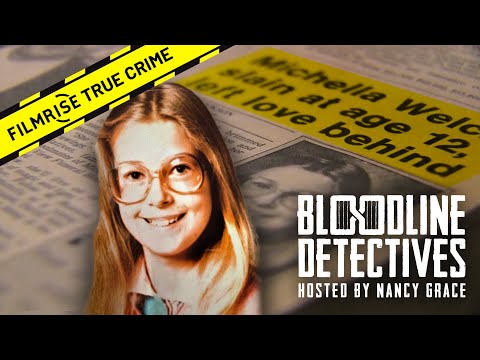
Bloodline Detectives - Season 2, Episode 15 - The Rapid City Rapist - Full Episode
Episode Description
February 1968 in South Dakota, 60-year-old pharmacist Gwen Miller fails to show up for work. Despite co-workers discover her body soon after, the case goes cold and remains so for decades.
A compelling new True Crime series, hosted by preeminent legal analyst and renowned former prosecutor Nancy Grace, that explores the advanced form of familial DNA testing.
Read the full transcriptHide the full transcript
- [DRAMATIC SOUNDS] NANCY GRACE: 1968, Rapid City South Dakota. A 60-year-old woman brutally raped and murdered
- inside her own home. [DRAMATIC SOUNDS] BRIAN OXMAN: The cause of death was strangulation.
- The manner was a homicide. This was a brutal vicious murder. NANCY GRACE: The investigation hits
- one dead end after the next. The case goes cold. WAYNE KEEFE: 1972 Rapid City experience a devastating flood.
- The basement of the police department was effectively filled in with silt, which thereby
- destroyed all of the records. M. WILLIAM PHELPS: So literally, you're starting back at the beginning again.
- [DRAMATIC SOUNDS] NANCY GRACE: Any hope of finding Gwen Miller's killer seems gone.
- Until one detective taps into a new form of investigative science. [DRAMATIC SOUNDS]
- WAYNE KEEFE: If I were able to match the suspect's DNA to one of these databases, there was no doubt in my mind
- I could at least come up with who his family members were. NANCY GRACE: This is the story of the brutal rape and murder
- of Gwen Miller and how thanks to forensic genealogy, her cold case is finally cracked.
- I'm Nancy Grace, and this is "Bloodline Detectives." [THEME MUSIC] [OMINOUS MUSIC]
- Rapid City is a rural and peaceful community. It's the second biggest town in South Dakota,
- and one of America's biggest tourist destinations. [OMINOUS MUSIC] WAYNE KEEFE: Rapid City is just a good quality Midwestern town.
- Its city is in its name and it's gotten considerably larger over the past few decades.
- Generally speaking, the people here, most of them are middle class hardworking families
- that just want to go on about their day in peace, and quiet, and calm. NANCY GRACE: One day in 1968, the peace
- and tranquility of this historic place is shattered. On February 29, 60-year-old Gwen Miller
- fails to show up for work. WAYNE KEEFE: Gwen Miller was a pharmacist and she worked at Bennett-Clarkson Hospital
- which was one of the two main hospitals in Rapid City at that time. And she was known to the people there.
- The nurses, the doctors, just the general hospital staff. She was known to be a diabetic.
- And she had over time had some diabetic seizures. She had passed out a few times, things like that.
- So they were-- the staff there were aware of that it wasn't a huge problem but they knew that about her.
- A couple of the nurses that were on staff there were very concerned about her because
- of her known diabetic status, and the two of them went together to her house on Hall Street to check on her,
- to find out what happened. Why is she not here? M. WILLIAM PHELPS: What do they find?
- Broken glass, the door open. So they go in. And they look around. And they see Gwen in bed.
- And they don't think much of it, they think maybe, huh, maybe she is in a diabetic shock, coma.
- But then they look closer and they see, no, she's dead. [MUSIC PLAYING] BRIAN OXMAN: Her co-workers immediately called the police,
- Rapid City Police Department. And when the police arrived, they did a crime scene investigation.
- They started collecting evidence, they collected Gwen's pajamas, they collected the sheets which were on the bed,
- they collected her purse. And they collected her checkbook which was really a strange thing because Gwen kept meticulous notes of all
- the places that she would go, and even the amounts of money that she would spend.
- If she spent $2.50 on a taxicab, she would note that in her checkbook. And all the expenditures of her life were there.
- [DRAMATIC SOUND] WAYNE KEEFE: There wasn't blood that they could find. It wasn't a bloody gruesome type of scene.
- They did notice a little bit more about her neck and there being contusions and kind of marks around it
- that might be consistent with her being strangled. [MUSIC PLAYING] M. WILLIAM PHELPS: So the coroner arrives on scene
- to oversee the body being taken to the pathology department for further forensic examination.
- But right away on scene, I mean, they can tell that Gwen Miller has been raped, and likely strangled because there's
- bruises on her neck. When they look deeper at this, they find out not only has she
- been strangled, but she's been strangled very violently by a strong person. Her ribs are even broken.
- So what does that tell me? That tells me the person kneeled on her chest while he strangled her to death.
- And she likely fought after he raped her. NANCY GRACE: Gwen Miller's home is now a crime scene.
- Investigators look for clues and possibly a motive. M. WILLIAM PHELPS: You go to the handles on the doors,
- you check for fingerprints. Then you go to the body and you begin to look at the body.
- And the body speaks even though the body is dead. NANCY GRACE: The homicide takes local law
- enforcement by surprise. BRIAN OXMAN: Rapid City was not a high crime area for a number of rapes.
- And this was a time when fingerprints and blood typing were the main stays of a criminal investigation.
- They found several latent fingerprints in Gwen's house. However, they were able to determine most of them
- except one. They were not able to determine who that one mysterious fingerprint belonged to.
- [MUSIC PLAYING] NANCY GRACE: Police want to know, who was Gwen Miller? M. WILLIAM PHELPS: Gwen Miller was born in 1908.
- And she was a child of that era. And she grew into a student who was interested in pharmacology.
- So she followed that path during a time really when it was mostly male dominated.
- So you could say that Gwen Miller really did what she wanted to do in life. Independent woman.
- JIM LINDGREN: She was one of the sweetest women you'd ever want to meet. She is always happy to see you come,
- was pleasant to be around, just a wonderful person. KAY MILLER-TEMPLE: Still remember just how
- happy Aunt Gwen was to see us. She was so happy to see her family members. And I think that's what I remember about Aunt Gwen.
- Is she just always was happy to be with her family. NANCY GRACE: Gwen Miller is known
- and loved in her community. Her work brings her in touch with so many neighbors and now, she's starting to wind down a career that she loves.
- JIM LINDGREN: I got a phone call and they told-- her family just told me that Gwen had passed away.
- And that's all they ever said. KAY MILLER-TEMPLE: I just thought that she had died from diabetes, nobody had talked any other.
- This was the first funeral that I was allowed to attend and I was a fifth grader.
- And then when I turned 28 and found out how Aunt Gwen died, after I got done being mad at my mother
- for never having told us that, I thought, oh, now I understand. I totally understand why that church was so quiet.
- M. WILLIAM PHELPS: And unassuming person who never bothered anybody, kept to herself.
- This is a home invasion, a murder, and a rape. It's rare, but it's scary. NANCY GRACE: A close-knit community is outraged.
- Police at a loss, who would want to rape and murder Gwen Miller? As we see next on "Bloodline Detectives,"
- police are afraid her killer could strike again. [DRAMATIC SOUNDS] [MUSIC PLAYING]
- February 1968, Rapid City South Dakota Police beginning to investigate the murder
- and rape of a 60-year-old woman, Gwen Miller. Her body discovered in her own home
- when Gwen doesn't show up for work. So far, a team of investigators has very little to go on.
- M. WILLIAM PHELPS: This investigation turns into three different agencies being involved.
- The Sheriff's Department, the local police, and the FBI. The local police detectives were the ones
- doing the gumshoe work. NANCY GRACE: In 1968, investigative police work is about the basics.
- Searching a crime scene for evidence that could yield a clue. WAYNE KEEFE: Some of the main pieces of evidence
- that were collected were they dusted the house for fingerprints, which was one of the main investigative tools
- at their disposal at that time. They took many different fingerprints from different locations on the scene.
- They gathered up things like her purse, canceled check stubs, they gathered up the sheets
- from the bed, they took of course the night clothes that she had on. Those were taken at autopsy.
- They took the rug and so forth that had glass fragments and the pieces of the brick that was
- used to break the back window. M. WILLIAM PHELPS: They're able to identify all of the fingerprints as Gwen's, her friends, family,
- except one set of prints. And that one set of prints if I'm a detective, I'm saying that's my killer.
- NANCY GRACE: Rapid City Police also reached out to that close-knit community for any information
- that could help. M. WILLIAM PHELPS: The first thing they start doing is canvassing the neighborhood.
- Knocking on doors, talking to people, what have you seen tonight? They might be making calls to other departments
- to find out if there's any similar crimes in the area. But their main tool of investigation
- is talking to people. Then they're going to go to Gwen's work. They're going to talk there.
- BRIAN OXMAN: The police did their best to find out what happened to Gwen. How this murder took place.
- And there was a report that a taxicab arrived at 10:30 PM that night, and that this was a female or maybe a male,
- they couldn't tell. The next door neighbor who made this report couldn't tell who got out of the taxicab,
- and then the taxi cab drove away. It remained a mystery, the police investigated
- the best they could. They questioned every single taxi driver they could find. They gave them lie detector tests, the polygraph.
- And yet, they could not find any indication that Gwen had taken a taxi cab. [OMINOUS MUSIC]
- WAYNE KEEFE: One of the neighbors told the police at that time that she had just finished
- watching the evening news, which would have started at 10:00 and ended at 10:30.
- When she believed a taxi pulled up into Gwen's driveway, a subject that she could not describe male or female
- got out, and the taxi backed out and left. Based on the fact that Gwen didn't drive,
- that she took a taxi on a regular basis, the lady didn't think much of it. But that information in and of itself
- started a particular line of this investigation at that time. NANCY GRACE: A late night taxi, the image of a man.
- And soon, investigators have a name and a suspect. That's next on "Bloodline Detectives."
- [DRAMATIC SOUNDS] [OMINOUS MUSIC] Rapid City South Dakota 1968, police think they may have a prime suspect
- in the rape and murder of a 60-year-old woman Gwen Miller. [MUSIC PLAYING] WAYNE KEEFE: Neighbors throughout that area
- were quick to point out a gentleman that lived in Rapid City, his name was Michael Beckers.
- Michael Beckers was a pharmacist himself and he owned Becker's Drugstore which was downtown in the 600 block
- of Main Street in Rapid City. [MUSIC PLAYING] M. WILLIAM PHELPS: Michael Beckers had his own pharmacy
- and Gwen Miller worked part time for him. So as they begin to look at this guy, they find out,
- h-m, he's kind of a womanizer. This guy, you know, he had his faults. But there was no indication that Gwen
- and him had any type of romance or anything going on. And there were no reports that maybe he had an obsession
- with her or anything like that. So as he begins to look like a good suspect, now you're starting to exclude him.
- One report particularly begins to interest detectives about this guy. And that's that neighbors report he was out there one night.
- It was dark, he was loud, he was making a scene in front of Gwen's house. However, the guy liked drinking, so he
- was possibly drunk at the time. Now if he's drunk and he's making a scene, that's one thing.
- If he's sober and he's making a scene, that's quite another thing. NANCY GRACE: Lots of people in Rapid City
- have opinions about Michael Beckers and none of those opinions are good. WAYNE KEEFE: Michael Beckers was known throughout our community
- to be a heavy drinker. He was a womanizer. He was separated from his wife and living with another woman.
- And he was reported to have gone to Gwen's house the summer prior to this murder.
- He showed up at night in a taxi. Because of his drinking, he also took taxis everywhere he went.
- He showed up at Gwen's house and was at her back door beating and pounding on the door demanding that she let him in.
- Making so much noise that the neighbors called the police at that point in time.
- And the police responded and took him away from the property. So that of course, made Michael Beckers a fairly decent
- suspect at that point in time. NANCY GRACE: Police ask Michael Beckers to take a polygraph test.
- BRIAN OXMAN: The polygraph test is such an interesting police technique. The police love it, they want to use it,
- they will tell you how effective it is. The scientists will tell you that it is totally ineffective.
- But what real criminologists will tell you is that it is when the suspect refuses
- to take the polygraph that they are now fingered as someone who is involved in the crime.
- Beckers refused to take the polygraph, he got scared. He didn't want to take it.
- WAYNE KEEFE: Many of the people in our community at that point in time believed Michael Beckers was the person
- that killed Gwen Miller. One of those people that came forth was the girlfriend that Michael Beckers
- was currently living with in an apartment near his pharmacy. One of her best friends, another female,
- was actually acquainted with one of the detectives that was working on this case.
- So Michael Beckers' girlfriend says to her friend, there is no doubt in my mind Michael Beckers is
- the one that killed that lady. That detective and another detective tried to make contact with Michael Beckers' girlfriend
- to verify the statement. They met her at the apartment near the pharmacy, started
- to conduct an interview with her or just basically telling them who they were and why we're here and getting some of the basics
- down when Michael Beckers burst into the apartment. And basically, threw the detectives out.
- Demanded that they leave. You may not talk to her those type of things. Rather than cause a scene, those detectives
- just backed away calmly and so forth, and went on about their day. Of course, noting the fact that Michael Beckers
- really didn't want us to talk to her. They assumed that at some point in time, they could talk to her in the near future at a place
- where he may not interrupt. The unfortunate part to this whole thing is approximately a week later, that female
- died of what was put on her death certificate as a drug overdose. So they were never able to conduct the interview with her.
- NANCY GRACE: A key witness is suddenly dead. Then completely out of the blue, something else happens.
- A stroke of bad luck that literally pours water on the investigation. [MUSIC PLAYING]
- M. WILLIAM PHELPS: There's boxes upon boxes of files, interviews, lie detector test results,
- analysis. And what happens is devastating to the investigation. In 1972, there's a flood in the office
- where the records are kept and the records are destroyed. So literally, you're starting back at the beginning again.
- And this is before digital and all of that, so now you're banking on memory. Because in any investigation you interview somebody
- and you want to go backwards and look at the case record, and maybe there's some information that lines up.
- They can't do that anymore. [MUSIC PLAYING] NANCY GRACE: The investigation hits another brick wall.
- Michael Beckers dies. BRIAN OXMAN: Michael Beckers died in 1973. This was one of the strange developments
- in the case of Gwen Miller where the prime suspect was no longer alive. The police went on to look at this as a cold case.
- They didn't have a suspect, they didn't have anyone who they could pin this crime on,
- and they were at a total loss. This case was going to go unsolved except for the fact
- that there was the development of DNA technology over the years, and except for the fact
- of one lone detective who decided, I ain't going to let this thing go. NANCY GRACE: The prime suspect is dead.
- Crucial evidence, destroyed. Five years after the rape and murder of a Gwen Miller,
- the case goes cold. Until new science and the "Bloodline Detectives" take over. That's next.
- [DRAMATIC SOUNDS] 2005, Rapid City South Dakota, 37 years have passed since the brutal murder of a Gwen Miller killed
- and raped in her own home. The case is cold, but now detectives think a new forensic science could bring it back to life.
- [OMINOUS MUSIC] WAYNE KEEFE: In 2005, the State Division of Criminal Investigation received a grant, I
- believe from the federal government to look into and process some unsolved cases using
- new DNA technology that was coming about. One of the cases that they worked on at that point in time
- was Gwen Miller's case. The evidence was sent to the state crime lab. Semen samples from her pajamas were processed
- and DNA extracted. [MUSIC PLAYING] M. WILLIAM PHELPS: So they submit that DNA into CODIS and all of the databases,
- and they don't get a hit. Now, is it disappointing? Yes. Is it expected? Yes. Because those databases are only good if an offender has
- committed another crime, and his or her information, his DNA, is put into that base.
- So what you have is you have an offender's profile but that offender is not in the system.
- NANCY GRACE: Rapid City investigators won't give up on the scientific weapon they now have.
- They look for another way to find a sample that might match DNA on Gwen's pajamas.
- WAYNE KEEFE: In 2010, the Division of Criminal Investigation again took another look at this case.
- Based on improvements in the DNA and their abilities to obtain a better profile, they looked at this case again.
- NANCY GRACE: Police exhume the body of Michael Beckers, their prime suspect in the original investigation
- hoping and praying for a match. WAYNE KEEFE: They were able to reprocess some of the evidence
- and obtain a complete DNA profile of the suspect at that point in time, including all
- of the Y-chromosome markers. They needed to be able to compare Michael Beckers' DNA with this full profile to determine
- if he was the suspect. NANCY GRACE: The process to legally exhume a body is very complicated.
- [DRAMATIC SOUND] M. WILLIAM PHELPS: They exhume his body, they tested DNA which is a sperm sample found
- on Gwen Miller's pajamas against Michael Beckers' DNA, and it's not a match. He did not rape her.
- NANCY GRACE: The case is cold again. So Rapid City Police bring in two new weapons
- to help solve Gwen's murder. The first, a veteran detective named Wayne Keefe. The second, forensic science called genetic genealogy
- that Wayne Keefe knows how to use. [MUSIC PLAYING] WAYNE KEEFE: I got a message from the chief one day
- and asked me to come to his office. And I didn't know what he wanted, but I went up there.
- Went to his office and sat down and he wanted to know what I had planned for after retirement.
- And I told him at that point I had two or three things that were kind of kicking
- around but nothing solid. And he asked if I would consider working on cold cases
- for the department. I jumped at that opportunity. Told him, absolutely, I would like to do that.
- It was during that time when I reviewed Gwen Miller's case and formed several opinions about what
- could be done with that case. BRIAN OXMAN: This is a cold, cold case. He started interviewing people just out of the desire
- to not let it go. He would interview people who were in the records as having known Gwen Miller.
- Her employee friends, co-workers, people at the hospital, people on the street, and where she lived.
- He would just try to find something that would give him a clue, that would give him a break.
- NANCY GRACE: Detective Wayne Keefe reaches out to Gwen Miller's relatives. [OMINOUS MUSIC]
- KAY MILLER-TEMPLE: So I'd arranged to meet Wayne in November of 2015, and that's when more information became available.
- And Wayne had-- there were 10 cold cases in South Dakota. Aunt Gwen's was the oldest at that time.
- Wayne was well into doing a lot of work. And I think one of the first things that he shared with us was just for that day and age,
- that he was so proud of how they had handled those initial days, months and the first year
- of Aunt Gwen's passing. Because they had worked on a regular basis. They had done a lot of work.
- He was amazed at how much. And I tell you what, when I discovered that, it just-- it made--
- it was heartwarming to know that there were people in that community that had worked that hard to try
- to find the right answer. During that same visit, we met with a couple of the detectives
- and talked to them about it and answered a lot of questions. And they told us how many hours and hours and how many people
- had worked on this case already and still hadn't been able to solve it. So they were really hopeful that they'd
- be able to find a person that did it and bring it to a conclusion. NANCY GRACE: Some of the original detectives still don't
- believe that Michael Beckers was the prime suspect is really innocent. Detective Keefe makes it a priority to clear
- Beckers once and for all. WAYNE KEEFE: I realized how beneficial it is to be able to know in Michael Beckers' case, who
- all his family members are. Were there any family members close in this area that I could obtain a familial DNA sample from a DNA sample
- from a family member that can be compared to the DNA from the grave marked as Michael Beckers?
- I was able to find three different family members fairly close to his grave and I traveled
- there two different times. Visited with family members, explained who I was and why I was looking into this case.
- And just frankly, I asked them, would you be willing to volunteer a DNA sample for me?
- And all three of them did that. NANCY GRACE: Detective Keefe uses familial DNA technology to clear Michael
- Beckers for the second time. WAYNE KEEFE: I was effectively able to determine that Michael
- Beckers was cleared in this case as being a suspect using DNA as the means to do that clearance.
- M. WILLIAM PHELPS: So now we have confirmation that he's not the guy. So we don't have to focus on him anymore.
- We move on to the next guy. And if he's not the guy, the next guy. And this is how it goes.
- You have the DNA sample, all you got to do is find the donor. NANCY GRACE: Detective Keefe turns to forensic genealogy
- to identify a possible suspect. WAYNE KEEFE: During the time of trying to determine all of who
- could be a suspect, it occurred to me that through doing my own genealogy work and submitting my own DNA to a major genealogy
- company in the field, that if I were able to match the suspect's DNA to one of these databases,
- there was no doubt in my mind I could at least come up with who his family members were.
- NANCY GRACE: The Rapid City Cold Case Unit now has a strategy. They've got a DNA profile.
- All they need is a match. That's next on "Bloodline Detectives." [DRAMATIC SOUNDS]
- [OMINOUS MUSIC] Rapid City South Dakota, 2018, a Cold Case Unit led by Detective
- Wayne Keefe continues their investigation on the rape and murder of Gwen Miller, February 1968.
- They are using genetic genealogy, a branch of forensic science that links DNA and family relationships.
- [OMINOUS MUSIC] DON HEDRICK: I did not know what it was but Detective Keefe did.
- And it was clear he had done his research, so he was able to explain it very carefully
- and explain how or why this could lead to the resolution of this case. BRIAN OXMAN: Would that possibly be a way of determining
- who this perpetrator was? They had the DNA, it had been preserved through floods, through all kinds of lost records,
- they had it. Couldn't they use it? NANCY GRACE: Wayne Keefe needs help, so he decides to track down one of the foremost experts
- in this new forensic science. WAYNE KEEFE: I came across a lady by the name of Colleen Fitzpatrick.
- She was a PhD that ran a company called Identifinders. I did a small amount of work on that
- and saw that she had already had some success with her method of searching these databases and coming up with a potential name
- for either a John Doe that somebody was trying to figure out who they were. Or in my case, to figure out a name for matching
- the profile for my killer. COLLEEN FITZPATRICK: He sent me the string of numbers which
- represents that, and my job was to compare that profile to the genetic genealogy,
- Y-STR public online databases. And that's quite a job. You can't do it by hand because there's
- probably 250,000 profiles scattered all over the internet on various websites. Well, we have software that can do that.
- Can do that comparison and mine that data for matches. So they gave me the Y-profile, I put it into my software
- and I came up with the name, Field or Fields. And I handed that to Wayne. With that information, although not a match,
- it was the best direction that I had. I went through and reviewed all of the reports
- again to see if I could come up with that last name. Nowhere in any of the reports that I had access
- to which was basically the Sheriff's Office nor any of the interviews that I had conducted
- was that name mentioned at all. So I went back to the Rapid City library, consulted
- all of the Pope directories that they have present and I created a spreadsheet of each and every name
- from 1947 up through 1975, I believe it was, that had the name of Field. One of the things I was particularly focused on
- was any of the addresses that were on there that would have been close to Gwen, close to Gwen's address
- on Hall Street. I wasn't able to come up with any that were right next door at that point in time.
- However, the closest address I could come up with was on the West Rapid Street and belonged to a man
- by the name of Eugene Field. NANCY GRACE: The complex work of Colleen Fitzpatrick
- and Detective Wayne Keefe pays off with a name of a prime suspect. Just who is Eugene Field?
- And does he have any connection to Gwen Miller? [OMINOUS MUSIC] WAYNE KEEFE: So over the next several months,
- I spent trying to figure out how or where Eugene Field could be connected to Gwen Miller.
- BRIAN OXMAN: Detective Keefe was relentless in trying to find out the background here.
- He interviewed a 100 people and tracked down Field that he worked at the airport as a ticketing
- agency in Rapid City. He figured that when Gwen who traveled all the time would go to the airport, she was bound to have run into him.
- There was a small Rapid City Airport, she would have seen him up close and personal.
- They would have met, they would have talked, he may have made advances to her. And he said, maybe it was that he
- wanted to have a relationship with her and she rejected him. And he thought, aha, aha.
- There is a potential motive. That is the likely motive that this was a situation where he was angry.
- He had been rejected, and this was the motive for murder. WAYNE KEEFE: But I still wanted to figure out how
- to put him in the neighborhood. I was able to determine that a few years prior to the murder,
- four years or five years prior to the murder, Eugene rented a room and lived in the basement of the house
- right next door to Gwen. Right next to the bedroom where Gwen was killed. M. WILLIAM PHELPS: So they start to really
- dissect Eugene Field's life. He was married twice. They talked to both of his ex-wives.
- And guess what, he was abusive, violent. Well, now we're building the profile of somebody who could have raped and murdered Gwen Miller.
- [MUSIC PLAYING] NANCY GRACE: Wayne Keefe discovers something else about Eugene Field.
- A detail critical to this investigation. [MUSIC PLAYING] M. WILLIAM PHELPS: Eugene Field for his occupation
- drove a taxi. NANCY GRACE: The team now runs into a major stumbling block. WAYNE KEEFE: So in order to find out
- if Eugene Field was my suspect, I was going to need DNA from him. That was compounded by the fact that he died in 2009.
- So I investigated pretty much every possibility I could for where I could obtain DNA from him
- except for having to exhume a grave as was done with Michael Beckers. NANCY GRACE: Eugene Field may be dead,
- but investigators can still collect DNA from his brother to see if there's a match.
- WAYNE KEEFE: I did a great deal of investigation of the whereabouts of Eugene's brother.
- And I located him in an area in Colorado, and ultimately it came to the point where I just needed to ask him voluntarily for a DNA sample.
- A buccal swab, a swab of the inside of his mouth to see if I could either confirm or ultimately
- deny that Eugene was the person that had raped and murdered Gwen Miller. And he willingly and gladly gave me that sample.
- BRIAN OXMAN: They tried to see if that was a match to the DNA that had been left at the crime scene.
- It wasn't, so the brother was not the perpetrator. But we found that the genealogy was an absolute correct match
- where it narrowed down the likelihood of Field being the actual perpetrator to 99.23% likelihood
- of him being the perpetrator. That's the kind of match they had. The detective got his man.
- WAYNE KEEFE: It was almost surreal in a lot of different ways. And just unbelievable that I was able to come up with that
- because it took so long to do. I was so happy to be able to call Gwen's family and tell them what had happened.
- KAY MILLER-TEMPLE: I was sitting at my desk and I work in an open area, so I had a cubicle
- and I was working away. And my phone was ringing, and I just, oh, nobody ever calls me at work.
- Wait a second, this is Wayne. If he's calling, I'm taking this call. And I won't forget the tone of his voice.
- And it's hard to describe that tone of voice. It was a little tremulous. I think it was a little teary.
- And he said, we've got a match. NANCY GRACE: The Rapid City Cold Case Unit goes public with details of this groundbreaking
- investigation. JIM LINDGREN: Very emotional to have all of the officials from the city and the Rapid City Police
- Department, the Sheriff's Department, some of the older detectives being there. It was very emotional.
- KAY MILLER-TEMPLE: I'm trying to think if I felt relieved or elated, or maybe a combination of both.
- It was just-- it was just so nice to finally know who. And I've always said, it'd be great to know why.
- NANCY GRACE: Everyone at the Rapid City Police department credits the important role forensic genealogy
- played in cracking this case. WAYNE KEEFE: Without genetic genealogy, just looking back
- at this case and I know I've talked to Colleen Fitzpatrick many times, she is such a wonderful person.
- She minimizes her role in this case. But the simple fact of the matter is without her role in this case,
- it would not have been solved. COLLEEN FITZPATRICK: You know, knowing the family
- and knowing on this side of the story how much they appreciated it and how much that brought release to them, now they know the answer.
- Now they know what happened. Now they can go on and take all that energy they were
- concentrating on, wondering what happened, they can take that and let it go. They can take a deep breath and go on with their lives.
- [MUSIC PLAYING] NANCY GRACE: Detective Wayne Keefe and his Cold Case team will never know why Eugene Field raped and murdered Gwen Miller.
- But their incredible work and the spectacular science of forensic genealogy achieves answers for her family
- and for hard working detectives who 50 years earlier did their best to find her killer.
- I'm Nancy Grace, thanks for being with us here at "Bloodline Detectives." [DRAMATIC SOUNDS]
- [THEME MUSIC]
Brief Summary
Gwen Miller's 1968 murder case was solved using forensic genealogy, identifying Eugene Field as the prime suspect after decades of investigation.
Key points
- The Murder of Gwen Miller. In 1968, 60-year-old Gwen Miller is brutally raped and murdered in her home.
- Investigation Goes Cold. The investigation into Gwen's murder hits dead ends and eventually goes cold.
- Michael Beckers: Prime Suspect. Michael Beckers, a local pharmacist, becomes a key suspect in Gwen's murder.
- Key Witness Dies. A key witness in the case dies unexpectedly, complicating the investigation.
- New Forensic Science Emerges. In 2005, new forensic science offers hope to solve Gwen's cold case.
- Detective Keefe's Dedication. Detective Wayne Keefe prioritizes clearing Michael Beckers, revealing his commitment to justice.
Episode highlights
- The Murder of Gwen MillerIn 1968, 60-year-old Gwen Miller is brutally raped and murdered in her home.“A 60-year-old woman brutally raped and murdered”0:17Jun 1, 2022
- Investigation Goes ColdThe investigation into Gwen's murder hits dead ends and eventually goes cold.“The case goes cold.”0:37Jun 1, 2022
- Michael Beckers: Prime SuspectMichael Beckers, a local pharmacist, becomes a key suspect in Gwen's murder.“Neighbors point out a gentleman named Michael Beckers.”13:56Jun 1, 2022
- Key Witness DiesA key witness in the case dies unexpectedly, complicating the investigation.“A key witness is suddenly dead.”18:49Jun 1, 2022
- New Forensic Science EmergesIn 2005, new forensic science offers hope to solve Gwen's cold case.“Detectives think a new forensic science could bring it back to life.”21:18Jun 1, 2022
- Detective Keefe's DedicationDetective Wayne Keefe prioritizes clearing Michael Beckers, revealing his commitment to justice.“I realized how beneficial it is to know who all his family members are.”27:20Jun 1, 2022
- A Breakthrough in ForensicsThe Cold Case Unit employs genetic genealogy to identify a prime suspect, Eugene Field.“The Rapid City Cold Case Unit now has a strategy: they need a match.”29:33Jun 1, 2022
- The Emotional RevelationDetective Keefe calls Gwen's family with the news of a match, bringing closure.“He said, we've got a match.”38:35Jun 1, 2022
Tension
75/ 100High tension